
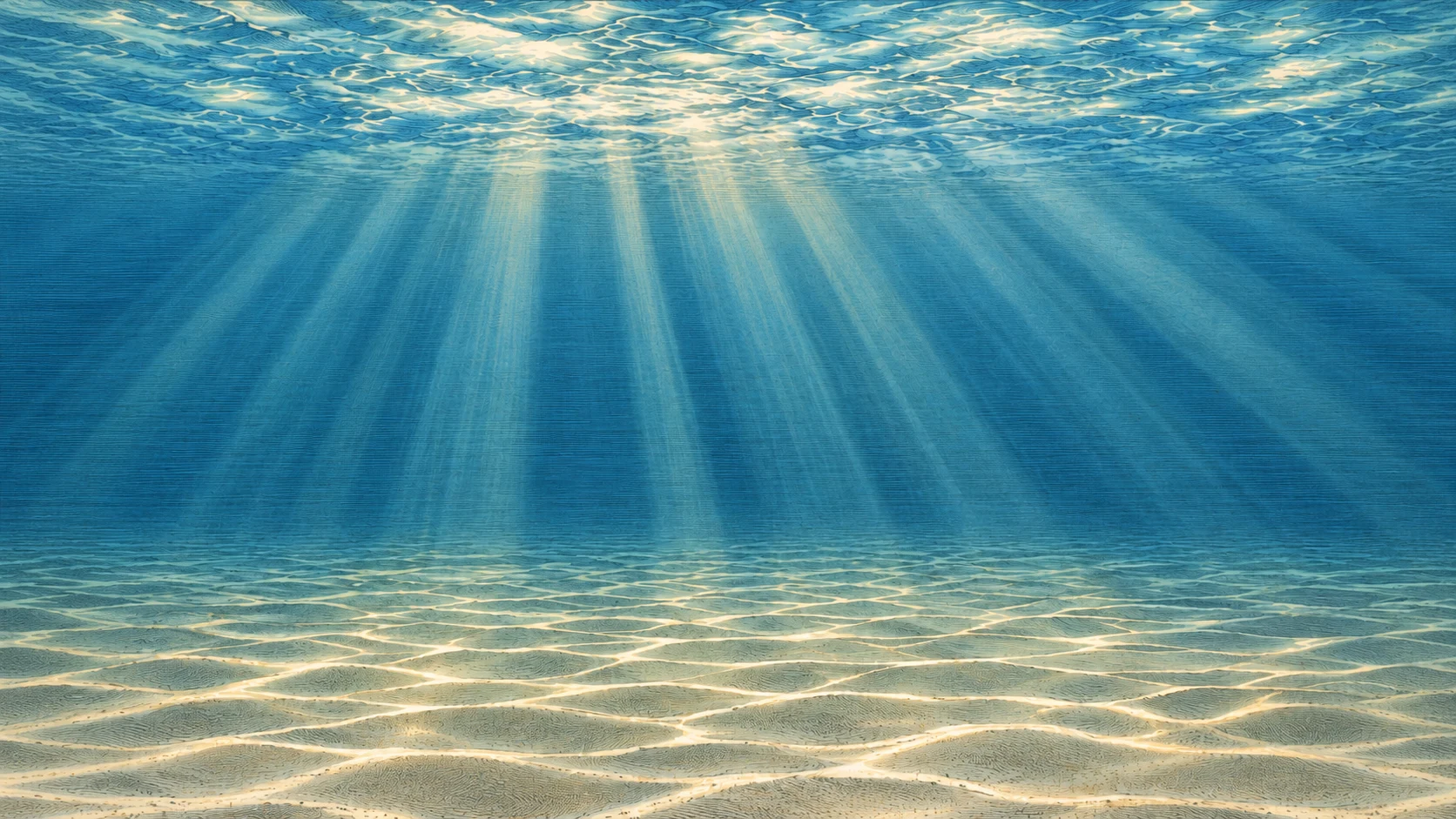
 Sandy Flats
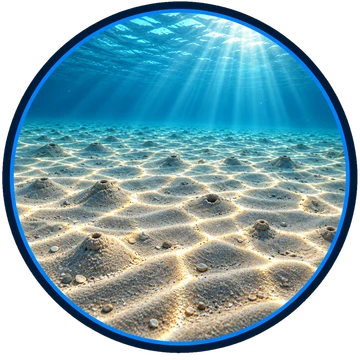 Sandy Flats
Sandy Flats
Open sand bottom past the break: sand slopes, halibut grounds, and sand channels between reefs.
About
The Sandy Flats biome is the open sand bottom that begins past the breaking waves and runs out across the continental shelf, the shallow, gently sloping edge of the continent that lies underwater. It covers the sand slope off a beach, the sand channels between reefs, and the wide plains a diver crosses on the way to rock or kelp. Nothing on it grows tall enough to give shelter, so the bottom often looks empty. Most of its animals live buried in the sand, and many of the fish and rays that hunt there lie half buried too.
A bottom that keeps moving
Sand and mud are soft sediment, loose grains that settle on the seafloor instead of forming solid rock. In the Monterey Bay National Marine Sanctuary, nearly 80 percent of the seafloor between the surf and about 30 meters (100 feet) deep is sand or mud, according to NOAA's sanctuary monitoring network. Waves and currents push that sediment around, building ripples and sand waves and sorting the grains by size.
The biome begins where the Surf Zone biome ends, and the farther from shore the sand lies, the less the waves move it. In Monterey Bay the sand bottom sorts itself along that gradient. The shallower band, with strong water motion, holds small, mobile crustaceans, and few animals there build lasting tubes or burrows. The deeper band has finer, more stable sand mixed with mud. Polychaete worms, segmented marine worms related to earthworms, dominate it and live in tubes and burrows that stay put.
Life buried in the sand
Animals that live inside the sediment are called infauna. The crustaceans of the shallow band are deposit feeders, which eat the organic material that settles onto the sand. In the deeper band, brittle stars, clams, tube anemones, and sea pens are suspension feeders, which catch food particles drifting past in the water. Sea pens are feather-shaped relatives of corals that anchor upright in soft bottom.
Sand dollars are the buried animal a diver is most likely to notice. The Monterey Bay Aquarium reports that as many as 625 can live in a single square yard, from the low intertidal zone, the part of the shore uncovered only at the lowest tides, down to about 40 meters (130 feet). In quiet water a sand dollar stands on its edge, partly buried, and moves food particles along its spines to a mouth on its underside. When the water turns rough, it lies flat or burrows under, and young sand dollars swallow heavy sand grains to weigh themselves down.
Fish and rays on the sand
NOAA's sanctuary network notes that fewer kinds of fish live over sand than on nearby reefs, and most of the fish on its list for Monterey Bay's sand floor are flatfish. The California halibut lives on the bottom, mostly over sand, from the surf zone to about 100 meters (330 feet). It is most common around 30 meters (100 feet), according to California Sea Grant. A halibut lies flat and still, buried or partly buried, and ambushes passing fish such as sardines and anchovies. The Pacific sanddab is a much smaller flatfish of sand bottoms.
Rays and sharks are the other large hunters on the sand. The round stingray lies motionless in sandy and muddy bottoms with only its eyes showing, mostly in water shallower than 15 meters (50 feet), according to the Florida Museum of Natural History. Bat rays feed on buried prey such as clams by flapping their wide fins against the sand to uncover it and digging with their snouts. The Monterey Bay Aquarium reports that the pits they leave can be 4 meters (13 feet) long and 20 centimeters (8 inches) deep. The Pacific angel shark, a flat-bodied shark, buries itself in sand or mud by day and ambushes fish that come within reach, including croakers and halibut.
Where the sand meets the reef
The Sandy Flats biome seldom stands alone. Its inshore edge meets the Surf Zone biome, and its outer and side edges often run up against rocky reef or kelp. Animals cross that border in both directions. Pacific angel sharks usually wait in sandy areas near rocky reefs, according to the ReefQuest Centre for Shark Research, and stay at the same ambush site for several days before moving at night. California sheephead, a reef fish, eat sand dollars.
Market squid come to the sand to breed. NOAA Fisheries reports that they spawn over sandy habitat, where females lay their egg cases on the bottom in large mounds, and that spawning in Southern California runs from October through April or May. California halibut move with the seasons too. Adults come in from deeper water to spawn at 5 to 18 meters (16 to 60 feet), according to California Sea Grant. Spawning runs from February through July and peaks in May. Young halibut spend about their first year in bays and estuaries before moving out to deeper water.
Where the biome occurs
Sand bottom runs the length of the West Coast. Off Washington, NOAA's Olympic Coast sanctuary describes sandy seafloor across the shelf shallower than 30 meters (100 feet), where the sand, mud, and silt shift over time and favor animals that burrow or tolerate the changes. In Southern California, a regional survey has sampled the sediment every 5 years since 1998. It covers the bays and the shelf from 6 to 200 meters (20 to 660 feet) deep. The animals range as widely as the sand. Sand dollars live from Alaska to Baja California, according to the Monterey Bay Aquarium. The Pacific sanddab ranges from the Bering Sea coast of Alaska to Cabo San Lucas, according to FishBase.
Diving over sand
Visibility over sand depends on how hard the water is moving. Turbidity, the measure of how cloudy water is, rises as sediment is mixed into it, and NOAA's National Ocean Service names winds and waves stirring up the bottom as a cause. Over a sand bottom, surge, the back-and-forth push of swell felt near the seafloor, lifts fine grains and clouds the water. Clear water over pale sand looks brighter for the opposite reason. Sand reflects sunlight back up through the water, and NASA cites that reflection as the reason shallow water over white sand looks turquoise.
Because so much of the life is hidden, the signs of it are small: a pair of eyes in the sand, the outline of a flatfish, or a pit left by a feeding bat ray. The round stingray carries a venomous spine on its tail that can cause a painful wound when stepped on, and the Florida Museum advises shuffling the feet when walking in shallow water at the beach.
Threats
NOAA's Monterey Bay sanctuary network lists dredging (digging sediment up off the bottom), the dumping of dredged material, and fishing gear dragged along the bottom as the human pressures on sandy seafloor. It also notes that the long-term effects of many of these activities are not well understood. Pollution is the other pressure. Between the late 1950s and the early 1970s, an estimated 800 to 1,000 tons of the pesticide DDT were discharged into the waters off Palos Verdes, south of Los Angeles, according to the US Environmental Protection Agency. The EPA found elevated DDT and PCBs, industrial chemicals once used in electrical equipment, across 44 square kilometers (17 square miles) of sediment on the Palos Verdes Shelf. White croaker, a fish on NOAA's list for Monterey Bay's sand floor, is 1 of 3 species the EPA warns anglers not to eat when caught between Santa Monica Pier and Seal Beach Pier.
Most of the buried community is healthy. In the Southern California survey's 2018 round, more than 99 percent of the area that could be assessed was in good condition, and none of the open shelf showed moderate or high disturbance. The enclosed bays and harbors were the exception, with nearly 30 percent of their area in moderate or high disturbance.
Marine Life
Listed here are many of the aquatic species that you can find in this biome.
 Spearfishing