


Taxonomy
Rarity
Abundance rates how many are in suitable habitat. Find difficulty rates how hard it is to locate one on a daylight snorkel or freedive through 50 ft. A higher find score means a harder search. The rarity category also reflects the kind of encounter; it is not an average of the 2 scores.
Regulations
CDFW rules verified 2026-09-07
Seasonality
Edibility
Cleaning is quick once learned. Pull the head, strip the quill and skin, then rinse the mantle. No bones and no bloodline.
Location
Market squid are endemic to the California Current, the cold southward flow along this coast, and they range from British Columbia to the tip of the Baja California peninsula, staying within about 200 miles of shore. They have been recorded down to about 1,600 feet.
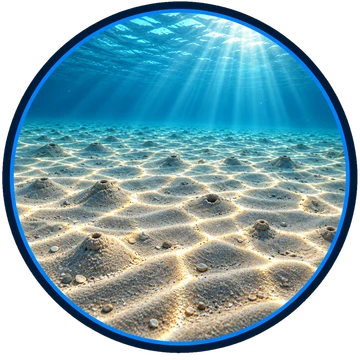
The part that matters to a diver is the spawning ground. Squid gather in dense schools near their spawning grounds over sandy habitat, and the egg beds sit between 66 and 197 feet. In southern California the run happens from October into April or May, and in central California it runs from April through October. Mating and egg-laying both happen in daylight, though the schools pack tighter at night than during the day.
Their color is a live signal rather than a paint job. Market squid carry chromatophores, pigment sacs in the skin holding red, brown, orange and yellow, each under direct muscular control from the brain. Pale coloration means a relaxed animal, and dark high-contrast patterning means an alert one. The blue-green shimmer that gives the species its scientific name comes from a different kind of cell entirely, called an iridophore, which reflects light rather than holding pigment.
Diet changes with size. Young squid eat small crustaceans, and adults eat krill, small crustaceans, small fish and other squid. The list of animals that eat them is far longer, and it reads like a roll call of everything worth catching on this coast: spiny dogfish, white seabass, Pacific bonito, albacore, Pacific mackerel, bigeye tuna, yellowtail, coho and Chinook salmon, lingcod, rockfish, California sea lions, harbor seals, porpoises, pilot whales, sperm whales, seabirds, and scavenging invertebrates on the bottom. Sarcastic fringeheads eat the eggs.
Harvest Brief
Southern and central California nearshore sand during the region’s spawning concentration season.
Taking market squid is not spearfishing and California does not authorize a spear for it. The legal gear is a hand-held dip net, hook and line, or hands, and there is no limit on how many.
Finding them rates a 2, and the whole difficulty is timing rather than searching. Outside a spawning run, market squid are dispersed in open water and effectively unreachable from shore. During a run they are concentrated over a known patch of sand at a known depth and lit up by the commercial boats fishing above them. The task is knowing when the run is on locally, which is October into spring in southern California and spring into autumn in central California. Squid are also drawn to light, which is the entire basis of the commercial method and works on a small scale for a shore diver with a torch.
There is no bag limit, and the reason is the same as the reason the population can support a 127 million pound fishery: these animals die after spawning regardless. The management concept that governs the commercial fleet is egg escapement, which means the fishery is designed so that squid have already spawned before they are caught. The plan behind it was adopted in 2004, published in 2005 and amended in August 2025. It carries weekend closures so that spawning gets uninterrupted stretches, rules on the shields and wattage of the lights used to attract squid, a ban on attracting lights inside the Gulf of the Farallones National Marine Sanctuary, restrictions around the Channel Islands to protect nesting seabirds, and a permit system that limits how many boats can enter.
On the table, market squid is calamari. The mantle is firm and white, the arms are tender, there are no bones and no bloodline, and cleaning takes seconds once learned: pull the head off, strip out the transparent quill and the skin, rinse the tube. The flesh is mild and slightly sweet and it is famously unforgiving about cooking time, which is why the 2 standard approaches are very fast heat or very slow heat and nothing in between.
Deep Dive
A market squid gets less than a year, one spawning, and then it is finished, and everything about the animal is organized around that.
The technical word is semelparous, meaning an animal that reproduces once in its life and then dies. Salmon do it. Most octopuses do it. For market squid the whole span is 6 to 9 months from hatching to death, which means the squid a diver swims through during a winter run were not alive the previous winter. There is no such thing as an old market squid.
The spawning itself is a crowd event with structure in it. Schools gather over sand in daylight. Males guard against rival males, while smaller males take a different approach and spawn alongside them without contesting anything, a strategy fisheries scientists call sneaking. A female then extrudes her eggs into sheaths and cements them into the sand with a sticky substance that holds them against current. Each sheath holds somewhere between 100 and 300 eggs, and NOAA's figure is about 20 cases per female at roughly 200 eggs each.
The sheath is not just a bag. The protein casing is coated with bacteria that help keep fungus off the developing eggs, which is a case of an animal recruiting microbes to defend its young. And the eggs are socially contagious: the presence of eggs already on the bottom stimulates other females to lay in the same place, which is how a patch of sand becomes a field of squid eggs covering large areas of sea floor. Hatching takes 3 to 5 weeks, faster in warm water.
The defenses are worth listing because they are all the classic cephalopod tools in one small animal. Camouflage through the chromatophores. Visual display through the same cells, used to threaten and to confuse. Speed, since squid are extremely fast swimmers. And ink, released to leave a shape in the water where the animal used to be. One recorded detail is oddly specific: prolonged inking happens when a squid jetting backward comes to an abrupt stop.
The name has moved. The genus changed after a review of how squid are related to one another, which is why older California pages and newer ones disagree about what to call this animal. The species half of the name never changed, and it is the right one. It means opalescent, which describes exactly what these squid look like in a torch beam.
Where to Find Them
Researched habitat and range candidates
San Diego · 21 beaches
Orange County · 15 beaches
Catalina Island · 14 beaches
Los Angeles · 17 beaches
Channel Islands · 24 beaches
Ventura · 24 beaches
Santa Barbara · 20 beaches
San Luis Obispo · 29 beaches
Monterey · 18 beaches
Oregon South Coast · 15 beaches
Oregon Central Coast · 8 beaches
Oregon North Coast · 8 beaches
South Sound · 12 beaches
Hood Canal · 12 beaches
Central Sound · 13 beaches
North Sound · 8 beaches
San Juan Islands · 8 beaches
Strait of Juan de Fuca · 5 beaches
Cape Flattery · 4 beaches
These locations have suitable habitat within the species range. An assignment is a possible encounter, not a confirmed sighting at every beach. Season, depth, and local conditions still matter. Historical habitat without present-day evidence is excluded.