


Taxonomy
Rarity
The moon jelly is one of the most common jellies on this coast. The Monterey Bay Aquarium calls it common in Monterey Bay and along the California coast, and Animal Diversity Web, the University of Michigan's animal database, describes it as especially plentiful in bays and harbors. The range runs from San Diego to Prince William Sound in Alaska, which covers every stretch of coast on this site.
The common name hides a complication. The native moon jelly of this coast is a single species, and a second species that looks almost identical has been introduced from the waters between Korea and northern Japan. The Smithsonian's invasive species database records it first in Foster City Lagoon on San Francisco Bay in 1988, and established in Southern California harbors, including Long Beach, Marina del Rey and Newport Bay, by 2000 and 2001. A moon jelly drifting in a Southern California marina may be either one.
No International Union for Conservation of Nature assessment was found. The Monterey Bay Aquarium describes moon jelly populations as still plentiful.
Seasonality
Location
Moon jellies float near the surface in warm water close to shore, and they gather in bays and harbors. They are also found in open water. Animal Diversity Web records the species surviving water temperatures from about 21 to 88 degrees Fahrenheit.
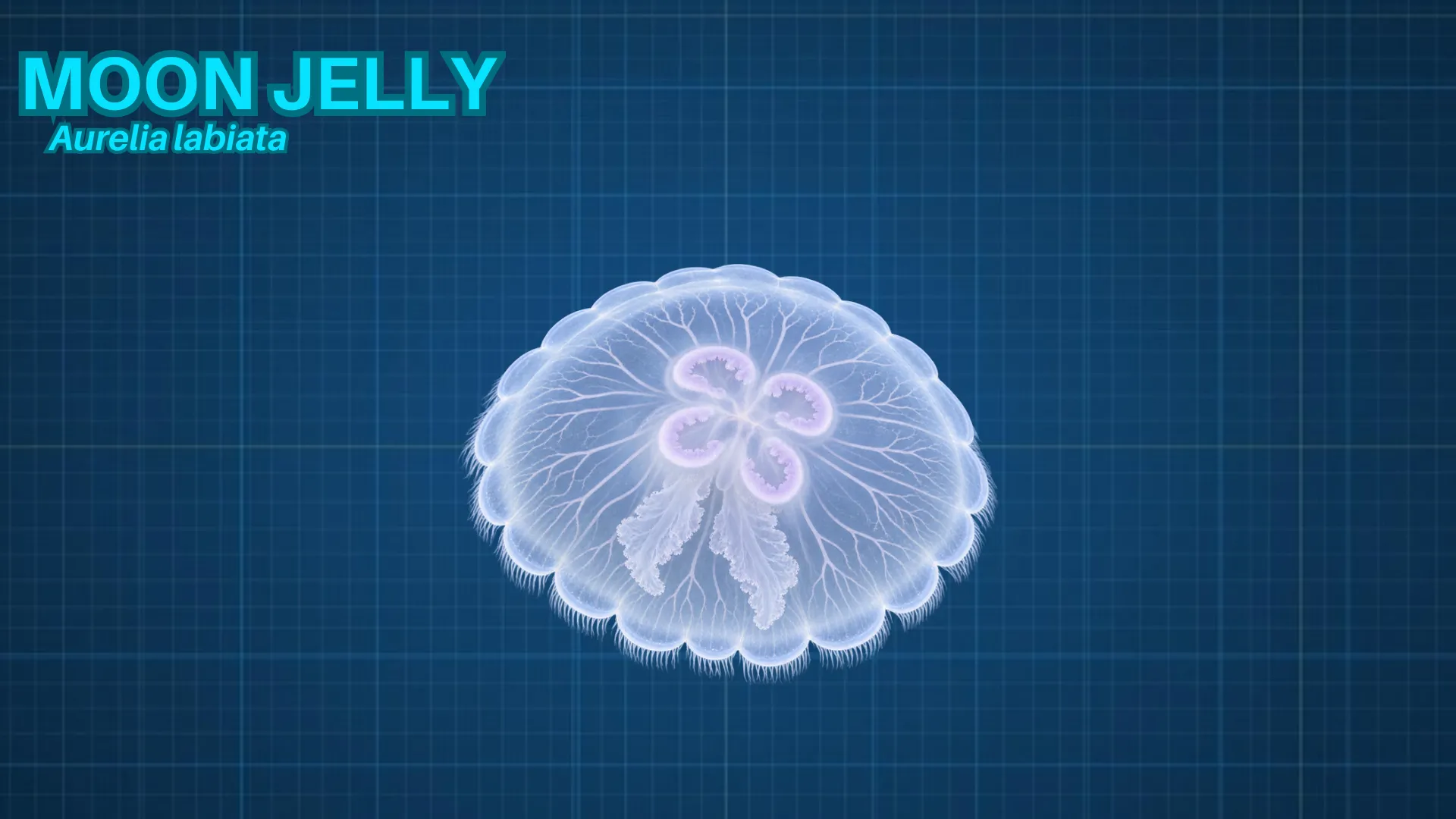
The name comes from the bell, which is clear and round like a full moon. Animal Diversity Web gives a bell diameter of about 4 to 18 inches, and the Monterey Bay Aquarium gives a maximum of 24 inches. Young jellies are see-through. Adults turn milky white and are sometimes tinted pink, purple or peach.
A moon jelly does not have the long trailing tentacles most people picture. Its tentacles are short and form a fine fringe around the edge of the bell. The sting is weak, and Oceana describes it as mild and harmless to people.
The native animal also changes shape along the coast. Animal Diversity Web describes 3 regional forms that differ in the central stalk hanging under the bell, called the manubrium. The southern form, from San Diego to Marina del Rey, has a wide, rounded, frilled stalk. The central form, from Santa Barbara to Newport, Oregon, has a longer, tapering stalk and is abundant in late summer. Monterey jellies of this form are usually purple, while Santa Barbara jellies are often pale pink. The northern form lives from Puget Sound to Alaska.
Deep Dive
A moon jelly feeds on some of the smallest animals in the water. Oceana lists small zooplankton, the drifting animals too small to see well, including tiny mollusks, fish eggs and other small jellies. Stinging cells on the short tentacles catch them. The Monterey Bay Aquarium describes what happens next: the tentacles sweep the food toward a layer of mucus on the edge of the bell. The Aquarium of the Pacific notes that moon jellies swim flat and near the surface, which spreads the tentacles over the widest possible area. At that aquarium they are fed brine shrimp, and after a meal the canals inside the bell turn orange.
The body is about 95 percent water, according to the Aquarium of the Pacific, and the drifting jelly does not live long. That aquarium gives up to 1 year in the drifting stage, and Oceana says less than 1 year.
Reproduction runs in 2 stages. In the first, males release strands of sperm and females take them in. The eggs are fertilized inside the female, who carries the developing larvae on her oral arms, the feeding arms around the mouth. The larvae then leave and settle on or near the sea floor, where each becomes a polyp, a small stalked animal fixed in place. A polyp can bud off new polyps. It can also go through a change called strobilation, in which it produces tens of tiny young jellies that swim off and grow into adults.
That second stage explains how moon jelly numbers can climb so fast. The Aquarium of the Pacific says blooms, meaning large numbers of jellies gathered in one place, have been linked to changing coastlines, overfishing of the animals that eat them and climate change. Blooms can clog the seawater intakes that cool coastal power plants and can interfere with fisheries. The introduced species has caused the same kind of trouble in California. The Smithsonian records dense populations that clogged the pumps used to flush Foster City Lagoon and fouled its beaches.
Telling the native and introduced species apart takes a close look at the animal. The Smithsonian describes the native jelly's central stalk as cone-shaped and about 40 percent as wide as the bell, with oral arms often bent counterclockwise. It also records that the first introduced jellies found in San Francisco Bay did not match jellies from Monterey Bay but did match animals raised in a Tokyo aquarium. The regional differences within the native species make identification in the water harder still.
Moon jellies have also been to space. The Monterey Bay Aquarium records that nearly 2,500 moon jelly polyps and young jellies flew aboard the space shuttle Columbia in May 1991, in a study of how weightlessness affects the way young jellies develop their internal organs.
The same aquarium points to a problem that plastic causes for the animals that eat jellies. A plastic bag floating in the ocean looks like a moon jelly to an animal that feeds on them, and the aquarium says thousands of turtles and birds die each year after swallowing plastic they mistook for jellies.
Where to Find Them
Beaches whose habitats match this species
San Luis Obispo · 16 beaches
Santa Barbara · 2 beaches
Ventura · 2 beaches
Channel Islands · 8 beaches
Los Angeles · 2 beaches
Catalina Island · 3 beaches
Orange County · 1 beach
San Diego · 3 beaches
Matched by habitat: a beach is listed when its biome tags overlap this species' biomes.