

Taxonomy
Rarity
The purple-striped jelly is mainly a California animal. The Monterey Bay Aquarium describes its range as limited to the waters off California, and the Aquarium of the Pacific places it off Monterey and Bodega bays, off Santa Barbara and in the San Pedro Basin. Scripps Institution of Oceanography extends the range north to Washington State. The accounts disagree about the northern edge and agree that California is the center.
It is not a rare animal, but most divers do not meet one on a normal day. Scripps says the species can be seen year-round in the San Diego area and does not usually form large surface blooms there. Off Monterey it shows up near shore in certain seasons, an arrival the Monterey Bay Aquarium calls mysterious. Most of the population lives in open water, and the Aquarium of the Pacific notes that scuba divers see them from time to time near the oil platforms off Huntington Beach.
No International Union for Conservation of Nature assessment was found for the species, and nothing in California's fishing rules is written for it.
Seasonality
Location
The purple-striped jelly lives in the open ocean and in the water over the continental slope, the steep drop where the shallow shelf falls away into deep water. It swims by pulsing its bell, which moves it only short distances. To travel farther it rides the current. The Aquarium of the Pacific records that it slows its pulsing when light increases, and that it can sense both the sea floor and the surface and normally avoids both.
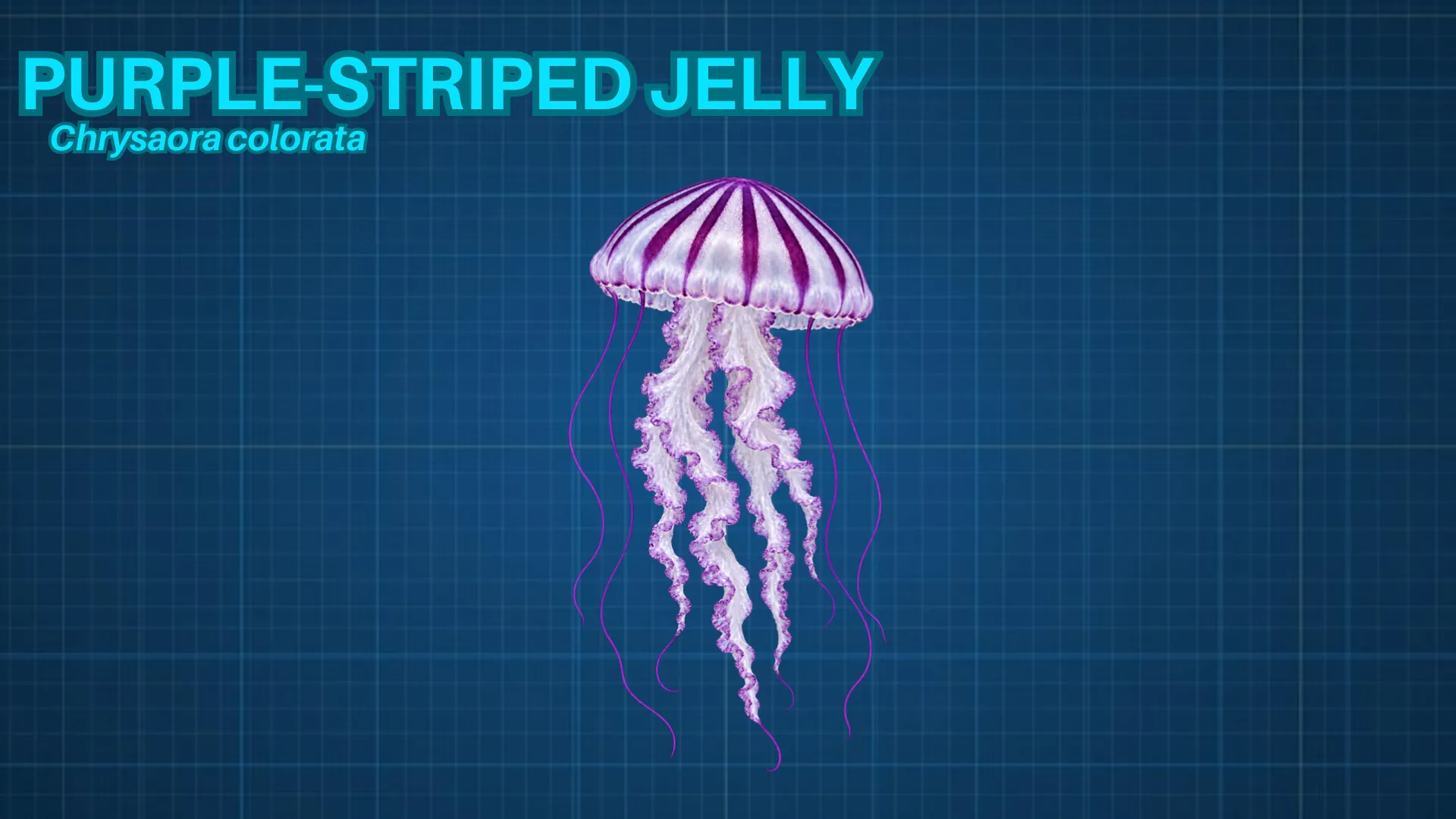
The adult is hard to mistake for anything else. The bell is bowl-shaped and pale silvery white, with a deep purple ring at the top and 16 purple stripes running out to the edge. The Aquarium of the Pacific compares it to a Tiffany lamp shade. Adults reach 28 inches across. Below the bell hang 4 long, frilly, spiraling oral arms, which are the feeding arms around the mouth, and 8 thin tentacles that can stretch to 70 feet.
Young jellies look like a different animal. Scripps describes jellies under about 5 inches as pink with dark red tentacles and no stripes. The purple pattern comes with size.
The sting is painful. The Aquarium of the Pacific calls it very painful but not life threatening, and Scripps describes it as strong.
Deep Dive
The purple-striped jelly catches its food with its tentacles. When a tentacle touches prey, the stinging cells along it fire and the tentacle contracts. It bends toward one of the oral arms, which takes the prey and passes it along a groove to the stomach. The oral arms can also collect food directly. The diet is small open-ocean animals: copepods, which are tiny shrimp-like crustaceans, along with fish eggs, larval fish, comb jellies and other jellies.
A body covered in stinging cells does not protect it from everything. Scripps lists ocean sunfish and sea turtles as predators. The Monterey Bay Aquarium notes that divers have watched ocean sunfish eat these jellies, which shows that at least some fish are unaffected by the sting.
One of the most unusual things about the species is what rides along with it. Young crabs are often found on the jelly, clinging among the tentacles and sometimes inside its stomach. The Aquarium of the Pacific identifies them as young slender crabs that travel with the jelly in open water until they are ready to settle on the bottom. How the crabs avoid being stung is not known, and that aquarium suggests the shell may protect them. The Monterey Bay Aquarium describes a benefit to the jelly as well. The crabs eat amphipods, small shrimp-like crustaceans that feed on the jelly and damage it.
The life cycle took a long time to work out. The Monterey Bay Aquarium says the full cycle was first discovered at the aquarium, and the Aquarium of the Pacific dates the key step to about 2008, when scientists first observed the species' polyp stage. The species has 2 very different stages. In the drifting stage, males release strands of sperm from the tips of their oral arms, and females gather them with their tentacles and oral arms. The eggs are fertilized inside the female and then carried on her oral arms until they develop into swimming larvae.
Those larvae settle and become polyps, small stalked animals fixed to a surface that feed with tentacles of their own. A polyp in poor conditions buds off identical copies of itself, and the Aquarium of the Pacific says this budding can go on for months or even several years. When water temperature, saltiness and food are right, the polyp releases tiny young jellies instead. Over the next 2 to 3 months each one grows lobes, sense organs, tentacles, oral arms and finally the adult bell.
The species was first classified with a different group of jellies. Scientists later moved it into the sea nettle group because its body so closely matches theirs, and it is still sometimes called the purple-striped sea nettle.
Where to Find Them
Beaches whose habitats match this species
San Luis Obispo · 12 beaches
Ventura · 1 beach
Channel Islands · 8 beaches
Los Angeles · 1 beach
Catalina Island · 2 beaches
San Diego · 2 beaches
Matched by habitat: a beach is listed when its biome tags overlap this species' biomes.