

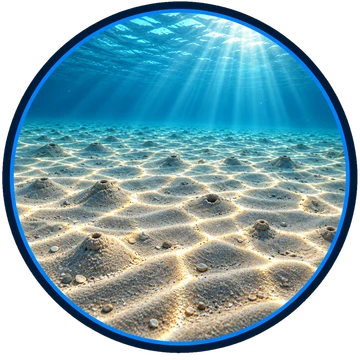


Photo: Casey Cole (@casey_cole), La Jolla Shores
Taxonomy
Rarity
Abundance rates how many are in suitable habitat. Find difficulty rates how hard it is to locate one on a daylight snorkel or freedive through 50 ft. A higher find score means a harder search. The rarity category also reflects the kind of encounter; it is not an average of the 2 scores.
Seasonality
Location
The banded guitarfish ranges from Jalama Beach, Santa Barbara County south to Oaxaca, Mexico, including the Gulf of California. Specimens from south of Mazatlan have to be separated from a close relative, the southern banded guitarfish, and the 2 are confused often enough that biologists say the genus needs a taxonomic revision. Records from Peru are probably misidentifications of that other fish.
Habitat sets this ray apart from the rest of the flat animals on the coast. Most of them are sand specialists. This one is reef-associated, holding in rocky areas mainly shallower than 33 feet, and it has been recorded from tide pools. Sandy bottoms and sandy lagoons are the other half of the picture, but rock comes first. FishBase adds the detail that makes the difference practical: the banded guitarfish seldom buries itself in sand. A diver looking for a thornback ray or a round stingray is looking for a shape under the sediment. A diver looking for this one is looking for a ray sitting in the open on a reef.
The depth changes with the season, and this is the only ray in this Ichthyopedia with a documented seasonal move. Fishery landings show the animals nearshore in spring and summer, then out into deeper water on soft bottoms in fall and winter. Records reach about 656 feet, so the winter fish are well past diving depth. Spring and summer are when the species is in reach from shore.
Identification comes down to the bars. The disc is wedge-shaped and about as wide as it is long, a single row of enlarged thorns runs down the middle of the back, and the whole dorsal surface is covered in small rough star-shaped prickles. On top the fish is sandy brown to dark gray crossed by several prominent black bars, and underneath it is pale with dark spots along the rear edge of the pectoral fins. Those bars are the whole identification. The shovelnose guitarfish, its cousin on the same coast, has a disc longer than it is wide and a plain back, sometimes with dark spots but never with bars. The published field key for California guitarfish separates them on exactly that pair of features.
Females grow larger than males, to about 38 inches against 33.
Deep Dive
The species name means made rough, and it is a literal description. The back of a banded guitarfish is covered in stellate prickles, small star-shaped denticles that give the skin a sandpaper texture, and the name records the first thing anyone handling one notices. The genus name is a comment on the fins: it means intensive fin, given because the vertical fins on this animal are larger than the fins on a skate. Both names describe how the fish felt and looked to the people who first sorted it, which is a fair summary of how 19th-century taxonomy worked.
The mouth is built for shellfish. The teeth are small, blunt and pebble-like, arranged in 60 to 75 rows in each jaw, and the diet is mostly mollusks and crustaceans. That is the same crushing arrangement the bat ray uses, on a smaller animal working rock instead of mud. Nothing about this fish is built for chasing.
Breeding involves a behavior worth picturing. Adult males and adult females form separate schools and congregate in the shallow areas of bays and lagoons during the breeding season. Pups arrive 3 to 4 months after mating, 4 to 11 to a litter, each 6 to 7 inches long at birth, developed inside the mother on yolk and then on nutrient-rich uterine fluid. Maturity comes somewhere between 22 and 30 inches. Those numbers describe an animal that replaces itself slowly, and they are the arithmetic behind the Vulnerable listing. A fish that produces at most 11 young after a 4-month pregnancy cannot absorb sustained net pressure.
Almost everything quantitative known about this species was measured in the Gulf of California rather than in California, which is a gap worth naming. The reproductive biology, the seasonal migration and the fishery decline all come from Mexican work. No California abundance figure or trend was found, and no maximum age has been published anywhere.
There is 1 California record that made a scientific paper, and it says something about where this coast is heading. In October 2020 a survey crew running baited underwater video cameras in Whaler's Cove at Point Lobos, Monterey County, recorded a banded guitarfish in 8 feet of water. That is roughly 160 miles north of Jalama Beach, and it was the first time the species had been documented anywhere near Monterey Bay. The authors placed it in a pattern rather than treating it as a fluke: warming events off Southern California have pushed the northern limits of a long list of fishes upward, and among sharks and rays the same period produced whale sharks, whitenose sharks, smooth hammerheads and giant mantas farther north than before, along with young white sharks now spending seasons in Monterey Bay.
The site treats that record as what it is. A single animal on video 160 miles past the known edge is a range extension worth reporting, not a reason to tell a diver in Monterey to look for banded guitarfish. The practical range is still Jalama Beach south, and the honest reading of the Point Lobos fish is that the edge may be moving rather than that it has moved.
One encouraging note comes from the far south of the range. In the Gulf of California the species has become scarce in fishing catches while remaining commonly encountered by divers inside Cabo Pulmo Marine Park, a protected area where those nets do not operate. That contrast is a community observation rather than a published survey, so it is offered as one, but it is the kind of pattern that protected areas exist to produce.
Where to Find Them
Researched habitat and range candidates
San Diego · 17 beaches
Orange County · 11 beaches
Catalina Island · 2 beaches
Los Angeles · 15 beaches
Channel Islands · 7 beaches
Ventura · 22 beaches
Santa Barbara · 12 beaches
Monterey · 2 beaches
These locations have suitable habitat within the species range. An assignment is a possible encounter, not a confirmed sighting at every beach. Season, depth, and local conditions still matter. Historical habitat without present-day evidence is excluded.