
 Spearfishing

Spearfishing Stats
Puget Sound north to the Bering Sea; not in Oregon or California.
Taxonomy
Rarity
Abundance rates how many are in suitable habitat. Find difficulty rates how hard it is to locate one on a daylight snorkel or freedive through 50 ft. A higher find score means a harder search. The rarity category also reflects the kind of encounter; it is not an average of the 2 scores.
Regulations
CDFW rules verified 2026-10-17
Seasonality
Edibility
Location
The Washington Department of Fish and Wildlife gives the range as St. Lawrence Island in the Bering Sea south to Puget Sound, and FishBase extends it west along the Aleutian Islands to the Kuril Islands. It lives on gravel, sand and mud, mostly on the continental shelf, from the shallows to about 807 feet, and is most abundant from about 66 to 131 feet.
Spearfishing Brief
Washington counts the northern rock sole as a flatfish, and flatfish count toward the state's daily bottomfish limit, which differs by marine area. In Marine Area 10 the limit is 15 bottomfish in total, bottomfish are open all year, and they may not be fished in water deeper than 120 feet. A spearfishing diver must be swimming or floating in the water. The rules reviewed for this page list no size limit for flatfish.
Finding one rates a 3, since it is most abundant in water a scuba diver can reach. Taking one that has been found rates a 2, since it lies still on the bottom. No source reviewed for this page describes its quality as food.
Deep Dive
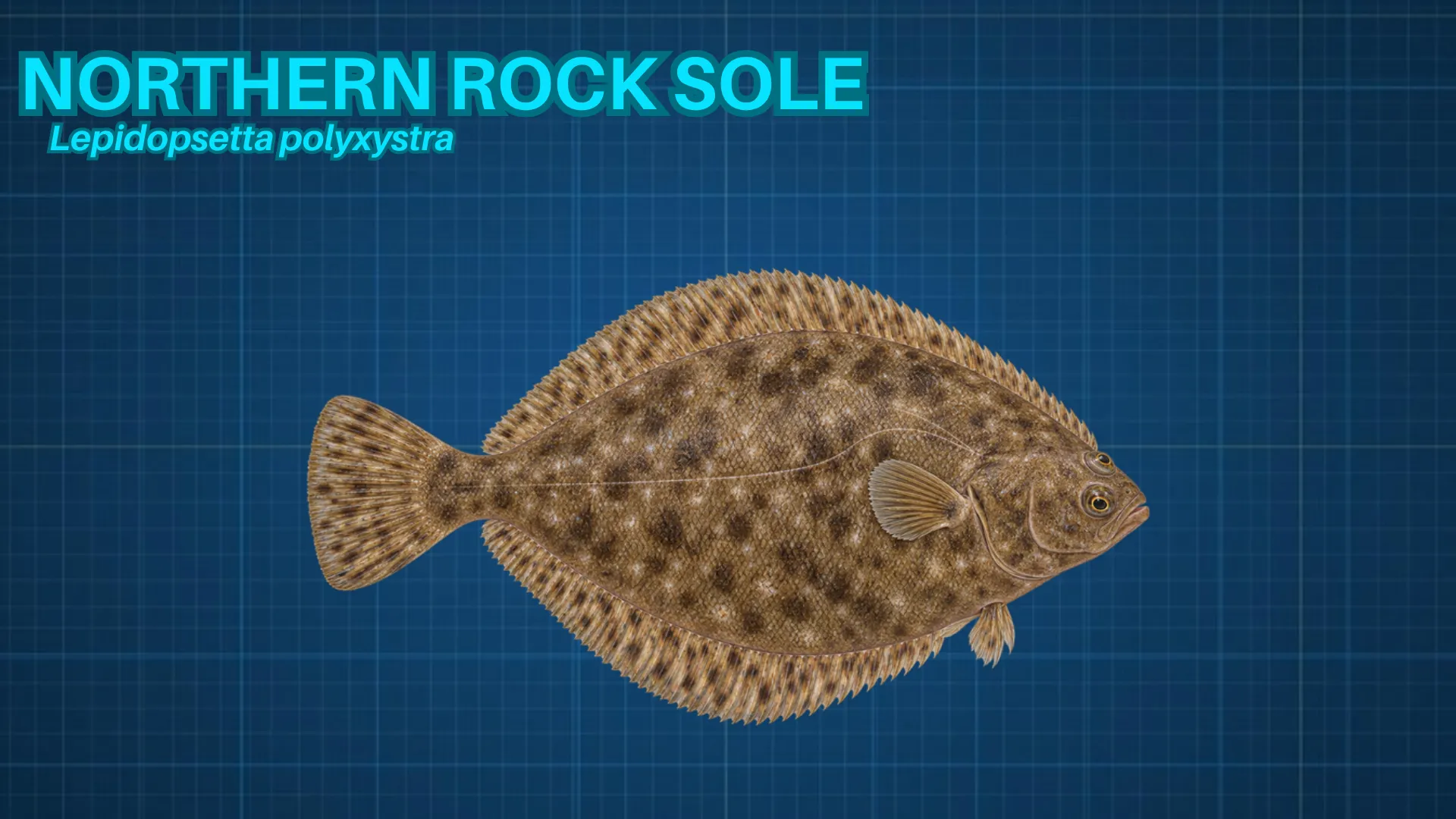
The northern rock sole is a right-eyed flatfish with a thick, oval to round body and rough scales on the eyed side, which is gray, olive, dark brown or black and mottled. It reaches about 27 inches, and FishBase gives a maximum age of 18 years.
It is almost a twin of the southern rock sole. The Washington Department of Fish and Wildlife separates them by the gill rakers, the comb-like bars inside the gills, which are more numerous in the northern fish, and by the blind side, which is plain white in the northern rock sole.
Where to Find Them
Researched habitat and range candidates
Central Sound · 1 beach
These locations have suitable habitat within the species range. An assignment is a possible encounter, not a confirmed sighting at every beach. Season, depth, and local conditions still matter. Historical habitat without present-day evidence is excluded.