
 Spearfishing


Spearfishing Stats
Bering Sea to Baja California; young fish in shallow bays and estuaries for their first year.
Taxonomy
Rarity
Abundance rates how many are in suitable habitat. Find difficulty rates how hard it is to locate one on a daylight snorkel or freedive through 50 ft. A higher find score means a harder search. The rarity category also reflects the kind of encounter; it is not an average of the 2 scores.
Regulations
CDFW rules verified 2026-10-17
Seasonality
Edibility
Location
The Washington Department of Fish and Wildlife gives the range as the Bering Sea and the Aleutian Islands south to San Cristobal Bay in Baja California, from the tideline to about 1,800 feet, over sand. The Oregon Department of Fish and Wildlife notes that the young are intertidal.
The shallow end of that range is the nursery. Pearson and Owen write that after the drifting larvae settle, the young fish spend their first year in shallow bays and estuaries, on sand, mud and eelgrass, and feed all the way up into the intertidal zone. Densities of young fish in estuaries are several times higher than on the open coast. In Southern California the shallow open coast may matter more as a nursery than it does farther north. By the end of the first year, at about 5 inches, most have moved offshore, and adults are seldom found in estuaries. Adults move into shallower water in summer and deeper in winter.
Spearfishing Brief
California counts the English sole as a federal groundfish. It is open all year at all depths, except in the Groundfish Exclusion Areas, and falls under the general limit of 20 finfish, with no more than 10 of any 1 species, and no size limit. The state can change the rules during the year. Take is prohibited in state marine reserves, and north of Ventura County spears may not be used within 100 yards of a stream mouth. Oregon counts it in a limit of 25 flatfish in aggregate and allows spears. Washington counts it among its bottomfish, under limits that differ by marine area.
Finding an adult rates a 4. The fish in diving depth are mostly the small young of the year, while the adults sit deeper. Taking one that has been found rates a 2, since it lies still on the bottom. Pearson and Owen describe it as a desirable fish for the market and restaurant trade, mostly sold as fillets.
Deep Dive
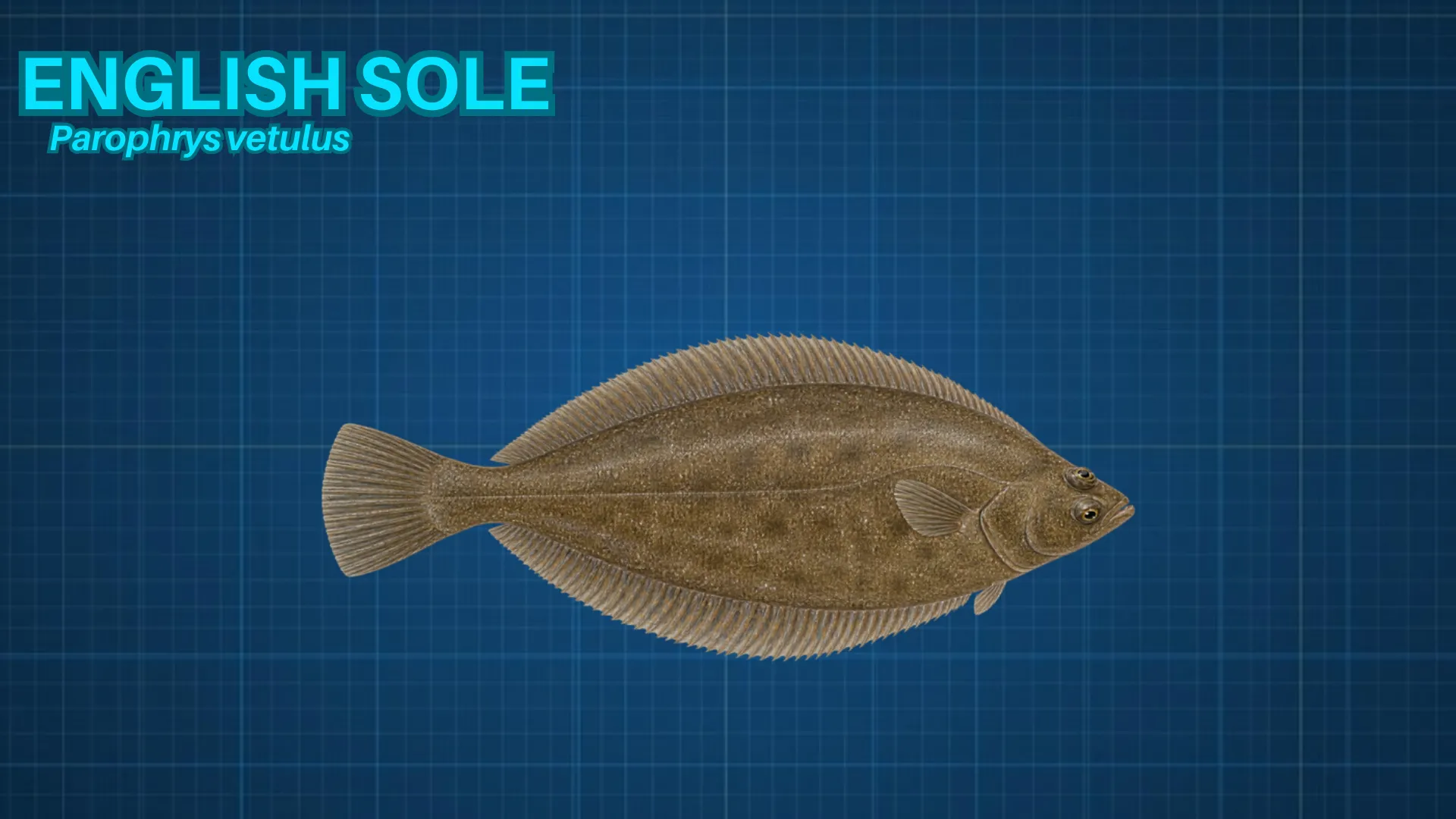
The English sole is a right-eyed flatfish with a long, diamond-shaped body. The Washington Department of Fish and Wildlife describes the eyed side as plain brown to olive brown, sometimes with white speckles, with a high, narrow ridge between the eyes and a nearly square tail with a slight point at its center. FishBase gives a common length of about 13 inches. Pearson and Owen report a 22.5-inch record from British Columbia and 21-inch fish from California, and an age of 22 years, read from rings on a bone of the gill cover.
Spawning happens over sand and mud at about 200 to 360 feet, from September to April, with a California peak from December to February. A 12-inch female releases about 150,000 eggs, and a 17-inch female almost 2 million. The eggs hatch in 4 to 12 days, and the larvae drift for 6 to 10 weeks before settling at about 0.75 inch. The young eat copepods, the tips of worms and the siphons of small clams. Adults take worms, small crustaceans and clams, and they can dig into the sediment to reach deeper prey.
One more oddity comes from the same account. The English sole can interbreed with the starry flounder, and the hybrid has its own name, the hybrid or forkline sole.
Where to Find Them
Researched habitat and range candidates
San Diego · 6 beaches
Orange County · 2 beaches
Los Angeles · 4 beaches
Channel Islands · 5 beaches
Ventura · 4 beaches
Santa Barbara · 3 beaches
San Luis Obispo · 4 beaches
Monterey · 1 beach
Oregon North Coast · 1 beach
Hood Canal · 4 beaches
Central Sound · 7 beaches
North Sound · 4 beaches
San Juan Islands · 1 beach
Strait of Juan de Fuca · 1 beach
Cape Flattery · 1 beach
These locations have suitable habitat within the species range. An assignment is a possible encounter, not a confirmed sighting at every beach. Season, depth, and local conditions still matter. Historical habitat without present-day evidence is excluded.