

Also calledbarndoor skate, Pacific great skate

Taxonomy
Rarity
Abundance rates how many are in suitable habitat. Find difficulty rates how hard it is to locate one on a daylight snorkel or freedive through 50 ft. A higher find score means a harder search. The rarity category also reflects the kind of encounter; it is not an average of the 2 scores.
Seasonality
Location
The big skate ranges across the North Pacific from Glubokaya Bay and the Aleutian Islands south to Cedros Island, Baja California. Depth records run from about 10 feet to roughly 2,625 feet, and most of the population sits between 10 and 360 feet, which is well within trawling depth and partly within diving depth.
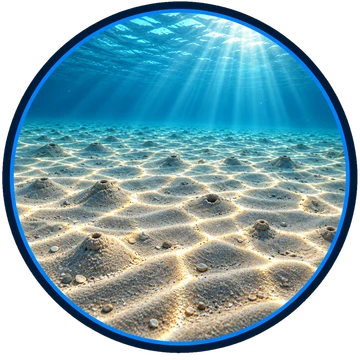
The bottom is soft. Sandy and muddy flats are where the species lives and where the females lay, and anglers also find them over sandy-shore beaches and inside bays. There is no rock in the picture and no kelp.
Identification is a matter of size and 2 spots. On top the skate is gray, brown, reddish brown, olive brown or nearly black, and it carries a prominent eyespot on each pectoral fin near the base, which is what the species name records. Those false eyes are the field mark. The body is the standard skate arrangement: broad pectoral fins fused to the snout and body so the whole animal reads as a single flat sheet, no anal fin, no tail fin, and 2 small dorsal fins set far back along the tail with a low fleshy keel running along each side of it behind them.
There is no sting anywhere on the animal. Skates carry thorns rather than venomous spines, and the big skate is rated harmless.
Deep Dive
The distinction between a skate and a ray is not cosmetic, and this is the first skate in the Ichthyopedia, so it is worth drawing. Rays bear live young. Every ray on this coast, from the round stingray to the bat ray to the electric ray, carries its embryos internally and gives birth to swimming pups. Skates lay eggs. The female deposits a tough leathery capsule with stiff pointed horns at the corners, pushes it into sand or mud, and leaves. Those capsules are what beachcombers call mermaid's purses, and a big skate capsule is genuinely big: 9 to 12 inches long and 4 to 8 inches wide.
Inside the capsule is the fact that makes this species unusual among all skates. Nearly every skate in the world puts 1 embryo in each egg case. The big skate puts up to 7. That single trait changes the arithmetic of the animal's life history, because a skate that packs 7 young into 1 capsule gets more offspring out of each act of laying than the entire rest of its family manages. The young hatch at 7 to 9 inches, already fully formed miniature skates, and there is a behavioral note attached that is difficult to read without anthropomorphizing: hatchlings tend to follow large objects, including their mother. Whether that is recognition or simple following behavior is not established.
Adults feed on crustaceans and fish taken off the bottom, and anglers catch them on squid, clams, ghost shrimp, marine worms and small fish, which describes an animal that is not fussy. Maturity arrives at about 51 inches, which for a fish reaching 8 feet means a long climb to breeding size. No maximum age has been published.
The wings are food and have been for a long time. Skate wings are the pectoral fins, they are marketed fresh and frozen, and they are eaten fried, baked, poached, steamed and pan-fried in butter. In Europe skate is a restaurant fish rather than a novelty. On this coast the big skate is caught commercially and turns up in fish markets, and it also lives in public aquariums, which is a reasonable indication that it handles captivity better than the electric ray does.
Skates occupy an odd position in California's rulebook, and it is worth explaining because it looks like a mistake. The rays on this coast are state-managed finfish and get no special mention. Skates are different: they sit inside the federal groundfish complex, the same management group that holds sablefish, Pacific cod, Dover sole and the thornyheads. California's own regulations name them in that list and state that the recreational fisheries for those species are open year-round at all depths. So a skate is grouped with commercial bottom fish rather than with the rays it looks like, which reflects how it is actually caught. Trawl nets working soft bottom for sole and sablefish bring up skates in the same haul.
The genus name points somewhere unexpected. It honors the Bering Sea, which taxonomists think is where the 2 species in this group originated, and it replaced an older and much more familiar genus name that the state's own fishing booklet still uses. That older name is what most published work about this fish carries. The animal is a North Pacific cold-water species that happens to reach down the coast into Baja California, and the name is a reminder that its center of gravity is the far north rather than California.
Where to Find Them
Researched habitat and range candidates
San Diego · 15 beaches
Orange County · 12 beaches
Catalina Island · 6 beaches
Los Angeles · 12 beaches
Channel Islands · 10 beaches
Ventura · 12 beaches
Santa Barbara · 12 beaches
San Luis Obispo · 10 beaches
Monterey · 10 beaches
Oregon Central Coast · 4 beaches
Oregon North Coast · 1 beach
South Sound · 2 beaches
Hood Canal · 4 beaches
Central Sound · 4 beaches
San Juan Islands · 1 beach
Strait of Juan de Fuca · 1 beach
Cape Flattery · 1 beach
These locations have suitable habitat within the species range. An assignment is a possible encounter, not a confirmed sighting at every beach. Season, depth, and local conditions still matter. Historical habitat without present-day evidence is excluded.