
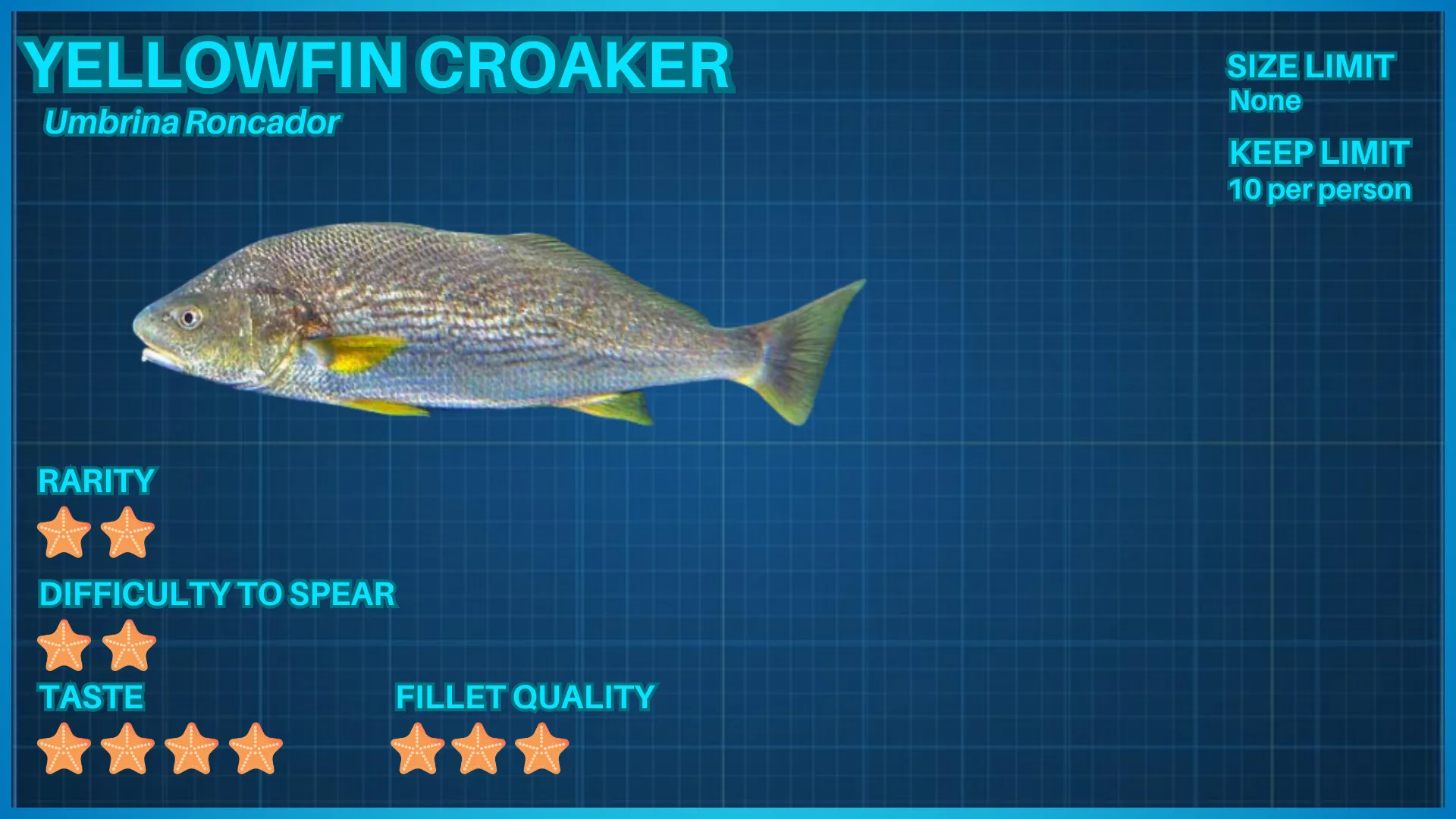
Also calledgolden croaker, Catalina croaker, yellowtailed croaker, yellowfin drum
 Spearfishing
Spearfishing Stats
Southern California sandy surf and bay mouths
Taxonomy
Rarity
Abundance rates how many are in suitable habitat. Find difficulty rates how hard it is to locate one on a daylight snorkel or freedive through 50 ft. A higher find score means a harder search. The rarity category also reflects the kind of encounter; it is not an average of the 2 scores.
Regulations
CDFW rules verified 2026-07-16
Seasonality
Edibility
Clean white meat, though softer than a corbina of the same size.
Location
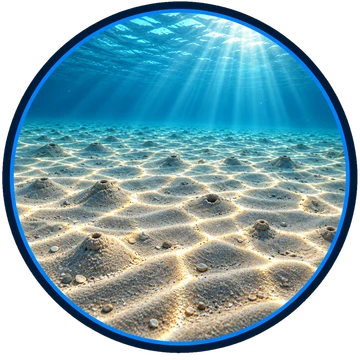
Yellowfin croaker range from Point Conception, Santa Barbara County, California, south to the Gulf of California, Mexico. The center of the population sits south of the Palos Verdes Peninsula in Los Angeles County and runs down through central Baja California. They are a warm-temperate fish, and El Niño events in the 1990s and 2000s pushed warmer water north into Southern California and expanded the summer range. The habitat is sandy bottom. The fish hold in the surf zone, on open beaches, and in bays, harbors, and channels, along with the sand around piers and jetties. Depth is almost always inside 30 feet during a summer day, with records to about 150 feet in winter. Loose schools cruise the sand, root along the bottom for buried prey, and hold behind the first sandbar rather than in the whitewater on the beach itself. They also gather in the depressions surf anglers call croaker holes, scooped into the sand at the outer edge of the sand shelf where the bottom starts to slope down. Groups settle into those holes rather than cruising through, and California corbina cluster in the same ones. Winter drives the population out to deeper water, and the shallows empty. Summer brings them back for the spawn, which runs from June through September and peaks in July.
Spearfishing Brief
Finding yellowfin croaker takes reading the surf, and that is where the time in the water goes. The find rates a 2, the same as the shot. The fish sit just behind the surf zone in the first pocket of deeper water. A diver looks for the darker water on the far side of the first sandbar, a strip of deeper water between 2 sandbars, or a croaker hole, one of the depressions cut into the sand where the shelf ends and the bottom starts to slope down. Yellowfin cluster in those holes, so a diver who finds one is better served working it than swimming a long stretch of flat sand. Sand crab beds are the anchor. The croakers root the bottom for sand crabs, small shrimp-like crustaceans called amphipods, marine worms, and shellfish. Where the sand crabs pile in during warm calm weather, the schools follow. Cast and Spear's surf-fishing guide rates an incoming tide the best window, the last few hours before high tide and the first hour after. A bigger surf turns the water into a sand cloud that no diver can shoot through. Even in good conditions, the visibility inside the surf zone is measured in single digits of feet.
The shot, once a diver is on a school, is not the hard part. Yellowfin croaker are loose schoolers rather than tight-formation fish, and Southern California angling sources treat them as bold, aggressive feeders that will strike a bait or investigate a disturbance rather than flush at the sight of a diver. No spearfishing source describes how yellowfin croaker read a diver in the water, so the underwater approach is uncertain. The general surf-zone freediving technique is a low, slow drop to the bottom and a wait, tucked flat against a piece of structure so the outline of the diver breaks up against the sand. Scratching a hand or a knife tip in the sand imitates the disturbance of exposed prey and can draw bottom feeders in for a closer look. The row of sensory pores along a fish's side that senses water movement, called the lateral line, still picks up the diver. That is why the diver stays still and keeps the gun clear of the bottom to avoid a warning vibration.
The weapon of choice is a short shore-diving speargun in the 60 to 90 centimeter range, or a quality pole spear. Cast and Spear's California guide recommends the same setup for beginners targeting fish under 15 pounds broadly, and yellowfin croaker fits well inside that class. The extra range of a longer gun is no help in water this shallow, and the sand cloud of a working surf zone rarely opens up far enough to use it. A shorter weapon also turns and reloads faster in the tight quarters of a surf-zone dive. A diver working from a low, hidden position takes the fish through the head or the spine just behind the gill plate, and on open sand there is no reef for a hit fish to bury itself in.
Yellowfin croaker is also one of the most popular rod-and-reel targets in the Southern California surf, and the sand a diver hunts is the same sand a surf angler works with a soft-shelled sand crab. Peak angling months are the same July through September window when the spawning aggregation packs the shallows. A diver hunting a Southern California beach in summer is hunting the same fish those anglers are trying to catch from above.
Deep Dive
Yellowfin croaker belong to the drum and croaker family, a group of mostly coastal fish that grunt, drum, and croak by vibrating a specialized muscle against the swim bladder, the gas-filled organ a fish uses to control its depth. That organ acts as a resonator and amplifies the sound. The fish's scientific name means snorer in Spanish, a reference to the drumming noise. The sound was formally documented in this species as early as 1948, and again on the 1952 Folkways record Sounds of the Sea. In the family generally, males have the more developed sonic muscles, and calling activity picks up during summer spawning nights, so the drumming almost certainly plays a role in gathering the summer aggregation. The specific acoustic profile of the yellowfin croaker's call has not been closely studied, and the family-level pattern is what the science supports for now.
The fish is easy to identify by 3 features. A single fleshy barbel hangs from the tip of the lower jaw, a bottom-feeder's sensor for finding prey by touch. The front of the anal fin carries 2 heavy spines. The sides and back carry many diagonal dark wavy lines over an iridescent blue-gray body with brassy reflections on top, silver below, and yellow fins. Adults reach about 22 inches and 4 pounds. The California state record fish, taken from Santa Monica Beach in Los Angeles County in 2000, weighed 3 pounds 14 ounces. The all-tackle world record, taken at East Cape in southern Baja California in 2001, weighed 5 pounds 8 ounces. Most fish caught from a pier run 10 to 14 inches. A 2008 study out of the Southern California Bight aged 1,209 individuals from their otoliths, the ear bones a fish grows in yearly layers like tree rings. The oldest fish was 15 years old. Females grew significantly faster and reached larger sizes than males, and males and females held an even sex ratio across the population. Fish mature at about 1 to 2 years and 6 to 9 inches. Sexes are separate for life. Unlike the California sheephead, a yellowfin croaker does not change sex. The sex it hatches with is the sex it dies with.
Yellowfin croaker feed off the bottom on sand crabs, small shrimp-like crustaceans called amphipods, marine worms, mollusks such as clams and mussels, and small fish and fish fry. They sit in the middle of the food web, with a trophic level of about 3.5 in ecological terms. Documented predators include larger predatory fish and marine mammals, with juveniles taken by a wider range of coastal fish predators in the surf zone and bays where they grow up. The species tolerates a broad temperature range and is centered on the warm-temperate waters of the outer Baja peninsula. When warm water pulses north into California during an El Niño event, the population follows. Winter cold pushes the fish back down and offshore into deeper water.
The most unusual chapter in the fish's history sits inside California law. The state stopped commercial netting of yellowfin croaker in 1909. It banned the commercial sale of the fish outright in 1915. That prohibition is still on the books today as Fish and Game Code section 8373, which forbids the sale, purchase, or commercial possession of yellowfin croaker, spotfin croaker, or California corbina anywhere fish are sold or food is offered for sale. Commercial fishing vessels cannot even carry them on a commercial trip. The result is that the state of California has reserved this fish for its recreational anglers and divers for more than a century, and yellowfin croaker has never appeared on a menu in the state during any living angler's lifetime. Only 2 other fish share that section: spotfin croaker and California corbina. A fourth croaker, the black croaker, came off the market separately in 1933.
On the plate, yellowfin croaker is a mild, respectable panfish. The meat is white, firm, and flaky, in small flakes, with a soft, tender texture, thin skin, and low fat. The scales come off easily and the fillets are clean and free of the heavier bones a bass carries. The soft flesh is delicate to handle in the pan, which is why the standard preparations are baked, broiled, pan-fried, grilled, or worked into ceviche or fish tacos. Baking or broiling is often recommended because the fat drips away from the meat. Anglers rate it good table fare, and some prefer the fillets to white seabass, though a minority of divers place it only a step above spotfin croaker. One warning applies. Yellowfin croaker is a bottom feeder, and fish taken from bays and harbors accumulate polychlorinated biphenyls, mercury, and other contaminants at higher levels than fish taken from the open coast. The California Office of Environmental Health Hazard Assessment publishes site-specific advisories covering yellowfin croaker at Mission Bay, San Diego Bay, Ventura Harbor to Santa Monica Pier, and Santa Monica Beach south to San Mateo Point, along with a statewide advisory for coastal waters without site-specific advice, and anyone eating fish from those waters should check the advisory first. From the open surf, a yellowfin croaker is honest table fare that comes from a fish the state has protected for the shore diver and the pier angler and nobody else.
Where to Find Them
Researched habitat and range candidates
San Diego · 17 beaches
Orange County · 13 beaches
Catalina Island · 7 beaches
Los Angeles · 16 beaches
Channel Islands · 12 beaches
Ventura · 23 beaches
Santa Barbara · 16 beaches
These locations have suitable habitat within the species range. An assignment is a possible encounter, not a confirmed sighting at every beach. Season, depth, and local conditions still matter. Historical habitat without present-day evidence is excluded.