
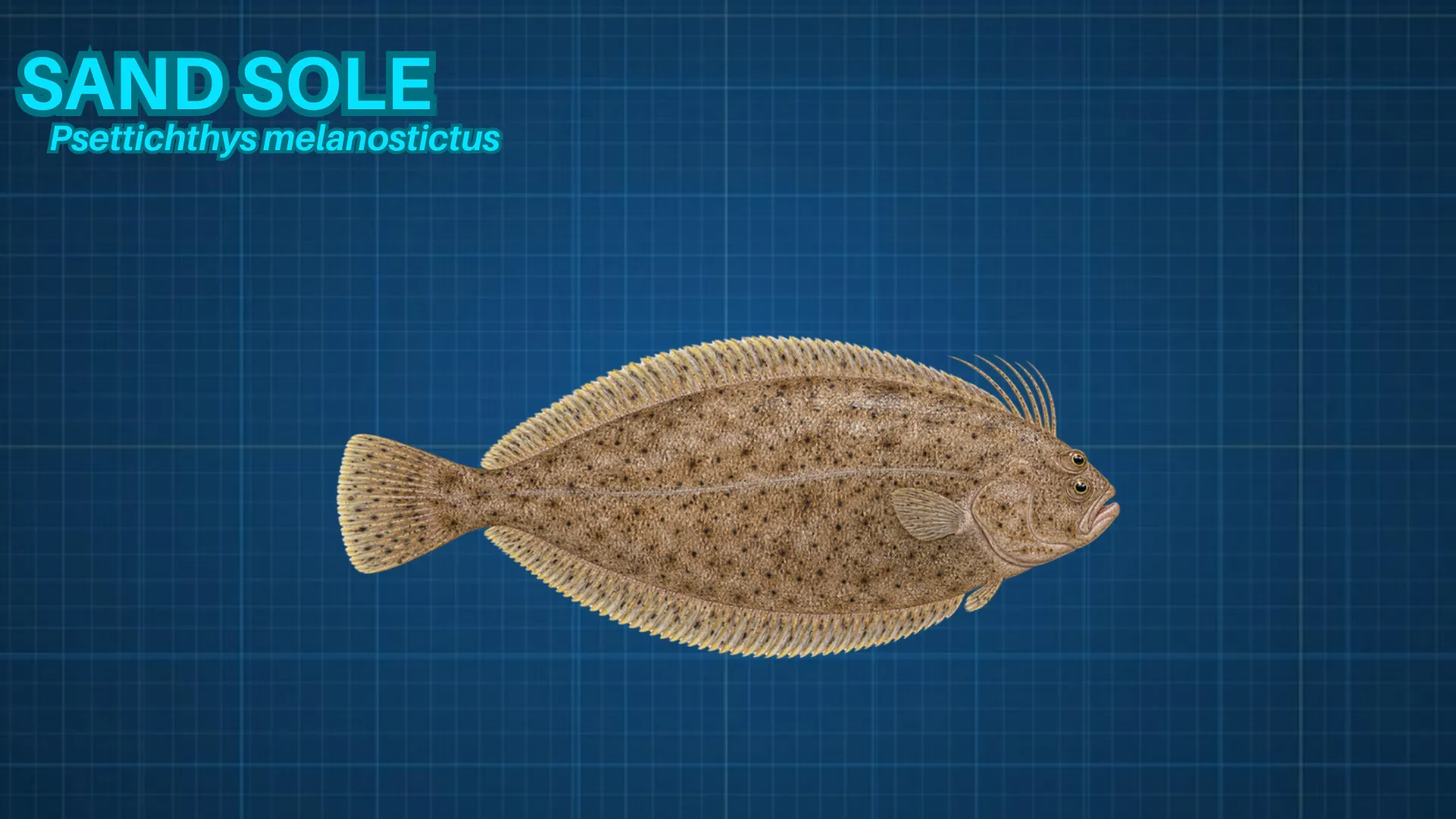
Also calledPacific sand sole, sand flounder, fringe sole
 Spearfishing

Spearfishing Stats
Bering Sea to Redondo Beach; common from Morro Bay north (Ken Jones).
Taxonomy
Rarity
Abundance rates how many are in suitable habitat. Find difficulty rates how hard it is to locate one on a daylight snorkel or freedive through 50 ft. A higher find score means a harder search. The rarity category also reflects the kind of encounter; it is not an average of the 2 scores.
Regulations
CDFW rules verified 2026-10-17
Seasonality
Edibility
A mid-sized flatfish, most under 16 inches, with a fillet on each side.
Location
The Washington Department of Fish and Wildlife gives the range as the Bering Sea and the Aleutian Islands south to Redondo Beach in Southern California, and calls the sand sole a shallow-water species of sandy bottom, mostly shallower than about 230 feet. The Oregon Department of Fish and Wildlife agrees that it usually stays shallower than about 240 feet. Jones notes that it has been recorded to 1,066 feet and that its southern limit is debated, with his own page giving La Jolla.
Jones names Seacliff State Beach Pier, Capitola Wharf, Santa Cruz Wharf and Pacifica Pier among the best places to catch one, along with piers around San Francisco Bay, Eureka and Crescent City. It is an occasional catch from sandy beaches in central California and only occasionally taken from boats.
Spearfishing Brief
California counts the sand sole as a federal groundfish in its "other flatfish" group. It is open all year at all depths, except in the Groundfish Exclusion Areas, and falls under the general limit of 20 finfish, with no more than 10 of any 1 species, and no size limit. The state can change the rules during the year. Take is prohibited in state marine reserves, and north of Ventura County spears may not be used within 100 yards of a stream mouth. Oregon counts it in a limit of 25 flatfish in aggregate and allows spears. Washington counts it among its bottomfish, under limits that differ by marine area.
Finding one rates a 3. It lives on open sand in the same shallow water divers use, from central California north. Taking one that has been found rates a 2, since it lies still on the bottom. Jones rates it excellent on the table, with white, mild, soft meat that is low in fat, best simply pan-fried.
Deep Dive
The sand sole is a right-eyed flatfish with a long oval body. The Washington Department of Fish and Wildlife describes the eyed side as light green or gray to brown, covered in fine dark speckles, and the long fins along the top and bottom often have dull yellow edges. The clearest mark is at the front of the top fin, where the first few rays are long and mostly free of the membrane.
It has a large mouth with large teeth, and FishBase lists fish, worms, crustaceans and mollusks in its diet. Jones notes that many sand sole are mistaken for California halibut.
Most pier fish are under 16 inches. Jones reports that 20 to 21 inches was long thought to be the maximum, but fish of 25 inches are now known, and FishBase gives about 25 inches as well. The International Game Fish Association record, listed by Jones, is 1 pound 8 ounces from Santa Cruz in 2013, and the Washington state record is 2.59 pounds from the San Juan Islands in 2019.
Where to Find Them
Researched habitat and range candidates
Los Angeles · 9 beaches
Channel Islands · 6 beaches
Ventura · 23 beaches
Santa Barbara · 19 beaches
San Luis Obispo · 16 beaches
Monterey · 7 beaches
Oregon South Coast · 10 beaches
Oregon Central Coast · 7 beaches
Oregon North Coast · 4 beaches
South Sound · 2 beaches
Central Sound · 1 beach
These locations have suitable habitat within the species range. An assignment is a possible encounter, not a confirmed sighting at every beach. Season, depth, and local conditions still matter. Historical habitat without present-day evidence is excluded.