

Taxonomy
Rarity
Abundance rates how many are in suitable habitat. Find difficulty rates how hard it is to locate one on a daylight snorkel or freedive through 50 ft. A higher find score means a harder search. The rarity category also reflects the kind of encounter; it is not an average of the 2 scores.
Depth and encounter availability
Adults and settled juveniles typically well below 100 ft; pelagic young are possible but no routine 50 ft encounter rate is established. This Rare rating reflects limited availability within snorkeling and freediving depths through 50 ft. It is not a claim that the species is equally scarce in its normal deeper habitat. Routine shallow occurrence is unverified; habitat suitability alone does not promise a sighting.
Seasonality
Location
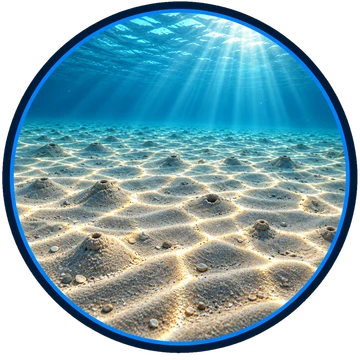
Halfbanded rockfish are common on flat offshore bottom, which is worth pausing on because the genus is otherwise defined by rock. Rockfish are built for hard structure: heavy head spines, deep compressed bodies, big pectoral fins for holding position in surge. This species and the calico rockfish are the 2 on the chart that took that body onto soft sediment, and they did it independently and in different ways, the calico on the mixed ground where rock breaks down and this one out on open flat bottom.
The build fits the life. The body is slender, between a quarter and a third as deep as it is long, with a long head, a short snout, a small terminal mouth, and eyes that are strikingly large for the size of the fish. The color is dusky pink across the back and paler silvery pink on the flanks, with 2 obvious dark red saddle blotches on the rear half of the body that darken to brown over the back. Those 2 partial saddles are the common name and the field mark. As with every rockfish, the fin spines are sharp and carry mild venom.
Large eyes and a small mouth on a fish in dim deep water point toward one way of feeding, and that is what the record says: adults eat krill and other zooplankton. This is a fish that picks small drifting animals out of the water above flat bottom, not one that ambushes prey off rock.
Deep Dive
Charles Gilbert described the halfbanded rockfish in 1897, and in the 129 years since, the published record has stayed close to where he left it. What is established: maximum length of 9.8 inches, maximum age of 15 years, the depth band, the range, the flat-bottom habitat, the appearance, that adults eat krill and zooplankton, and that it bears live young as every rockfish does. What is not: when it gives birth, how many young a female carries, at what size or age it matures, whether it schools, whether it holds any patch of bottom, what eats it, or how many there are.
The fish still earns its place on the chart, and the reason is worth stating. There are 2 reasons this species is a useful counterexample to what people assume about rockfish. The first is the habitat. A family whose name is literally about rock has members that live on open sediment, and this is one of them. The second is the size. The genus contains a 3-foot bocaccio and a 39-inch cowcod and this 9.8-inch fish, and the small ones are not juveniles of something bigger. They are complete adults that took the same body plan in the other direction.
The maximum age of 15 years is the shortest of any species researched for this batch, against 106 for the redbanded rockfish, 84 for the canary, 55 for the cowcod and 50 for the greenblotched. That is a genuinely different way of being a rockfish. The long-lived species accumulate decades of adults and rebuild over 20 or 30 years, which is why their fisheries need rebuilding plans measured in generations. A 15-year fish that matures early replaces itself far faster, and it is why FishBase rates this species low resilience rather than the very low ratings it assigns the greenblotched, the widow and the cowcod.
None of that has ever been tested on this fish, because no fishery has pressed on it. It comes up as incidental catch from flat bottom at 200 to 1,300 feet, and it goes back over the side or into the aggregate. For most of the bottom half of the CDFW identification chart, that is the whole story, and it is more honest to say so than to fill the page.
Where to Find Them
Researched habitat and range candidates
San Diego · 15 beaches
Orange County · 11 beaches
Catalina Island · 7 beaches
Los Angeles · 12 beaches
Channel Islands · 15 beaches
Ventura · 12 beaches
Santa Barbara · 10 beaches
San Luis Obispo · 6 beaches
Monterey · 12 beaches
These locations have suitable habitat within the species range. An assignment is a possible encounter, not a confirmed sighting at every beach. Season, depth, and local conditions still matter. Historical habitat without present-day evidence is excluded.