

Also calledhumpback perch, porgie
 Spearfishing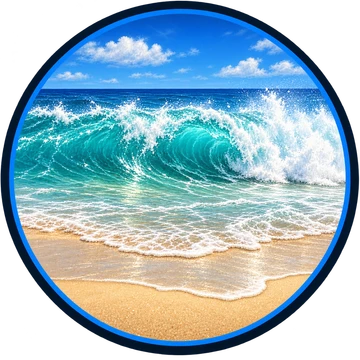
Spearfishing Stats
Central California sandy surf beaches.
Taxonomy
Rarity
Abundance rates how many are in suitable habitat. Find difficulty rates how hard it is to locate one on a daylight snorkel or freedive through 50 ft. A higher find score means a harder search. The rarity category also reflects the kind of encounter; it is not an average of the 2 scores.
Regulations
CDFW rules verified 2026-09-08
Seasonality
Edibility
Small, soft fillets on a fish that rarely passes 11 inches, though calico run slightly larger than the barred surfperch alongside them.
Location
Calico surfperch range from Cape Flattery in northern Washington down to northern Baja California, with records taken 32 kilometers from the Canadian border at the top end. The species backlog for this Ichthyopedia flagged the southern limit as unverified, and it is now settled from 3 independent sources: the range covers southern California and continues into Baja. The fish is here. It is simply not the most numerous thing on the beach.
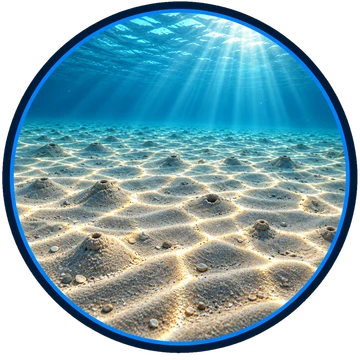
This is a surf-zone animal and nothing else. Every source that describes its habitat names sandy beaches and stops there, the state's ocean-versus-bay split is 96 percent to 4, and the recorded depth range runs only to about 30 feet, the shallowest of any California surfperch. A diver looking for calico surfperch is looking in the wash, the trough and the sand directly outside the first break, which is exactly the water that produces the worst visibility on the coast.
There is one reliable concentrator. Calico surfperch school tightly around the inshore pilings where a pier crosses the surf line, and California pier anglers report that fishing as close to those pilings as possible produces the largest fish. For a diver, that translates into working the sand right at the base of pier structure rather than searching open beach.
Identification takes a moment and is worth the moment, because on a southern California beach a calico will be mixed with barred surfperch. The calico is silvery with a brassy overlay, the back bluish or olive, the lower head and the front of the belly tinged with red, and the fins reddish. Along the sides run rough narrow vertical bars made of brown speckling rather than solid lines. A barred surfperch carries the clean vertical bars its name describes and lacks the reddish fins and red-tinged head.
Further north the confusion shifts to the redtail surfperch, and the classic separators are shape and dorsal fin. Calico is the more disc-like, rounder fish; the redtail is more elongate. On a calico the longest dorsal spines are about the same length as the longest soft rays, while a redtail's spines are clearly longer. The most reliable single check is the eye: on a calico, the lower edge of the eye sits below the level of the upper lip. That comparison matters little in southern California, because the redtail does not occur south of Point Arguello.
Spearfishing Brief
No dedicated account of spearing calico surfperch exists in print. The ratings below come from the documented habits of the fish and from where the barred surfperch, its closest relative and constant companion, already sits in this Ichthyopedia.
Finding one rates a 3, which is 1 step harder than the barred surfperch at 2.5. That is not a comment on visibility. The 2 fish share the same beaches, the same water and the same depth, and the difference is entirely which one is in front of the diver. On southern California sand the barred surfperch is the dominant animal, so the work is picking the less numerous fish out of a school and then confirming it is the right one, which on a moving target in turbid water is genuinely harder than finding a fish.
The shot rates a 2.5, matching the barred surfperch exactly, because the problem is identical. This is an open-water fish over open sand in moving water. There is no rock to work toward, no structure to pin it against, and no cover for a diver making an approach. Surf-zone visibility rarely helps. Overall difficulty is 3.
A long pole spear is the tool, for the same reason it is the tool for barred surfperch. The reach is the point. This is a fish that will not let a diver close the distance, so the spear has to make up the gap that the approach cannot.
The table is honest and modest, and it is the same table the whole surf-zone trio shares. The flesh is white, mild, low in fat, finely flaked and soft, and California anglers who fish barred, calico and redtail surfperch treat all 3 as fine eating. Frying dominates, and the fish grills and bakes without complaint. Yield is the limit, as it is across the family: an 11-inch fish gives small, soft fillets. Calico run slightly larger than the barred surfperch they share the beach with, which is a small point in their favor rather than a transformation.
Deep Dive
Californians have been arguing about this family's future for more than a century, and the calico surfperch sits close to the center of the argument.
The commercial closure came first, in 1913, when the state shut the commercial surfperch season from May 1 through July 15 to protect the birthing period. That closure still stands and still exempts the shiner perch. Then in 1953 the state went further and banned commercial take of surfperch entirely south of Point Arguello. Six years later it softened that, replacing the blanket ban with a species-specific one covering just 3 fish: barred surfperch, calico surfperch and redtail surfperch. Those 3 are the large sand-beach species, the ones a commercial beach seine could take in quantity, and they are still the 3 named in the rule today. A recreational angler or a diver is unaffected. What the rule records is which fish the state judged worth protecting from a commercial fishery 67 years ago, and calico surfperch made that short list.
Then came 2002, and this time the recreational side was the target. Until that year the daily limit for surfperch was 20 fish with no more than 10 of any 1 species, and there was no limit at all on shiner perch. The state cut the San Francisco Bay aggregate to 5, established a minimum size on the redtail, closed San Francisco Bay to surfperch from April 1 to July 31, and gave the shiner perch its own limit of 20. The stated purpose was to reduce recreational harvest and stabilize population levels. The 20-fish aggregate a southern California diver counts against today is what survived from before those changes.
The reason all of that caution exists comes down to how these fish reproduce, and here the calico surfperch is a frustrating example, because almost nothing about its reproduction is known. Surfperch do not lay eggs. Fertilization is internal, the female carries the young to full development, and what is born is a small complete fish that swims immediately. Brood sizes across the family run from a handful to a little over 100, and every California species in the state's summary table has at least a partial figure. Every species except this one. For calico surfperch the brood size column reads not available, the mating season column reads not available, and the birth season column reads not available. It is the only member of the family with all 3 blank.
That absence deserves to be stated rather than papered over. It would be easy to assume calico works like the barred surfperch, since the 2 are closely related, share a genus, share a beach and share a diet of sand crabs. The assumption is probably right. It has also never been checked, and a fishery that has lost half its catch rate in 2 decades is a poor place to start guessing. What the state does know is where the fish lives, how many are caught, and that the number is going down. The rest of the life history of one of California's principal surf fish is still open.
Where to Find Them
Researched habitat and range candidates
San Diego · 17 beaches
Orange County · 12 beaches
Catalina Island · 6 beaches
Los Angeles · 16 beaches
Channel Islands · 12 beaches
Ventura · 23 beaches
Santa Barbara · 20 beaches
San Luis Obispo · 13 beaches
Monterey · 12 beaches
Oregon South Coast · 10 beaches
Oregon Central Coast · 8 beaches
Oregon North Coast · 5 beaches
South Sound · 3 beaches
Hood Canal · 4 beaches
Central Sound · 4 beaches
Strait of Juan de Fuca · 1 beach
Cape Flattery · 1 beach
These locations have suitable habitat within the species range. An assignment is a possible encounter, not a confirmed sighting at every beach. Season, depth, and local conditions still matter. Historical habitat without present-day evidence is excluded.