
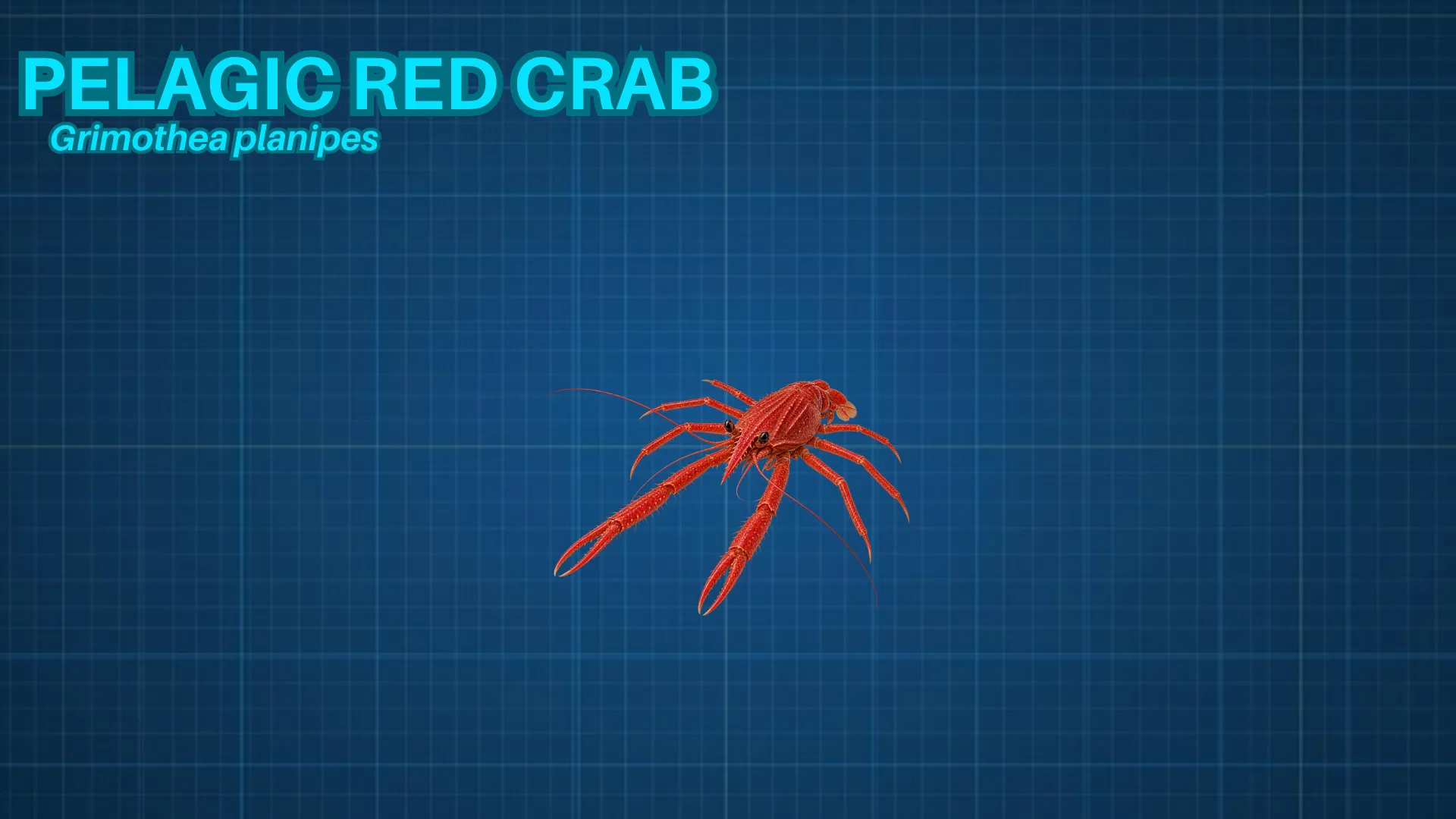
Also calledtuna crab, red crab, lobster krill


Taxonomy
Rarity
Abundance rates how many are in suitable habitat. Find difficulty rates how hard it is to locate one on a daylight snorkel or freedive through 50 ft. A higher find score means a harder search. The rarity category also reflects the kind of encounter; it is not an average of the 2 scores.
Seasonality
Location
SeaLifeBase gives the range as California to Ecuador. Mexican Crabs, a guide to the crabs of Mexico, reports that during El Nino years it is found along the entire Pacific coast of Mexico. The Monterey Bay sanctuary's network notes that it has been seen as far north as Oregon and Washington during those events, and National Geographic reported that it reached Oregon in spring 2017.
Its life is split between open water and the seafloor. Mexican Crabs explains that the young spend their first year drifting as plankton, riding the California Current far out to sea and returning toward the coast on a deeper current. The adults settle onto sand and mud on the continental shelf, at about 160 to 1,200 feet, but still rise into the water to swarm, mate and feed. SeaLifeBase adds that adults move inshore in the first half of the year and offshore in the second.
Deep Dive
The pelagic red crab is not a true crab. National Geographic describes it as a squat lobster, and Mexican Crabs notes its long, flattened, lobster-like body, 3 pairs of thin walking legs, a pair of slender claws and a long, sharp spine at the front of the shell. It is red-orange to reddish brown. Sources disagree on size. National Geographic reported 1 to 3 inches, about the size of a thumb, while SeaLifeBase gives a maximum of about 3 inches and Mexican Crabs about 5.
It feeds by filtering. Mexican Crabs reports that it strains microscopic algae, copepods, diatoms and detritus from the water with the dense hairs on its legs. It is a weak swimmer, according to National Geographic, and moves mostly by drifting with tides, winds and currents. That is how it ends up on beaches. LAist reported that Scripps oceanographer Mark Ohman, aboard a research ship about 10 nautical miles west of Point Loma in 2015, found the crabs abundant but patchy. He estimated that a single patch held 100,000 to 400,000 crabs visible near the surface, and then saw almost none for a few miles. Ohman explained that the crabs move up and down in the water every day, which leaves them open to currents carrying water north.
A 2021 study in the journal Limnology and Oceanography, led by Megan Cimino and drawing on 10 datasets from 1950 to 2019, found that the crabs' appearances off central California tracked unusual flows of water from Mexico. Those flows did not always come with El Nino. The study also suggested that the crabs can stay in northern waters for several years after they arrive. Many die in the colder water, though. Michael Shane of the Hubbs-SeaWorld Research Institute told National Geographic that the crabs start to die because local waters are much cooler.
Many animals eat them. Mexican Crabs lists fish, baleen whales, seals and sea lions, squid, octopuses, seabirds and sea turtles, and reports that the crabs at times make up 85 percent of the diet of yellowfin tuna. In Monterey Bay, Steve Webster of the Monterey Bay Aquarium described gulls so full of red crabs that they could not fly. National Geographic reported that they are not safe for people to eat, because they may have eaten plankton that produce toxins.
Where to Find Them
Researched habitat and range candidates
San Diego · 5 beaches
Orange County · 1 beach
Catalina Island · 2 beaches
Los Angeles · 4 beaches
Channel Islands · 12 beaches
Ventura · 2 beaches
Santa Barbara · 1 beach
San Luis Obispo · 12 beaches
Monterey · 1 beach
These locations have suitable habitat within the species range. An assignment is a possible encounter, not a confirmed sighting at every beach. Season, depth, and local conditions still matter. Historical habitat without present-day evidence is excluded.