
Also calledblack sea turtle, black turtle



Taxonomy
Rarity
Abundance rates how many are in suitable habitat. Find difficulty rates how hard it is to locate one on a daylight snorkel or freedive through 50 ft. A higher find score means a harder search. The rarity category also reflects the kind of encounter; it is not an average of the 2 scores.
Seasonality
Location
San Diego Bay holds the best-known group. NOAA reports that its turtles are long-term residents that usually stay in the south part of the bay, leave to nest in Mexico, and come back afterward. A power plant warmed the south bay from 1960 to 2009, and while it ran, the turtles there grew at some of the fastest rates ever recorded for green turtles. The largest East Pacific green turtle on record, at 540 pounds, came from San Diego Bay.
The Long Beach and Seal Beach group lives around the mouth of the San Gabriel River and the Seal Beach National Wildlife Refuge. NOAA adds that the turtles also use other bays, lagoons and coastal inlets along the Southern California coast.
At La Jolla Shores the turtles share the water with people. The site is a protected area with daily kayaking, snorkeling and diving, and the 2021 study found that its turtles have grown used to people. They stay a long time: the turtles the study followed lived there for an average of at least 424 days. The researchers also saw them feeding in water as cold as about 60 degrees Fahrenheit, the lowest temperature on record for feeding green turtles.
Deep Dive
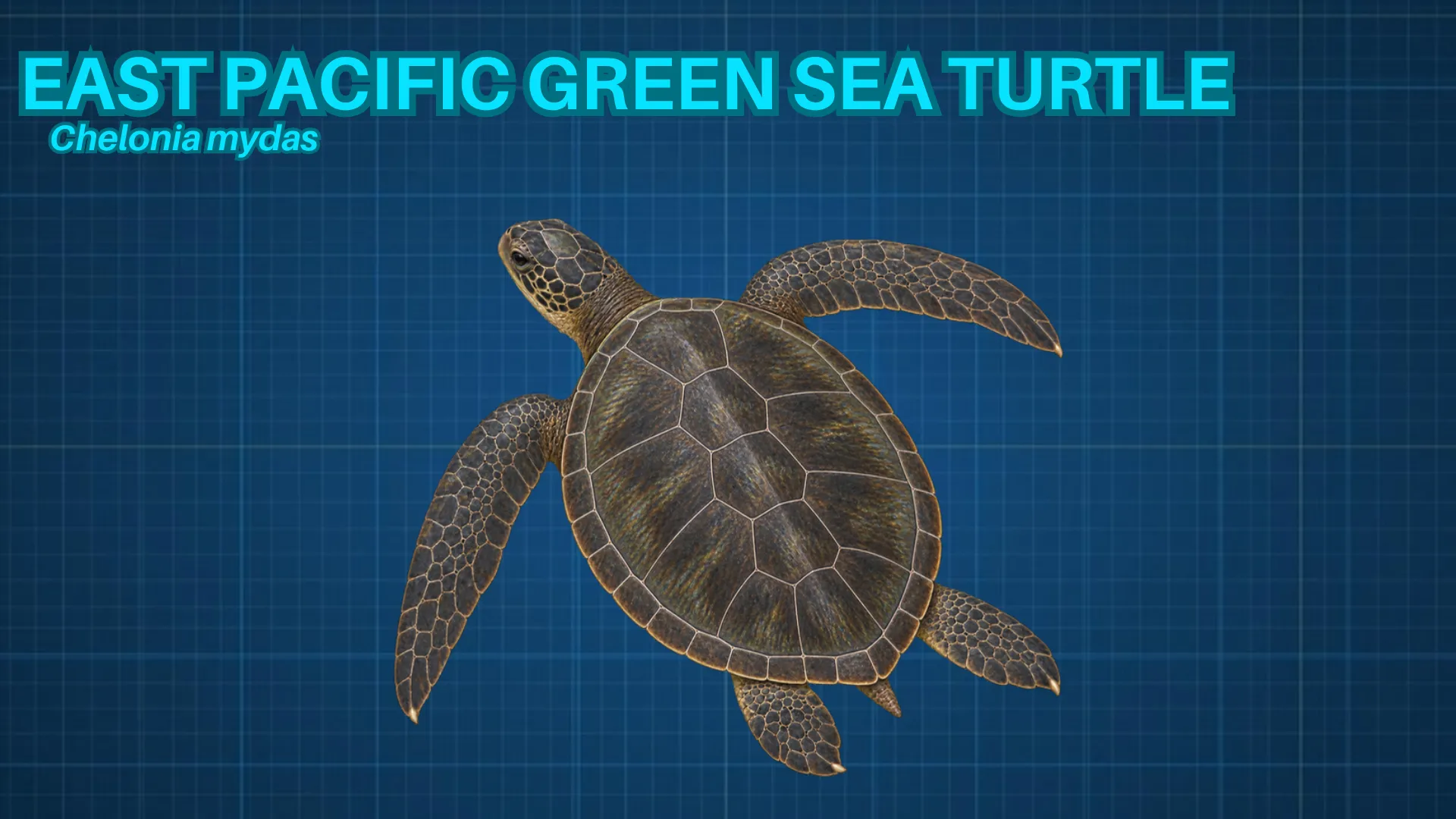
The green sea turtle is not named for its shell. NOAA Fisheries explains that the name comes from the greenish color of its body fat. An adult's shell is dark brown, gray or olive, and the underside is yellow to white. The East Pacific turtles run darker still, which is why they are often called black sea turtles. Scientists once described them as a separate species, but genetic work found them to be the same species as other green turtles.
A green turtle has a fairly small head, a beak with a serrated edge, and 2 large scales between the eyes. Its shell carries 5 large plates, called scutes, down the middle and 4 along each side. NOAA gives a typical adult as 3 to 4 feet long and 300 to 350 pounds. Females take 25 to 35 years to mature, and the species is thought to live 70 years or more.
Adult green turtles eat mainly algae and seagrass, but the East Pacific population eats more animal food than other green turtles do. In San Diego Bay, NOAA reports, the turtles eat eelgrass and the invertebrates that live in it. The young spend their first years drifting in the open ocean, feeding on plants and small animals in floating mats of seaweed, before they move to shallow coastal feeding grounds.
The turtles that feed in California do not nest here. Every 2 to 5 years an adult travels hundreds to thousands of miles to a nesting beach, and females usually return to the general area where they hatched. A female nests alone and at night, laying about 110 eggs every 2 weeks over several months, and the eggs hatch after about 2 months. The temperature of the sand decides how many hatchlings are male and how many are female.
Fishing gear and boats are the biggest threats. NOAA lists bycatch, being caught by accident in fishing gear, as a primary threat, and reports that boat strikes on turtles have increased in Southern California in recent years. Scientists have also found heavy metals and other pollutants in the shells and blood of the San Diego Bay turtles, though they found no harm from them.
Federal law protects every one of them. Under the Endangered Species Act and the NOAA Fisheries rule that applies it to threatened sea turtles, it is illegal to harass, harm, pursue, hunt, capture or collect a sea turtle, or to try to. NOAA asks people to stay at least 50 yards away, never to touch or feed a turtle, and to slow down and steer around turtles when boating. NOAA also collects sightings from the public through its Sea Turtle Sightings Survey, recording the date, time, place and what the turtle was doing.
Where to Find Them
Researched habitat and range candidates
San Diego · 6 beaches
Orange County · 2 beaches
Los Angeles · 4 beaches
Channel Islands · 5 beaches
These locations have suitable habitat within the species range. An assignment is a possible encounter, not a confirmed sighting at every beach. Season, depth, and local conditions still matter. Historical habitat without present-day evidence is excluded.