

Also calledsilver perch

Taxonomy
Rarity
Abundance rates how many are in suitable habitat. Find difficulty rates how hard it is to locate one on a daylight snorkel or freedive through 50 ft. A higher find score means a harder search. The rarity category also reflects the kind of encounter; it is not an average of the 2 scores.
Seasonality
Location
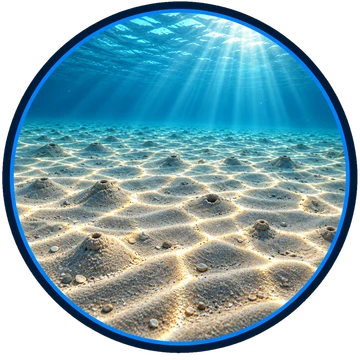
Spotfin surfperch range from Seal Rock in central Oregon down to central Baja California, and they belong to the surf zone biome and nothing else. Every source that describes the habitat names the surf zone of sandy beaches and open sandy bottom, which puts this species in the same water as the barred and calico surfperch and none of the rocky or kelp ground the rest of the family uses. The recorded depth range runs to about 300 feet, which comes from trawls rather than from anywhere a person would look.
Identification is the whole practical problem with this fish, and it is a 3-way problem. Spotfin, walleye and silver surfperch are all small, silvery, deep-bodied fish that were until recently placed in the same genus, and they turn up over the same sand in the same schools. The checks are clean once known. A walleye surfperch has black tips on the pelvic fins and an eye that looks a size too large for the head. A silver surfperch has a pink tail and no fin markings beyond a small orange spot that usually sits on the anal fin. A spotfin surfperch has large black spots in both the dorsal fin and the anal fin, which is what the common name is describing and which neither of the other 2 carries. The body is silver with a dusky back.
The diet contains 1 genuinely surprising item. Spotfin surfperch eat marine worms, small crustaceans, algae and fish eggs, all of which is ordinary, and they also eat young squid. Only 1 other California surfperch has a cephalopod on its diet list, the rubberlip seaperch, which takes octopus and is more than twice this fish's length. A 6-inch surf-zone fish hunting juvenile squid is not what the family is known for.
Deep Dive
The name on this page is not the name in most California books, and the reason is worth explaining, because anyone checking a field guide will find something different.
For most of the past century this species sat in the same genus as the walleye and silver surfperches, and it is still listed that way in the international database that carries its biology, and in the California Department of Fish and Wildlife's own chapter on the surfperch family. The World Register of Marine Species now places it in a separate genus of its own, and that is the accepted name today. This Ichthyopedia follows the accepted name, which is the same call already made on the pile perch, where the state and federal agencies still use a superseded combination. Nothing about the fish changed. The classification did, and the literature has not caught up.
The other thing worth knowing about this species is how short its life is. The maximum reported age is 3 years. Set that against the rest of the family and it stands out sharply: striped seaperch and rubberlip seaperch both live to about 10, shiner perch and redtail surfperch to 9, walleye surfperch to 6. The state gives 2 to 10 years as the family range, and the spotfin sits at the bottom of it.
A 3-year life span changes the arithmetic of everything else. Surfperch do not lay eggs. Fertilization is internal, the female carries the young to full development, and what is born is a small complete fish that swims immediately. A spotfin brood runs from 4 to 20. A female that matures, breeds a couple of times, and dies inside 3 years has a very small lifetime output, and the entire population turns over fast enough that a bad couple of years leaves nothing older to carry it.
That would be a worrying combination if the fish were fished, and the saving grace is that it is not. Nobody keeps a 6-inch surfperch. The species is too small for a fishery, too small to interest an angler, and lives in surf that no commercial gear works. Whatever is happening to spotfin surfperch populations is happening for reasons other than harvest, which is an unusual position in this family and makes it a cleaner natural experiment than most of its relatives.
The trouble is that nobody is running the experiment. The state's brood-size figure exists, but the mating season is recorded as not available, and the birth season is not observed at all. The table gives it as summer and then adds, in a parenthetical, that this is based on the number of small juveniles found in coastal waters. In other words, the only reason anyone knows when this fish gives birth is that at a certain time of year small ones start showing up. For a species that lives on public beaches from Oregon to Baja, in water a person can wade into, that is a thin file. It is also the ordinary condition for the small half of this family, and it is the reason California manages all 18 species under one shared limit rather than trying to write a rule for each.
Where to Find Them
Researched habitat and range candidates
San Diego · 17 beaches
Orange County · 12 beaches
Catalina Island · 6 beaches
Los Angeles · 16 beaches
Channel Islands · 12 beaches
Ventura · 23 beaches
Santa Barbara · 20 beaches
San Luis Obispo · 13 beaches
Monterey · 12 beaches
Oregon South Coast · 10 beaches
Oregon Central Coast · 2 beaches
These locations have suitable habitat within the species range. An assignment is a possible encounter, not a confirmed sighting at every beach. Season, depth, and local conditions still matter. Historical habitat without present-day evidence is excluded.