
 Spearfishing
Spearfishing Stats
Monterey Bay to the Gulf of California.
Taxonomy
Rarity
Abundance rates how many are in suitable habitat. Find difficulty rates how hard it is to locate one on a daylight snorkel or freedive through 50 ft. A higher find score means a harder search. The rarity category also reflects the kind of encounter; it is not an average of the 2 scores.
Regulations
CDFW rules verified 2026-10-15
Seasonality
Edibility
Location
FishBase gives the range as Monterey Bay to the Gulf of California, and Mexican Fish adds the whole west coast of Baja California. It lives on sand and mud. Mexican Fish records it from about 33 to 1,570 feet, a wider span than FishBase gives. Mexican Fish's photographs of the species include fish caught off Redondo Beach and San Diego.
Spearfishing Brief
Finding a bigmouth sole rates a 5, mainly because of depth. Mexican Fish describes it as a camouflaged ambush hunter, half buried on the bottom. Taking one that has been found rates a 2, because it lies in wait on the bottom.
California has no special rules for it. The bigmouth sole is not on either of the state's federal flatfish lists, so it falls under the general limit of 20 finfish, with no more than 10 of any 1 species, and no size limit. Take is prohibited in state marine reserves.
It is valued as food. FishBase notes that it is said to be an excellent food fish, and Mexican Fish reports that it is sold commercially.
Deep Dive
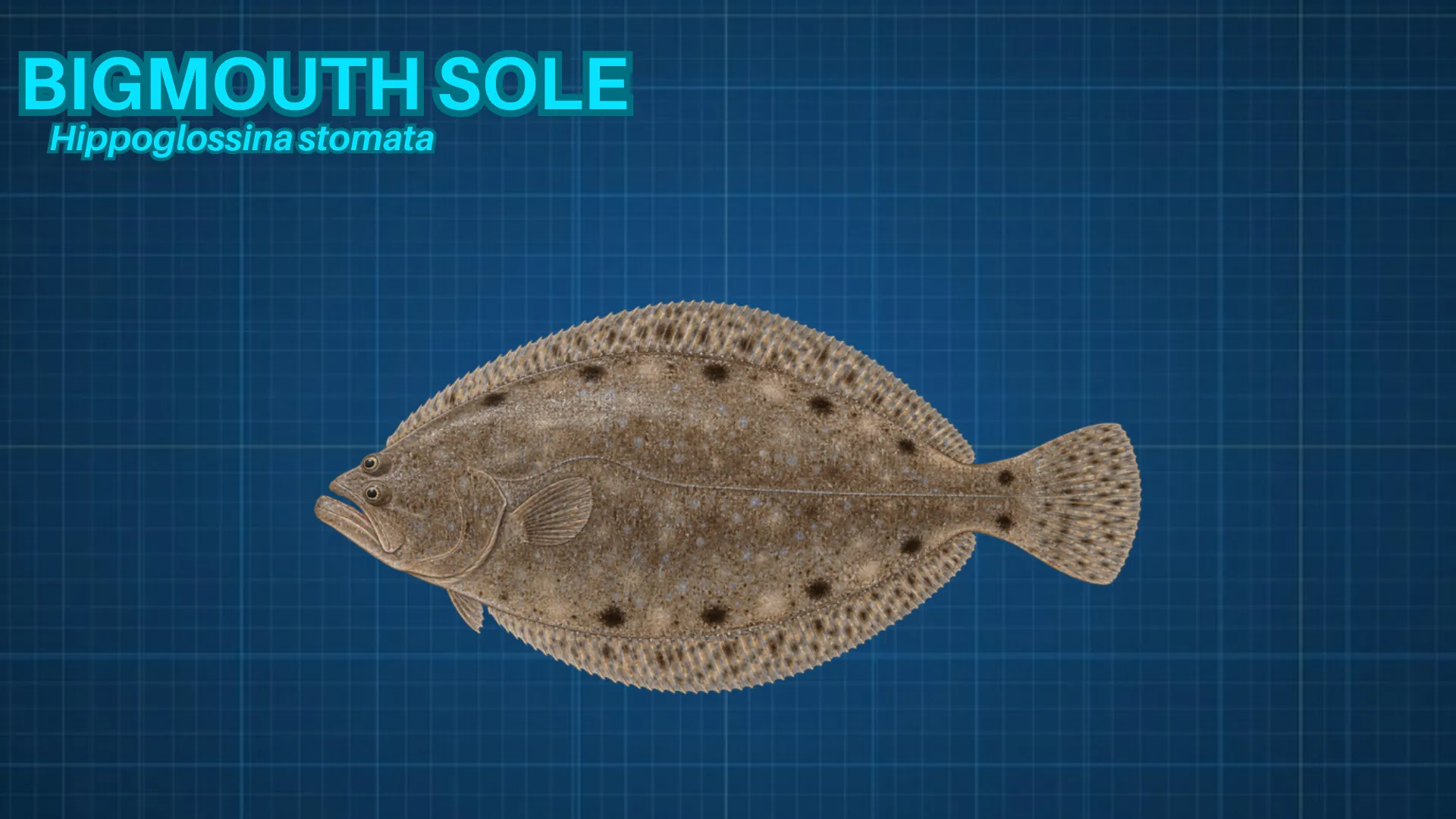
The bigmouth sole is a flatfish with both eyes on the left side of its head. Mexican Fish describes a long body and a long mouth that reaches back to the rear edge of the lower eye. The eyed side is gray brown with blue reflections and many blue and pale brown spots, along with 5 dark brown eyespots along the upper and lower edges of the body and a dark spot at each side of the tail base. The tail is pointed, and the lateral line is strongly arched. It reaches about 16 inches.
Mexican Fish reports that it eats small fish and a wide range of crustaceans, and that California sea lions eat it. FishBase adds that females spawn many times over a long season. Mexican Fish notes that it is hard to confuse with any other fish, thanks to its long body, big mouth, arched lateral line and spots.
Where to Find Them
Researched habitat and range candidates
San Diego · 3 beaches
Orange County · 1 beach
Los Angeles · 3 beaches
Channel Islands · 4 beaches
Ventura · 1 beach
Santa Barbara · 1 beach
These locations have suitable habitat within the species range. An assignment is a possible encounter, not a confirmed sighting at every beach. Season, depth, and local conditions still matter. Historical habitat without present-day evidence is excluded.