



Taxonomy
Rarity
Abundance rates how many are in suitable habitat. Find difficulty rates how hard it is to locate one on a daylight snorkel or freedive through 50 ft. A higher find score means a harder search. The rarity category also reflects the kind of encounter; it is not an average of the 2 scores.
Seasonality
Location
A 2021 checklist of the region's fishes by Milton Love and colleagues gives its range as Barkley Sound on Vancouver Island and Washington south to the Gulf of California and Chiapas, Mexico, with a report off northern Peru. A 1973 paper in the journal California Fish and Game recorded it from Yaquina Bay, Oregon. The same checklist records it from the intertidal zone to 1,519 feet, and FishBase says it usually lives between about 100 and 260 feet.
It lives on soft bottom. FishBase records it on mud and sandy mud, and Mexican Fish adds eelgrass beds, estuaries and bays.
Deep Dive
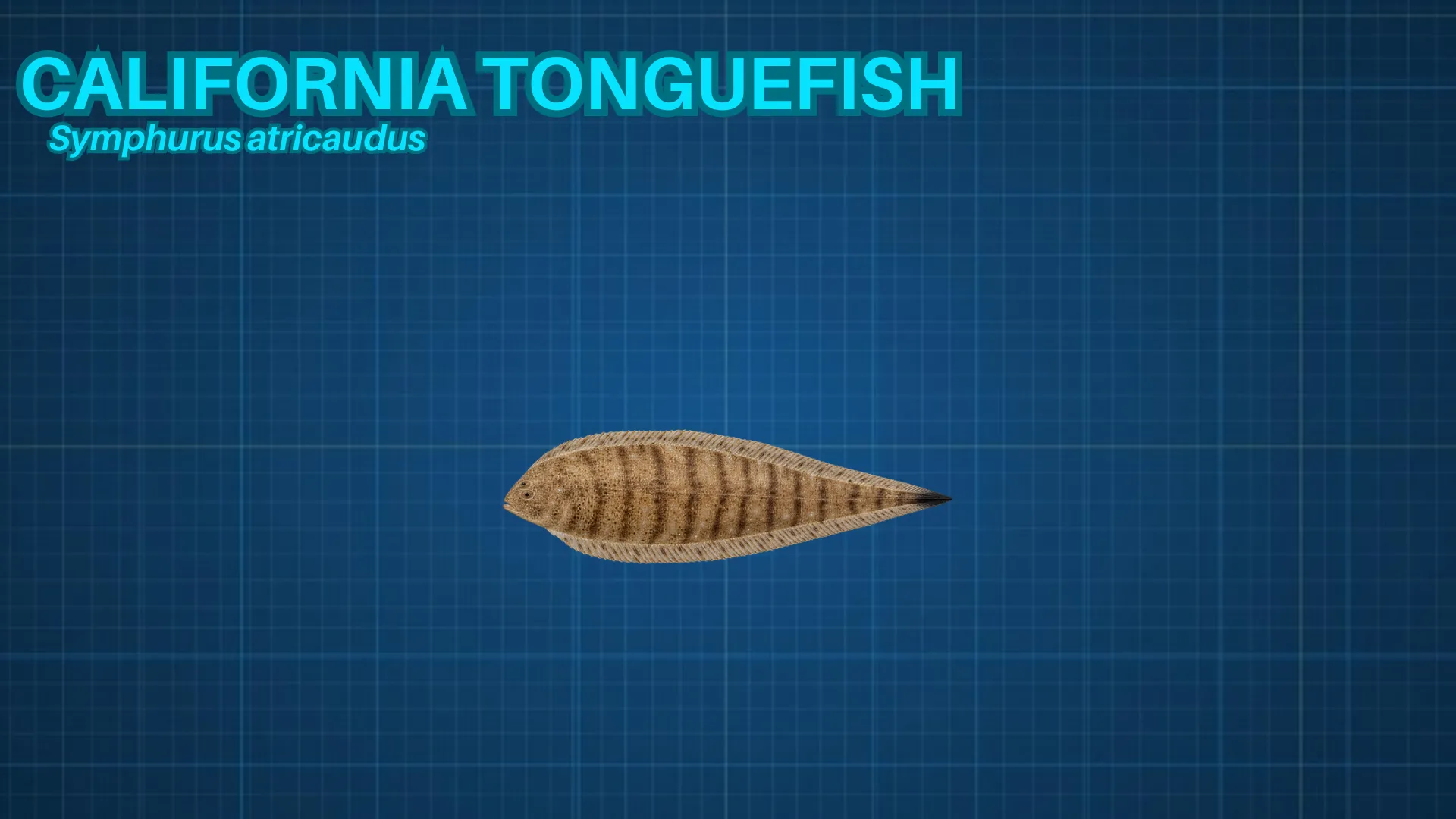
A tonguefish is a flatfish shaped like a tongue: an oval body that tapers to a pointed tail. The California tonguefish has both eyes on the left side of the head, small and set close together. Mexican Fish describes the eyed side as light brown with dark brown spots, and adults carry 9 dark crossbars that do not reach all the way across the body. The underside is cream.
It is stripped down even by flatfish standards. It has no pectoral fins at all, only 1 pelvic fin, and no lateral line, the row of sensory pores most fish carry along the side. The fins along its back and belly run all the way to the tail and join the pointed tail fin. It grows to about 8 inches.
FishBase reports that it eats small fish and invertebrates. Its eggs and larvae drift in open water. Beyond that, little is known. Mexican Fish calls it poorly studied, with almost no information on its age, growth, movements or reproduction, and it names coastal development as a long-term threat.
California counts it toward the general bag limit: no more than 10 per person per day, as part of a total of 20 finfish, with no size limit and no closed season. It is not a federally managed groundfish, so the groundfish depth and season closures do not apply. Take is prohibited inside state marine reserves.
Where to Find Them
Researched habitat and range candidates
San Diego · 6 beaches
Orange County · 2 beaches
Los Angeles · 4 beaches
Channel Islands · 5 beaches
Ventura · 4 beaches
Santa Barbara · 3 beaches
San Luis Obispo · 4 beaches
Monterey · 1 beach
Oregon North Coast · 1 beach
Hood Canal · 4 beaches
Central Sound · 7 beaches
North Sound · 4 beaches
San Juan Islands · 1 beach
Strait of Juan de Fuca · 1 beach
Cape Flattery · 1 beach
These locations have suitable habitat within the species range. An assignment is a possible encounter, not a confirmed sighting at every beach. Season, depth, and local conditions still matter. Historical habitat without present-day evidence is excluded.