
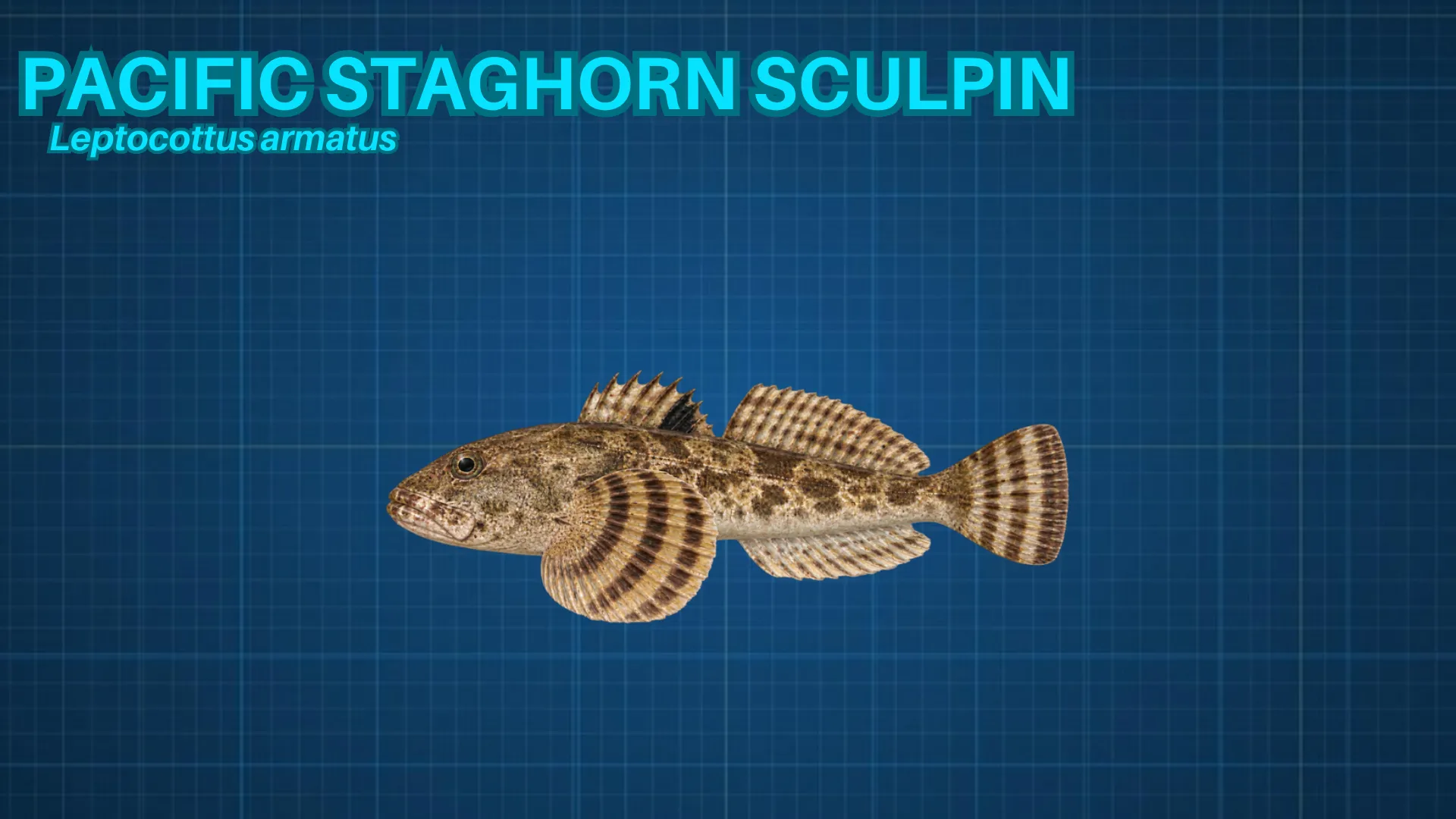
Also calledbullhead, smooth cabezon, smooth sculpin


Taxonomy
Rarity
Abundance rates how many are in suitable habitat. Find difficulty rates how hard it is to locate one on a daylight snorkel or freedive through 50 ft. A higher find score means a harder search. The rarity category also reflects the kind of encounter; it is not an average of the 2 scores.
Seasonality
Location
The staghorn sculpin lives from Izembek Lagoon on the Bering Sea coast of Alaska to Bahia San Quintin in northern Baja California. FishBase describes it as common near shore, especially in bays and estuaries, and most often on sand. It is recorded as deep as about 510 feet, but most live in shallow water.
It moves easily between salt and fresh water. FishBase reports that some young fish, just after taking their adult shape, move from the estuaries where they hatched into completely fresh water and stay up to 6 weeks, and that adults tend to stay in the shallow lower estuary or farther offshore. Staghorn sculpin in the intertidal zone can breathe air out of water, and they can leave a tide pool when its water turns bad.
Deep Dive
The fish is named for its spines. Each side of the head carries a large spine just in front of the gill cover that ends in 3 or 4 sharp, upturned, curved points, like the antlers of a stag. Ken Jones notes that the Latin name armatus means armed, after that spine, and Mexican Fish warns that it should be handled with care because of it. The other mark FishBase uses to identify it is a large dark spot at the back of the first dorsal fin.
The body is grayish olive to green on top and yellow to white below, and Mexican Fish notes that it can change color to match the bottom. The head is wide and flat, with large eyes on top and a broad mouth full of small teeth. The pectoral fins are yellow with 5 or 6 dark green bars. The skin has no scales. FishBase gives a maximum length of about 18 inches and a maximum age of 10 years, and Ken Jones reports that most caught from piers are 6 to 8 inches.
It hums. FishBase reports that a stressed staghorn sculpin spreads its gill covers and makes a low-pitched humming sound.
It eats mostly crabs, shrimp and amphipods, according to FishBase, along with worms, mollusks, other invertebrates and fish at every stage of life. Mexican Fish lists guitarfish, sharks, marine mammals and shore birds among its predators.
Mexican Fish reports that each female lays 2,000 to 10,000 eggs, that the adults leave for deeper water soon after spawning, and that the eggs hatch in about 10 days. It also notes that the species was an important food for Native Americans.
Anglers mostly see it as a pest. FishBase calls it a nuisance to anglers, and Ken Jones describes days when he could hardly keep these bait stealers off his hooks. Some anglers fry them like catfish, though Ken Jones has been told they taste bland. He calls them excellent bait for striped bass in the San Francisco Bay area, and Mexican Fish reports that they are sold there as live bait.
Where to Find Them
Researched habitat and range candidates
San Diego · 4 beaches
Orange County · 2 beaches
Los Angeles · 7 beaches
Channel Islands · 4 beaches
Ventura · 2 beaches
Santa Barbara · 3 beaches
San Luis Obispo · 4 beaches
Monterey · 1 beach
Central Sound · 1 beach
These locations have suitable habitat within the species range. An assignment is a possible encounter, not a confirmed sighting at every beach. Season, depth, and local conditions still matter. Historical habitat without present-day evidence is excluded.