
Also calledCortez bonefish, silver ghost, macabi


Taxonomy
Rarity
Abundance rates how many are in suitable habitat. Find difficulty rates how hard it is to locate one on a daylight snorkel or freedive through 50 ft. A higher find score means a harder search. The rarity category also reflects the kind of encounter; it is not an average of the 2 scores.
Seasonality
Location
The 2011 paper that named the species, by Edward Pfeiler and colleagues in the journal Zootaxa, gives its range as the Gulf of California to the coastal waters of California. FishBase adds the outer coast of the Baja California peninsula and places the southern edge near Mazatlan.
It lives in shallow water. Jones describes it in bays, lagoons and estuaries and along sandy beaches, usually in schools, so an angler who catches a bonefish may catch more. He names south San Diego Bay as the best bonefish water on the West Coast, and lists catches from shore in Mission Bay, Newport Bay, Huntington Harbour, Alamitos Bay and Marina del Rey. It is caught most often from piers inside San Diego Bay, and now and then from oceanfront piers from Imperial Beach to Long Beach. The fish are in the bays all year, though the best months run from March through October.
Deep Dive
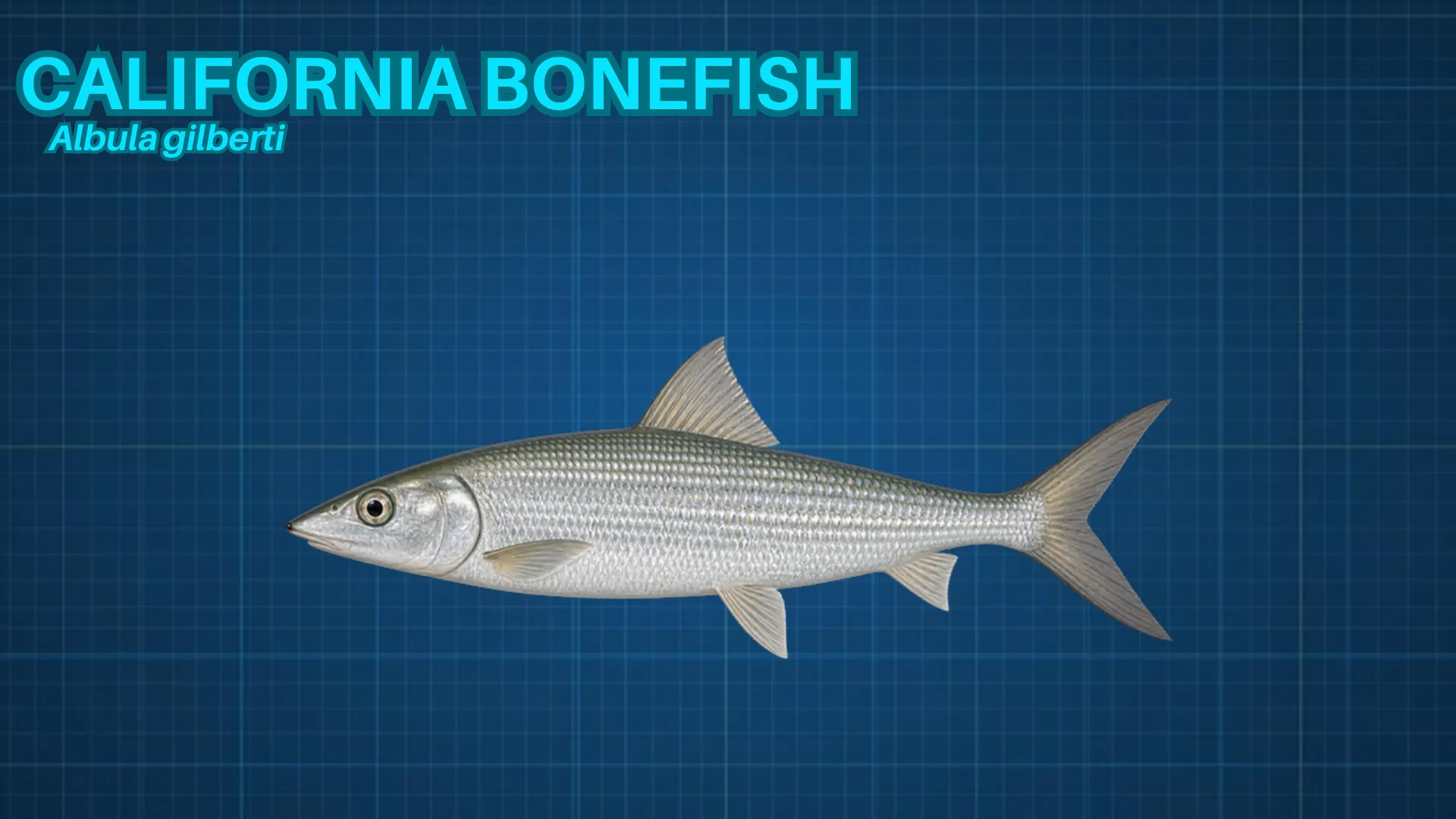
The California bonefish is a hidden species. It was long lumped with other bonefish, and was known to scientists only by a placeholder label until Pfeiler and his colleagues described it in 2011. Their paper explains that it can be told apart from its closest relative, a bonefish of the tropical eastern Pacific, only by differences in its DNA. No outward feature reliably separates the 2. Their ranges meet and overlap in the southern Gulf of California.
Jones describes a fish with a cone-shaped snout, a small mouth and a single dorsal fin in the middle of the back. It is gray, bluish or greenish above and silvery below, with yellowish fin bases. Some fish, usually young ones, show bars along the side, which fade when the fish dies. Pier anglers sometimes mistake it for a mullet.
It is small for a bonefish. Jones reports that most caught from California piers are 10 to 12 inches long, and cites published maximums from about 14 to 18 inches. The world record listed by the International Game Fish Association weighed 1 pound 11 ounces and came from San Diego Bay in 2022. The famous bonefish of the Florida Keys, a different species, can reach 41 inches.
It still fights. Jones hooked a fish in shallow water at the Dana Harbor Pier in 2017 that made a long, curving run on light tackle. He recommends ghost shrimp as the best bait, along with bloodworms, lugworms, mussels, clams and shrimp, and notes that it can be taken on small soft lures. The fish is reported to be fairly good eating, with firm, mild flesh, but Jones notes that it is full of small bones, which give the fish its name.
Where to Find Them
Researched habitat and range candidates
San Diego · 17 beaches
Orange County · 11 beaches
Catalina Island · 2 beaches
Los Angeles · 16 beaches
Channel Islands · 7 beaches
Ventura · 23 beaches
Santa Barbara · 11 beaches
These locations have suitable habitat within the species range. An assignment is a possible encounter, not a confirmed sighting at every beach. Season, depth, and local conditions still matter. Historical habitat without present-day evidence is excluded.