



Taxonomy
Rarity
Abundance rates how many are in suitable habitat. Find difficulty rates how hard it is to locate one on a daylight snorkel or freedive through 50 ft. A higher find score means a harder search. The rarity category also reflects the kind of encounter; it is not an average of the 2 scores.
Seasonality
Location
FishBase and a 2014 genetic study by Giacomo Bernardi both give the range as Monterey Bay to Bahia Magdalena in Baja California Sur, with a separate population in the Gulf of California. Bernardi describes it living mostly over shallow sand below the low-tide line, and occasionally in large tide pools, and he caught his samples with beach seines at Carlsbad, Mission Bay and Los Alamitos. Mexican Fish adds bays and estuaries and gives a depth limit of about 80 feet, and FishBase notes that it is usually shallower than about 33 feet. Mexican Fish's photographs of the species come from Del Mar Lagoon and Mission Bay in San Diego.
Deep Dive
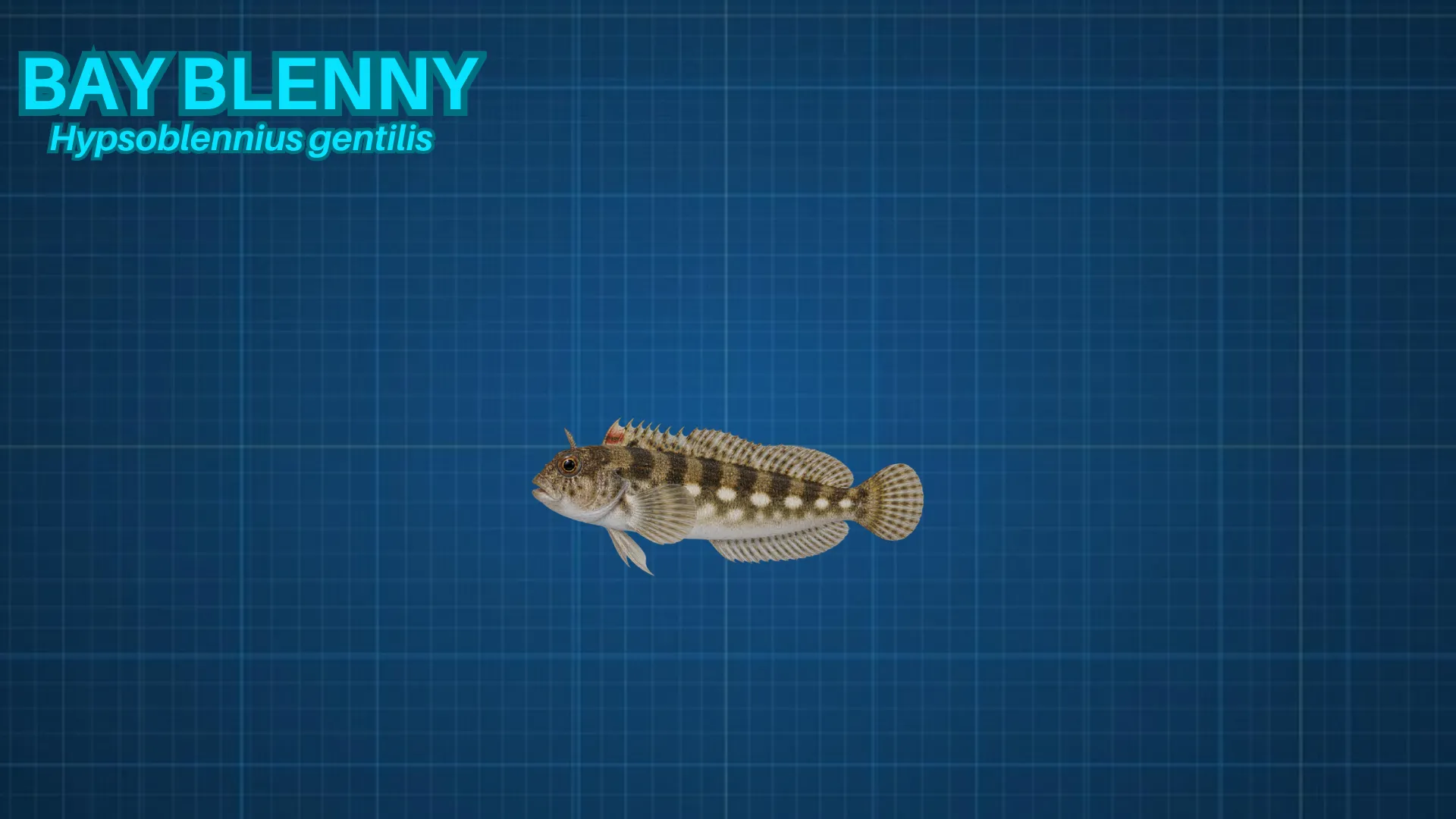
The bay blenny is a combtooth blenny with a short, blunt head and a steep forehead. Mexican Fish describes it as dark brown with a green tint and a white throat and belly, with dark saddles along the back, a row of off-white blotches along the side and a red spot at the front of the dorsal fin. The sexes look different. Males have a red bar across the throat that brightens in the breeding season and very long tufts of skin above the nose, while females have a large metallic blue spot near the front of the dorsal fin. It grows to nearly 6 inches.
It handles a wide range of conditions. Mexican Fish reports that it tolerates extreme winter and summer temperatures, and FishBase lists it in both salt and brackish water. It eats algae and small invertebrates from the bottom.
Breeding follows the pattern of its relatives. The 1970 study found that these blennies spawn from spring through late summer and that the male guards the eggs, which hatch in 4 to 18 days depending on the water temperature. Mexican Fish reports that each female spawns 3 or 4 times a year, attaching sticky eggs to the walls of a shelter, and that the male guards them for 2 to 3 weeks. Bernardi reports that the larvae drift in open water for about 66 days. Both FishBase and Mexican Fish give a lifespan of up to 7 years.
Where to Find Them
Researched habitat and range candidates
San Diego · 4 beaches
Orange County · 2 beaches
Los Angeles · 7 beaches
Channel Islands · 4 beaches
Ventura · 2 beaches
Santa Barbara · 3 beaches
San Luis Obispo · 4 beaches
Monterey · 1 beach
These locations have suitable habitat within the species range. An assignment is a possible encounter, not a confirmed sighting at every beach. Season, depth, and local conditions still matter. Historical habitat without present-day evidence is excluded.