


Taxonomy
Rarity
Abundance rates how many are in suitable habitat. Find difficulty rates how hard it is to locate one on a daylight snorkel or freedive through 50 ft. A higher find score means a harder search. The rarity category also reflects the kind of encounter; it is not an average of the 2 scores.
Seasonality
Location
The California skate ranges from the Strait of Juan de Fuca in Washington south to central Baja California. Depth records run from about 45 feet to roughly 5,250 feet, an enormous span, and the 2 useful numbers inside it point in different directions. FishBase describes the species as common in inshore water from about 50 feet and in shallow bays. The commercial record puts most fish between 190 and 760 feet. Both are true and they describe different observers: trawlers work the deeper band, and the shallow fish are the ones an angler or a diver could plausibly meet.
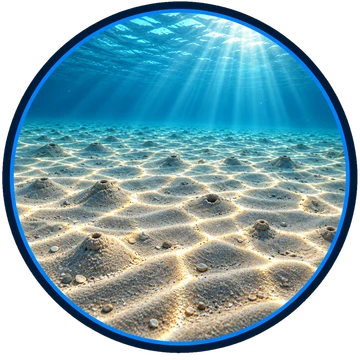
The bottom is always soft. Sandy and muddy flats, inshore and inside bays, with no rock and no structure in any account of the species.
Identification is a matter of what is missing. On top the skate is olive brown with a blotchy pattern, and the underside is mostly white. There are no eyespots, which is the separation from the big skate that shares this coast and this bottom. The species name means unadorned, and it fits. FishBase carries no formal description of the animal at all, which is unusual and says something about how little attention it has received.
Size is modest for a skate. The maximum is about 30 inches and the length most often encountered is about 18. The world record weighing under 3 pounds for a fish that can reach 30 inches shows how little of a skate is body: the animal is essentially a thin sheet with a tail.
Deep Dive
Put the 2 skates in this Ichthyopedia side by side and the comparison does more work than either page alone. The big skate reaches 8 feet and 200 pounds, matures at about 51 inches, and lays a capsule 9 to 12 inches long that can hold as many as 7 embryos. The California skate reaches 30 inches, matures at about 18 to 20, and lays a capsule around 3 inches long. Same family, same egg-laying strategy, same soft bottom, and 1 animal is roughly 3 times the length of the other at every stage of its life.
The maturity figures are the part worth dwelling on. Males mature at about 18 inches and females at about 20, on a fish whose typical length is 18 inches. That means most California skates a trawl brings up are at or just under breeding size, and the population is made up largely of animals right at the threshold. Compare the big skate, which has to reach 51 inches out of a possible 96 before it breeds at all. A small skate that matures early can rebuild a depleted population far faster than a large one, which is generally the difference between a fish that tolerates a trawl fishery and a fish that does not.
Reproduction follows the family pattern. The female lays a tough leathery capsule with stiff pointed horns at the corners and presses it into sand or mud, and the embryo inside develops entirely on its own yolk with no further help from the mother. Hatchlings emerge at 6 to 9 inches, fully formed. How many embryos ride in each California skate capsule was not found in any source, so this page does not guess. The default across skates is 1, and the big skate's 7 is the documented exception, but neither number has been established for this animal.
Diet is the smallest prey list of any cartilaginous fish on this coast: small bottom-dwelling invertebrates, bristle worms and shrimp. That is a fish picking through mud, and it matches the flat plain body and the shallow soft habitat.
The skate ends up on plates. It is sold as skin-on wings, skin-off wings and fillets, the flesh is firm with a mild taste and can run stringy, and it is baked, deep fried, poached or sauteed. Winter-caught fish are considered better than summer ones even though summer is when most are landed. As with every shark and ray, handling decides the result: the tissue of cartilaginous fish holds urea, which turns to ammonia within hours of death, so a skate that is not bled and iced quickly smells wrong no matter how it is cooked.
The management story has an unexpected shape. Bottom trawling is the most ecologically damaging way to catch anything, and it is how most California skates are taken. Restrictions on trawling inside California's protected areas have reduced trawl effort, and skate catches have fallen along with it. So the trend in landings for this species reflects a change in fishing rules rather than a change in the fish, which is exactly the trap that makes catch records a poor measure of abundance. The state's own conclusion is the one to hold onto: stable, and not well enough known to say more.
A last note for anyone who checks the scientific name against a database, because the 2 main authorities currently disagree. The World Register of Marine Species lists this fish in the same genus as the big skate, and FishBase has already moved it into a genus erected in 2022 specifically for the California skates. Both names are in active use in published sources. This site follows the World Register, as it does elsewhere in the Ichthyopedia, which means the 2 skates here share a genus. If the register adopts the newer arrangement, they will not.
Where to Find Them
Researched habitat and range candidates
San Diego · 15 beaches
Orange County · 12 beaches
Catalina Island · 6 beaches
Los Angeles · 12 beaches
Channel Islands · 10 beaches
Ventura · 12 beaches
Santa Barbara · 12 beaches
San Luis Obispo · 10 beaches
Monterey · 10 beaches
Oregon Central Coast · 4 beaches
Oregon North Coast · 1 beach
South Sound · 2 beaches
Hood Canal · 4 beaches
Central Sound · 4 beaches
Strait of Juan de Fuca · 1 beach
Cape Flattery · 1 beach
These locations have suitable habitat within the species range. An assignment is a possible encounter, not a confirmed sighting at every beach. Season, depth, and local conditions still matter. Historical habitat without present-day evidence is excluded.