

Taxonomy
Rarity
Abundance rates how many are in suitable habitat. Find difficulty rates how hard it is to locate one on a daylight snorkel or freedive through 50 ft. A higher find score means a harder search. The rarity category also reflects the kind of encounter; it is not an average of the 2 scores.
Depth and encounter availability
Published range starts near 60 ft, just outside baseline; 50–100 ft is materially more suitable than 0–50 ft. This Rare rating reflects limited availability within snorkeling and freediving depths through 50 ft. It is not a claim that the species is equally scarce in its normal deeper habitat. Routine shallow occurrence is unverified; habitat suitability alone does not promise a sighting.
Seasonality
Location
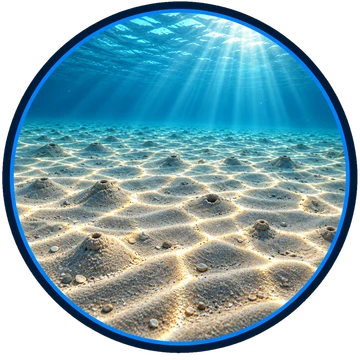
Calico rockfish hold on and near soft bottom, on the transition ground where rocky substrate mixes with fine sediment, and around structure including artificial reef. That habitat choice is the single most useful thing to know about the species, because it is what separates it from everything else in the family. Nothing has been published on how it behaves there. There is no study of territoriality, home range, schooling, or when in the day it feeds. It eats mysids, other shrimps, krill and small fishes, with cephalopods and bivalves reported as well, and larger fish, seals and seabirds are named as its predators without numbers behind the claim.
The fish is small and, alive, unmistakable. The ground color is greenish yellow, crossed by diagonal reddish-brown bars on the flanks, with mottled brown spotting over it, dark dorsal and caudal fins, orange and red pectorals, and clear anal and pelvic fins tinged with red. The bars fade after death, which means a photograph taken on a boat deck shows a duller fish than the one that was on the bottom. It reaches 9.8 inches and about 1.1 pounds and lives up to 12 years. As with every rockfish, the fin spines carry mild venom, so a careless grab delivers a puncture that hurts well out of proportion to its size.
Deep Dive
Carl Eigenmann and Charles Beeson described the calico rockfish in 1894, placing it in a genus that no longer stands, and named it for William Healey Dall of the Smithsonian Institution, the malacologist and Arctic explorer whose name is attached to a good deal of Pacific natural history. The species has attracted about as much scientific attention since as most of the small rockfish do, which is to say very little, and the little that exists needs reading carefully.
An example is worth showing, because it illustrates the problem with taking secondary sources at face value. One widely mirrored account states that female calico rockfish mature at 9 years and males at 7. That cannot be right. The species lives a maximum of 12 years, reaches under 10 inches, and matures at a length of about 3.5 inches according to FishBase. A fish that matures at 3.5 inches is not waiting 9 years to do it, and the numbers 9 and 7 look like centimetre measurements that were transcribed into the wrong column. This entry therefore reports the length at maturity and leaves the age blank, which is the correct answer when the only available figures are internally contradictory.
The same caution applies to reproduction. Birth is reported from January through May with a February peak, and a female is reported to release between 3,900 and 18,000 larvae a year, but both figures trace to a single uncited account rather than to a study. They are set down here as reported. What is certain is the mechanism, because it holds across the entire family: fertilization is internal, the female carries the developing young, and she gives birth to live larvae that drift as plankton before settling.
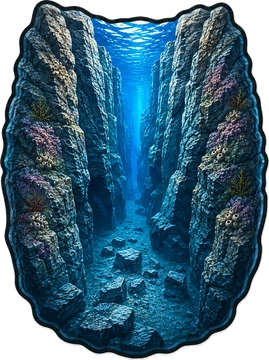
The habitat is where this fish earns its place in an encyclopedia rather than just on an identification chart. Rockfish are, as a group, the definitive hard-bottom fish of the Pacific coast, and the shape of the whole family follows from that: heavy head armor, big pectoral fins for holding position against surge, cryptic coloring matched to rock. The calico rockfish took the same body onto soft sediment. It lives where the reef ends, on the mixed ground and the sand-rock edge that most of its relatives use only as a boundary. That is a genuinely different life, and nobody has studied it.
For a diver, the practical upshot is simple. If a small greenish-yellow fish with diagonal reddish bars turns up over mixed bottom somewhere below 60 feet in southern or central California, that is a calico rockfish, and it is the one rockfish on the chart that is supposed to be there rather than on the rock.
Where to Find Them
Researched habitat and range candidates
San Diego · 15 beaches
Orange County · 11 beaches
Catalina Island · 7 beaches
Los Angeles · 12 beaches
Channel Islands · 15 beaches
Ventura · 12 beaches
Santa Barbara · 10 beaches
San Luis Obispo · 6 beaches
Monterey · 12 beaches
These locations have suitable habitat within the species range. An assignment is a possible encounter, not a confirmed sighting at every beach. Season, depth, and local conditions still matter. Historical habitat without present-day evidence is excluded.