
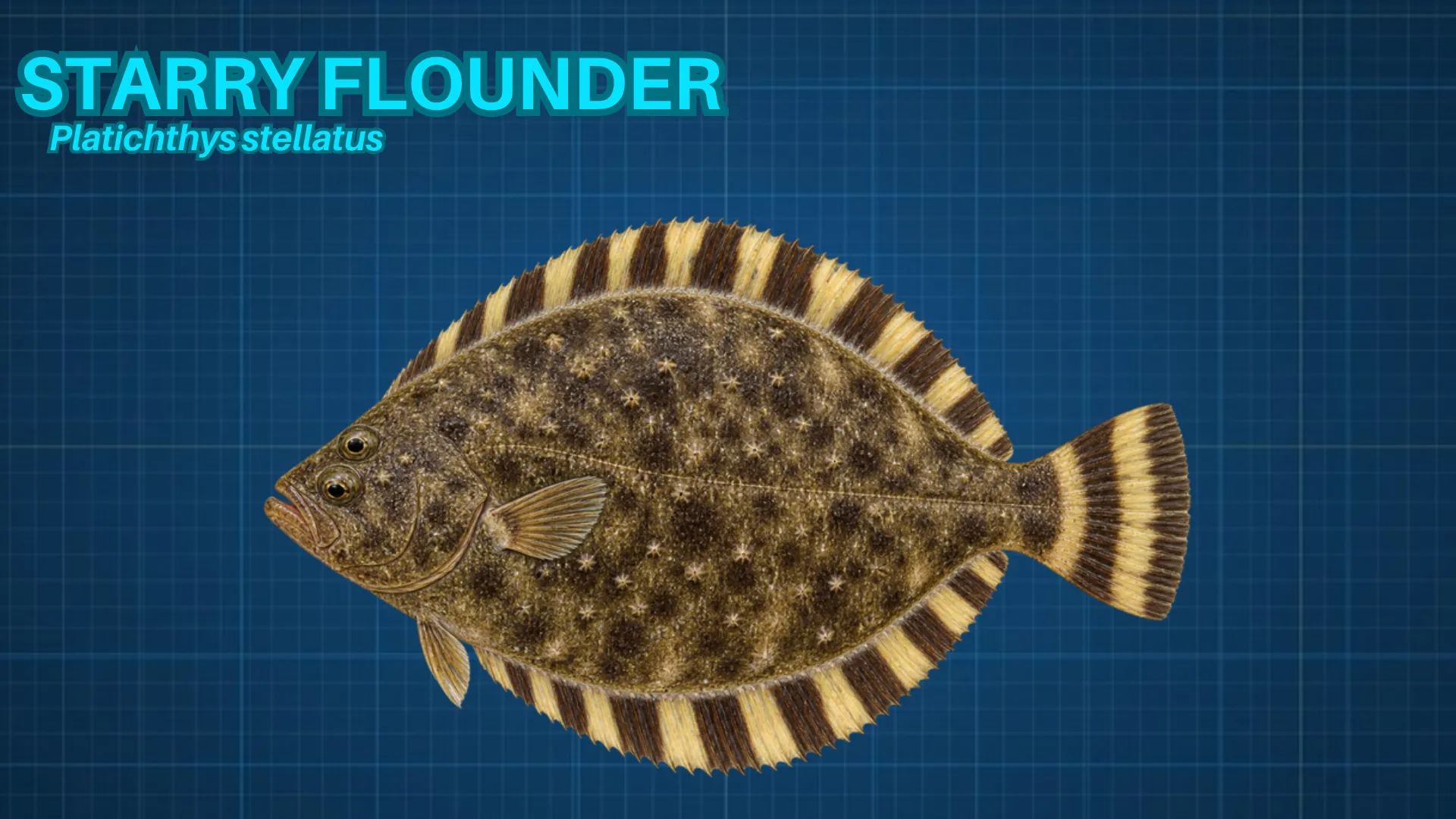
Also calledroughjacket, emery flounder, grindstone, leatherjacket, sand paper flounder, swamp flounder
 Spearfishing

Spearfishing Stats
Southern California north to the Arctic; uncommon south of Point Conception, scarce in California since the late 1980s.
Taxonomy
Rarity
Abundance rates how many are in suitable habitat. Find difficulty rates how hard it is to locate one on a daylight snorkel or freedive through 50 ft. A higher find score means a harder search. The rarity category also reflects the kind of encounter; it is not an average of the 2 scores.
Regulations
CDFW rules verified 2026-10-13
Seasonality
Edibility
White flatfish meat, though Ken Jones finds the flavor of some fish only fair.
Location
The starry flounder's range stretches across the North Pacific. It lives from Korea and Japan north through the Bering Sea to the Arctic coasts of Alaska and Canada, and south along North America to Southern California. Ken Jones gives Los Angeles Harbor as its southern limit.
It is a coastal fish of sand and mud, and it avoids rock. The 2001 report notes that it is recorded to about 900 feet but is much more common in shallow water, and that in bays and estuaries it is often one of the commonest fish. It handles brackish and even fresh water, and young and adult fish travel up rivers. Ken Jones reports that it gathers around the mouths of streams and rivers from December to March, and lists piers from Cayucos and San Simeon north to Crescent City as the best places to find one.
Spearfishing Brief
The starry flounder rates a 4 overall, and almost all of that is the search.
Finding one rates a 4. The 2001 report calls it very good at taking on the color of the bottom it rests on, and it is scarce in California waters to begin with, which is why abundance rates a 2. The best odds are on sand and mud in bays, estuaries and the shallow water near river mouths, especially in winter and early spring. North of California, in the bays of Oregon and Washington, it is far more common.
The shot rates a 1. A flatfish holding still on the bottom gives a diver a close, easy target, and a pole spear or a short speargun covers the distance. The state's own regulations booklet shows that divers do take them: the cover of the 2026 edition shows Toan Nguyen with his state diving record starry flounder, taken at Pacifica State Beach.
California's rules are simple. There is no bag limit and no size limit, and the season is open all year at every depth. Because the starry flounder is a federal groundfish, it may never be taken in the Groundfish Exclusion Areas, and the state can change its rules during the season. Take is prohibited in state marine reserves, and north of Ventura County spears may not be used within 100 yards of a stream mouth, which matters for a fish that gathers near river mouths. Oregon counts it toward a limit of 25 flatfish in aggregate and allows spears. Washington counts it as a flatfish within its bottomfish limits, which differ by marine area.
On the table, Ken Jones calls it generally good, though some fish have only a fair flavor, and says it is best fried or baked. He also warns that fish from heavily polluted areas may be unsafe to eat.
Deep Dive
The 2001 report calls the starry flounder probably the easiest California flatfish to recognize. Its dorsal and anal fins carry bold bars of black alternating with yellow or orange, and its skin is rough with scattered star-shaped scales. Those scales give it the name starry and the nickname roughjacket, and Ken Jones lists many more, including emery flounder, grindstone and sand paper flounder.
Its eyes can sit on either side. The family is called the righteye flounders, but the 2001 report says California starry flounder are split about evenly between left-eyed and right-eyed fish, while those off Japan are nearly all left-eyed. Ken Jones notes that nobody knows whether the difference comes from genes or the environment.
It grows big. The 2001 report gives a maximum of 36 inches. Ken Jones reports that the California record weighed 11 pounds 4 ounces, caught at San Simeon in 1993, and the world record listed by the International Game Fish Association weighed 10 pounds 9 ounces, caught at Bolinas in 2007. FishBase gives a maximum age of 42 years. In central California, the 2001 report says, most males mature at 2 years old and about 14.5 inches, and most females at 3 years and about 16 inches. Females grow faster and larger.
Its diet changes as it grows. Young fish eat tiny crustaceans. By about 5 inches the jaws and teeth can crush small clams and pull worms from their burrows, and fish of 10 to 12 inches nip the siphons off clams too big to swallow. Larger fish add crabs, sand dollars, brittle stars and other fish. Herons, cormorants and harbor seals eat the young in estuaries.
Most spawning happens in winter, in shallow water near river and estuary mouths. A 27-inch female may carry about 11 million eggs, which float near the surface. In laboratory tests they hatched in 2.8 to 4.5 days, faster in warmer water. The young settle as fish less than half an inch long, often in low-salinity water inside estuaries. The 2001 report adds that fish are sometimes caught that look halfway between a starry flounder and an English sole, and may be hybrids of the 2.
Where to Find Them
Researched habitat and range candidates
Los Angeles · 4 beaches
Channel Islands · 4 beaches
Ventura · 4 beaches
Santa Barbara · 3 beaches
San Luis Obispo · 4 beaches
Monterey · 1 beach
Oregon North Coast · 1 beach
Hood Canal · 4 beaches
Central Sound · 7 beaches
North Sound · 4 beaches
San Juan Islands · 1 beach
Strait of Juan de Fuca · 1 beach
Cape Flattery · 1 beach
These locations have suitable habitat within the species range. An assignment is a possible encounter, not a confirmed sighting at every beach. Season, depth, and local conditions still matter. Historical habitat without present-day evidence is excluded.