
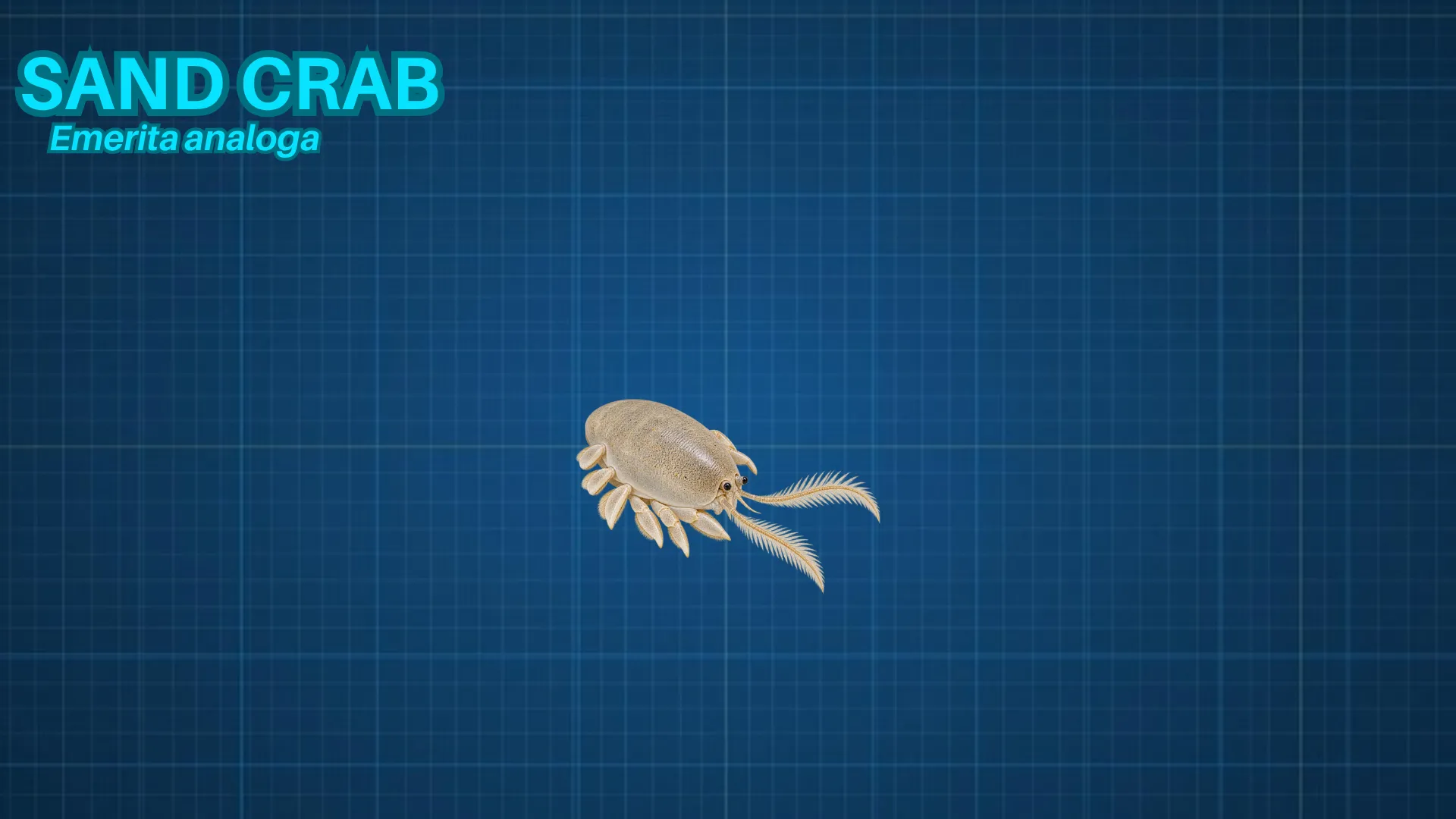
Also calledPacific mole crab, mole crab, Pacific sand crab


Taxonomy
Rarity
Abundance rates how many are in suitable habitat. Find difficulty rates how hard it is to locate one on a daylight snorkel or freedive through 50 ft. A higher find score means a harder search. The rarity category also reflects the kind of encounter; it is not an average of the 2 scores.
Regulations
CDFW rules verified 2026-10-13
Seasonality
Edibility
Location
The Monterey Bay Aquarium gives the range as Kodiak Island, Alaska, to Magdalena Bay in Baja California, and LiMPETS adds a second population in South America, from Ecuador to Argentina. Walla Walla University's guide to Pacific Northwest invertebrates notes that the crab is rarely found north of Oregon, and appears on Washington beaches mainly after warm El Nino years.
It lives only in the swash zone, the strip of a sandy beach that each wave washes over and leaves behind. LiMPETS calls this an especially harsh place on the beach to live, because of the crashing waves and constantly shifting sand. The Walla Walla guide adds that the crab prefers clean sand without pebbles or stones.
Harvest Brief
Kodiak Island (rarely north of Oregon) to Magdalena Bay, Baja California.
Finding sand crabs rates a 2. They sit just under the surface where waves wash up the beach. The Walla Walla guide describes how to spot them: a crab pops up in shallow water behind an advancing wave, and its feeding antennae leave a small V-shaped wake in the retreating water. LiMPETS notes that they live in clusters, so searchers look for a patch. Females tend to sit lower on the beach than males and young crabs.
California allows 50 sand crabs per person per day, with no size limit and no closed season. Crabs are among the few animals that may be taken on the shore between the high-tide line and 1,000 feet beyond low tide, but no invertebrate may be taken in a state marine reserve, and other protected areas may close their beaches. The only tools allowed are hand-operated spades, shovels, hoes, forks, rakes, slurp or clam guns and rigid pipes. A pump or any other device that liquefies sand is illegal.
Sand crabs are best known as bait. The Monterey Bay Aquarium reports that barred surfperch eat so many that sand crabs make up about 92 percent of their diet, which is why surf fishermen use them. LiMPETS lists California corbina as another fish that eats them.
Deep Dive
The sand crab looks little like most crabs. The Monterey Bay Aquarium describes a gray, curved, heavily armored shell about the size of a thumb, with no claws on the first pair of legs. LiMPETS gives a maximum of about 1.4 inches long and 1 inch wide, with females growing larger than males. The Walla Walla guide describes the egg-shaped body and the flattened legs used for digging, and notes that the last, slender pair of legs is used to clean the gills.
It moves only backward. The aquarium explains that a sand crab burrows tail first into the sand facing the sea, leaving only its eyes and a first pair of antennae showing, which LiMPETS notes it uses for breathing. When a wave runs back down the beach, the crab uncoils a second pair of feathery antennae and sweeps them through the water to strain out plankton, mostly tiny dinoflagellates, and it can do this several times in a single wave. The Walla Walla guide describes a crab popping up to ride a wave a few feet, then digging back in, so that it moves up and down the beach with the tide. The aquarium adds that if a crab is knocked loose, it can swim or tread water by beating its back legs, which is unusual for a crustacean.
Reproduction is fast. LiMPETS reports that from February to October a female can produce a clutch of up to 50,000 eggs a month, carried under her tail for about 30 days. The larvae drift as plankton for 4 to 5 months, passing through 8 to 11 stages, and may travel far offshore before currents bring them back to settle on a beach. The aquarium reports that sand crabs can breed in their first year and may not live more than 2 or 3 years.
Many animals depend on them. LiMPETS lists sanderlings, godwits, black-bellied plovers, willets, curlews and surf scoters among the birds that eat them, along with sea otters, and notes that sand crabs carry spiny-headed worms, parasites that pass to these predators and can kill them. The aquarium adds that because sand crabs filter the water, the amount of domoic acid, a natural algal toxin, in their flesh can show how much is in the water. It also notes that laboratories use sand crabs in studies of the nervous system, because their tails hold the largest sensory neurons found in any animal.
Where to Find Them
Researched habitat and range candidates
San Diego · 16 beaches
Orange County · 11 beaches
Catalina Island · 2 beaches
Los Angeles · 16 beaches
Channel Islands · 7 beaches
Ventura · 22 beaches
Santa Barbara · 19 beaches
San Luis Obispo · 13 beaches
Monterey · 7 beaches
Oregon South Coast · 10 beaches
Oregon Central Coast · 7 beaches
Oregon North Coast · 4 beaches
South Sound · 2 beaches
Central Sound · 1 beach
These locations have suitable habitat within the species range. An assignment is a possible encounter, not a confirmed sighting at every beach. Season, depth, and local conditions still matter. Historical habitat without present-day evidence is excluded.