
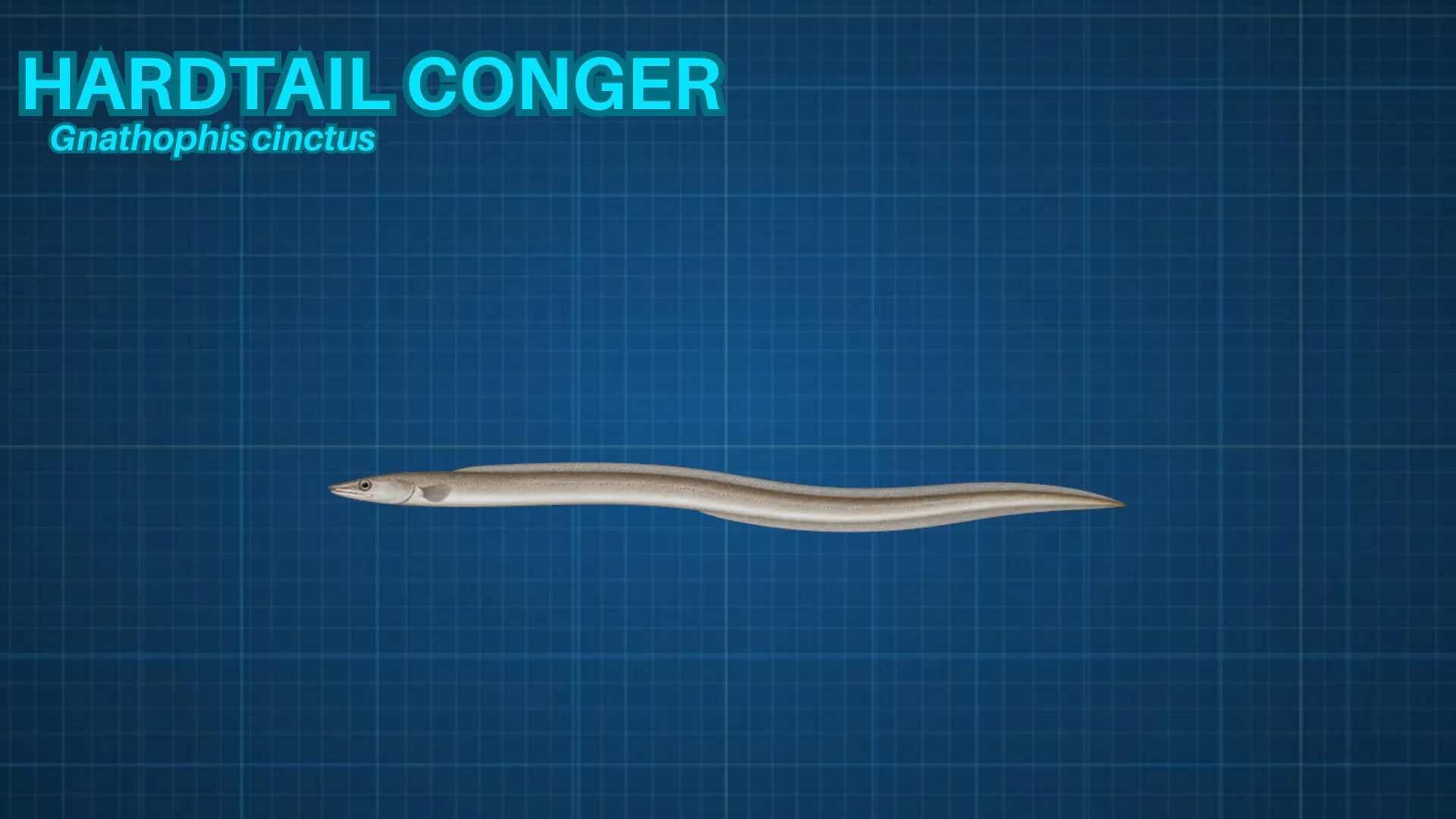
Also calledCatalina conger

Taxonomy
Rarity
Abundance rates how many are in suitable habitat. Find difficulty rates how hard it is to locate one on a daylight snorkel or freedive through 50 ft. A higher find score means a harder search. The rarity category also reflects the kind of encounter; it is not an average of the 2 scores.
Seasonality
Location
The 2021 checklist of the region's fishes by Milton Love and colleagues gives its range as Santa Rosa Island, one of the northern Channel Islands, south to Peru, including the Gulf of California and the Galapagos Islands. It records the species from about 30 to 1,200 feet. Some much deeper records exist, but the checklist explains that they come from midwater trawls and record only the deepest the net fished, so the fish may have been caught far shallower.
FishBase describes it as a soft-bottom fish that burrows into loose sand. Mexican Fish describes it buried in coastal sand.
Deep Dive
A conger is an eel, and congers share a family with the garden eels. The hardtail conger has well-developed pectoral fins, the small fins behind the head. It is long and narrow, a uniform pale gray-brown with a silvery midsection. Mexican Fish describes a pointed head with an overhanging snout and eyes that are large for the fish's size. The fins along its back and belly run together with the tail fin, and the tip of the tail is small and stiff, which gives the species its name. It grows to about 16.5 inches.
It is also called the Catalina conger. Mexican Fish names the needletail conger as the fish most easily confused with it, and the needletail has small, beady black eyes.
FishBase offers 2 details that hint at how it lives. Collectors have found it fairly resistant to the chemicals used to sample fish. And bottom-feeding predators eat conger eels they catch in the open. Its diet, breeding season and lifespan are not covered in the sources reviewed for this page.
California sets no rule specific to the species, so it counts toward the general bag limit: no more than 10 per person per day, as part of a total of 20 finfish, with no size limit and no closed season. Take is prohibited inside state marine reserves.
Where to Find Them
Researched habitat and range candidates
San Diego · 3 beaches
Orange County · 1 beach
Los Angeles · 2 beaches
Channel Islands · 2 beaches
These locations have suitable habitat within the species range. An assignment is a possible encounter, not a confirmed sighting at every beach. Season, depth, and local conditions still matter. Historical habitat without present-day evidence is excluded.