
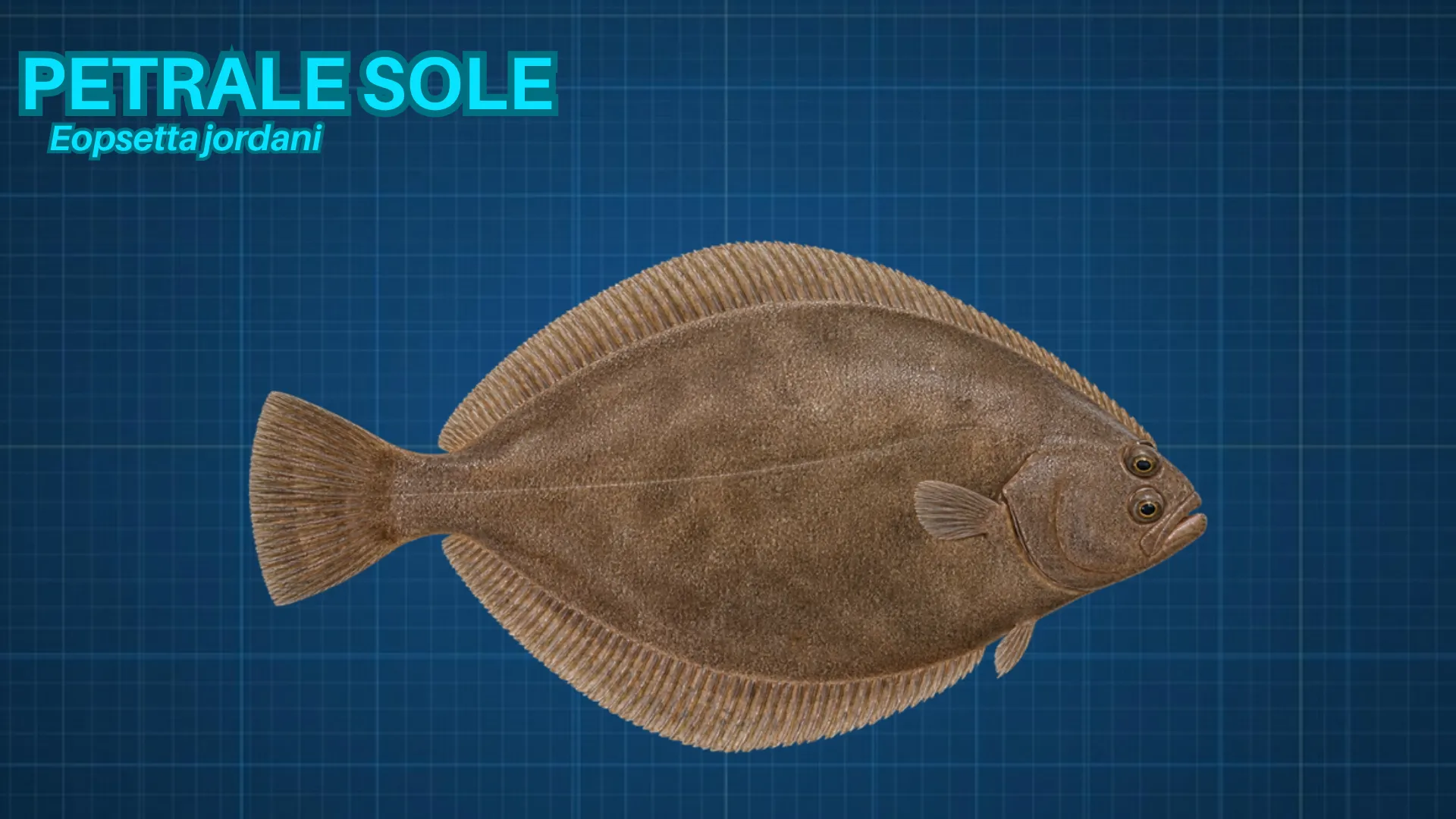
Also calledbrill, California sole, Jordan's flounder, cape sole, round nose sole
 Spearfishing
Spearfishing Stats
Alaska to the Coronado Islands, northern Baja California.
Taxonomy
Rarity
Abundance rates how many are in suitable habitat. Find difficulty rates how hard it is to locate one on a daylight snorkel or freedive through 50 ft. A higher find score means a harder search. The rarity category also reflects the kind of encounter; it is not an average of the 2 scores.
Regulations
CDFW rules verified 2026-10-13
Seasonality
Edibility
Fine-grained flatfish fillets from the fish FishBase calls the premium sole of the Pacific coast.
Location
Petrale sole live from Alaska to the Coronado Islands off northern Baja California. NOAA Fisheries notes that they are rare north and west of southeast Alaska. They live on sand and mud bottom, and the 2019 assessment describes them as a dominant fish of the middle and outer continental shelf off northern and central California.
They move with the seasons. The 2019 assessment reports that most catches come from about 230 to 720 feet deep from March through October, and from about 950 to 1,440 feet from November through February, when the fish gather at deep spawning sites. NOAA Fisheries describes the adults moving from deep water, where they spawn, to shallower water to feed in summer.
Spearfishing Brief
The petrale sole rates a 5 overall, and the search sets it.
Finding one rates a 5. NOAA Fisheries gives a depth range of about 50 to 1,370 feet, with most fish living 330 to 500 feet down, far below the reach of a breath-hold diver. No account of spearing petrale sole turned up in the research for this page, so these ratings are reasoned from the fish's depth and habits rather than taken from a published one.
The shot rates a 2. A flatfish lying on the bottom gives a close, slow target, and a pole spear or a short speargun suits it.
California sets no limit, no size limit and no closed season for petrale sole. It is a federal groundfish, so it may never be taken in the Groundfish Exclusion Areas, and the state can change its rules during the year. Take is prohibited in state marine reserves, and north of Ventura County spears may not be used within 100 yards of a stream mouth. Oregon counts it in a limit of 25 flatfish in aggregate and allows spears. Washington counts it as a flatfish within its bottomfish limits, which differ by marine area.
On the table it has a strong reputation. FishBase calls it generally regarded as the premium Pacific coast sole, and NOAA Fisheries describes a sweet, delicate, nutty flavor with a fine texture. FishBase lists steaming, frying and baking.
Deep Dive
The petrale sole is a righteye flounder, meaning both eyes sit on the right side of its body. NOAA Fisheries describes an oval to round body, uniform light to dark brown on the eyed side and white underneath, sometimes with traces of pink. It has a large mouth with 2 rows of small, arrow-shaped teeth in the upper jaw.
Females grow larger than males. NOAA Fisheries reports that females reach about 24 inches and males about 18 inches, and the 2019 assessment gives a maximum recorded length of about 27.5 inches. The fish can live to about 35 years, though NOAA Fisheries notes that recent data suggest few live past 17. They begin to spawn at 3 to 8 years old, at about 1 foot long.
A female releases her eggs into open water once a year, and a large one can produce about 1.5 million. The eggs drift and hatch in about 6 to 14 days, depending on the water temperature. NOAA Fisheries reports that the larvae spend their first 5 to 6 months up in the water column before they change into the flat adult form and settle to the bottom. Adults eat shrimp and other crustaceans, krill, small open-water fishes, brittle stars and even young petrale sole. Sharks, marine mammals and larger flatfishes eat them in turn.
The fishery is old. The 2019 assessment traces it to San Francisco Bay before 1876, when fishermen worked with hand lines and beach seines, and notes reports that petrale sole numbers fell by at least half between 1942 and 1947. FishBase adds that the livers of large fish are a rich source of vitamin A.
Where to Find Them
Researched habitat and range candidates
San Diego · 3 beaches
Orange County · 1 beach
Los Angeles · 3 beaches
Channel Islands · 4 beaches
Ventura · 1 beach
Santa Barbara · 1 beach
Central Sound · 1 beach
These locations have suitable habitat within the species range. An assignment is a possible encounter, not a confirmed sighting at every beach. Season, depth, and local conditions still matter. Historical habitat without present-day evidence is excluded.