
Also calledsinging fish, California singing fish, singing toadfish, humming toadfish




Taxonomy
Rarity
Abundance rates how many are in suitable habitat. Find difficulty rates how hard it is to locate one on a daylight snorkel or freedive through 50 ft. A higher find score means a harder search. The rarity category also reflects the kind of encounter; it is not an average of the 2 scores.
Seasonality
Location
The midshipman ranges from Sitka, Alaska to Magdalena Bay in Baja California. FishBase describes 2 separate populations, 1 from Oregon north and 1 from San Francisco south, and the Oregon Coast Aquarium notes that the fish is absent from the Oregon coast between them.
Most of the year it lives on sand and mud bottom, as deep as about 1,200 feet, and makes vertical migrations at night to feed. In late spring and summer it moves into shallow water to breed. The males build nests under rocks and boulders in the intertidal zone and burrow into the mud of bays and estuaries. A falling tide can leave a nesting male stranded under its rock or even fully out of the water. FishBase reports that the adults can breathe air, and the Oregon Coast Aquarium says they can survive out of water for up to 8 hours as long as they stay moist.
Deep Dive
The fish is named for its lights. A midshipman is a junior naval officer, and Mexican Fish explains that the rows of glowing spots on the fish, called photophores, sit where the buttons sit on a midshipman's uniform. A single fish carries more than 700 of them. The Oregon Coast Aquarium reports that they give off a blue-green light that helps the fish blend into the bright water above when seen from below. Midshipmen in California glow, but those in Puget Sound do not, because the chemical the light needs comes from a tiny planktonic crustacean, an ostracod, that does not live there.
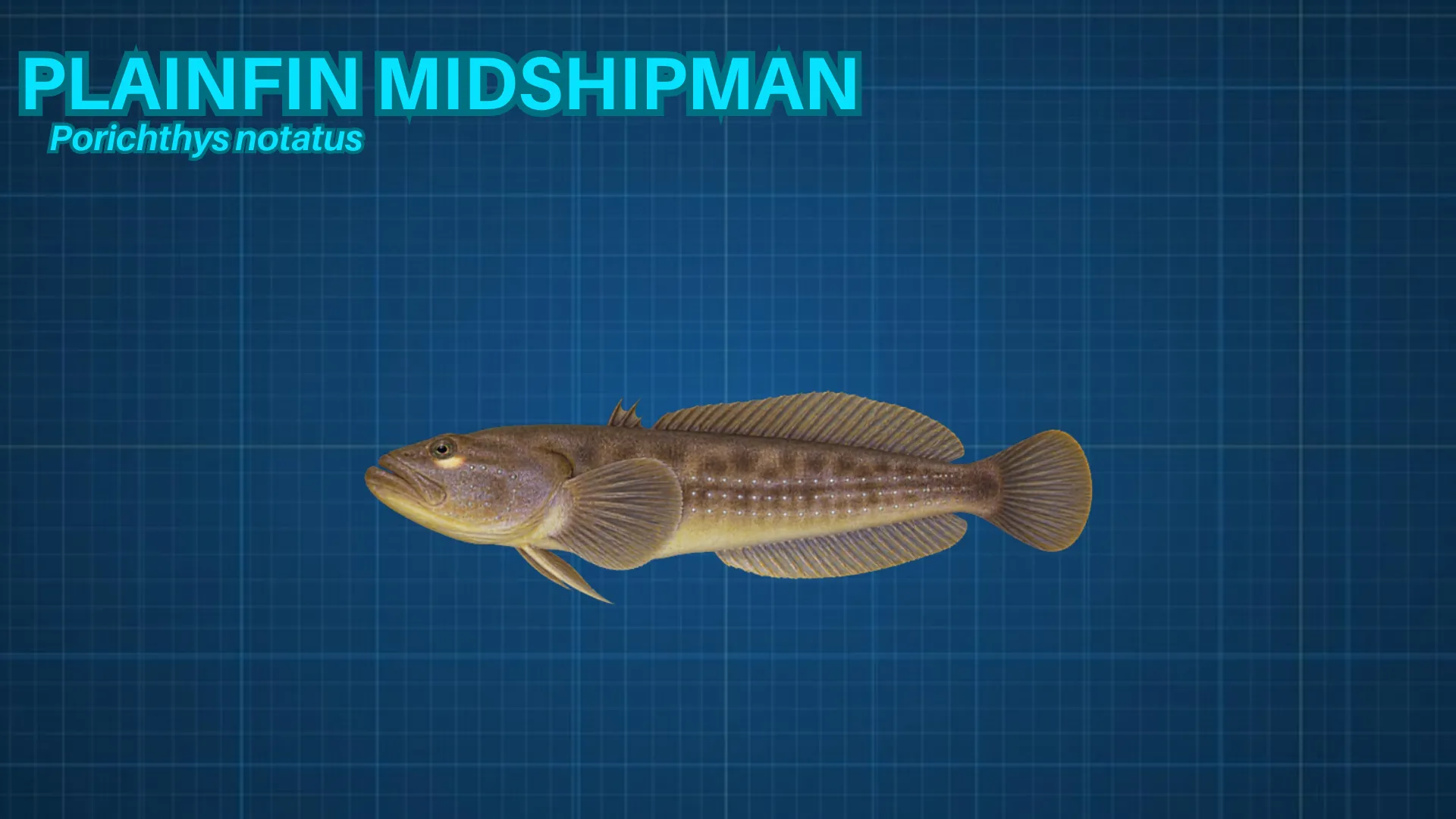
It is a toadfish, with a large, flat head, eyes on top, and an upturned mouth full of sharp teeth. Each gill cover carries a sharp spine, which Mexican Fish describes as not venomous. The skin has no scales. FishBase describes the back as olive brown to bronze or dark iridescent purple, fading to golden yellow underneath, with a white patch under the eye and a black crescent below it. It grows to about 15 inches, and the Oregon Coast Aquarium reports that it lives at least 5 years.
The midshipman is best known for its song. There are 2 kinds of males. The large Type I males dig and guard the nests and make 3 sounds: a hum to attract females, a grunt to warn off intruders, and a growl. Starting soon after dark, a nesting male can hum for as long as 14 minutes. The much smaller Type II males build no nests. They slip into a Type I male's nest to fertilize eggs, and like the females, they can only growl. The sound comes from muscles that vibrate the swim bladder, the gas-filled sac inside the fish.
The Oregon Coast Aquarium describes what happens at the nest. A female drawn in by the hum spends up to 20 hours laying 70 to 200 sticky eggs on the roof of the nest, the male fertilizes them, and then he chases her out and starts humming again. A single nest can hold up to 2,000 eggs from many females. The male stays to brush and fan the eggs, and at low tide, when the nest is out of the water, he splashes them to keep them wet. The eggs hatch after 40 to 45 days, and the young stay attached to the rock for weeks before they swim off.
That humming once kept a town awake. In 1985 The Christian Science Monitor reported that houseboat residents in Sausalito, across the bay from San Francisco, had complained about a nighttime drone coming through the concrete hulls of their boats, likened to a B-29 bomber or a giant electric shaver. John McCosker, director of the Steinhart Aquarium, and Thomas Niesen, a marine biology professor at San Francisco State University, pointed to the most likely source: male plainfin midshipmen calling for mates from the mud of the bay. Mexican Fish notes that the fish later became the namesake of the Sausalito Humming Toadfish Festival.
Young midshipmen eat zooplankton and the larvae of small crustaceans. Adults eat crustaceans and fish, and the Oregon Coast Aquarium adds worms and squid.
Where to Find Them
Researched habitat and range candidates
San Diego · 6 beaches
Orange County · 3 beaches
Los Angeles · 7 beaches
Channel Islands · 5 beaches
Ventura · 4 beaches
Santa Barbara · 3 beaches
San Luis Obispo · 4 beaches
Monterey · 2 beaches
Oregon North Coast · 1 beach
Hood Canal · 4 beaches
Central Sound · 7 beaches
North Sound · 4 beaches
San Juan Islands · 1 beach
Strait of Juan de Fuca · 1 beach
Cape Flattery · 1 beach
These locations have suitable habitat within the species range. An assignment is a possible encounter, not a confirmed sighting at every beach. Season, depth, and local conditions still matter. Historical habitat without present-day evidence is excluded.