


Taxonomy
Rarity
Abundance rates how many are in suitable habitat. Find difficulty rates how hard it is to locate one on a daylight snorkel or freedive through 50 ft. A higher find score means a harder search. The rarity category also reflects the kind of encounter; it is not an average of the 2 scores.
Regulations
CDFW rules verified 2026-10-13
Seasonality
Edibility
Cleaning a Pismo clam means opening it and keeping only the white meat. The state Department of Fish and Game advises discarding all of the dark meat and the digestive organs, because Pismo clams have been linked to several deaths from paralytic shellfish poisoning.
Clean white meat with nothing left to trim once the dark parts are gone.
Location
The Department of Fish and Game gives the historic range as Half Moon Bay south to Socorro Island in Mexico, including Santa Cruz and Santa Rosa islands. The clam has not been found at Half Moon Bay for decades, and its range now reaches north only to Monterey Bay.
It lives on flat, sandy beaches of the open coast, from the intertidal out to about 80 feet, and now and then in the entrance channels of bays, sloughs and estuaries. Its siphons, the paired tubes it breathes and feeds through, are short, so it stays close to the surface. It seldom burrows deeper than 6 inches, though clams have been found 8 to 12 inches down in Southern California. A Pismo clam sits upright in the sand with its hinge toward the ocean.
Harvest Brief
Monterey Bay to Socorro Island; legal-size clams scarce on southern beaches (Bignami 2022).
The search is the hard part, and it rates a 4. The Department of Fish and Game describes how divers find the clams: by probing the sand with a knife, or by looking for exposed shells, siphons, or tufts of a small hydroid, a tiny animal related to jellyfish, that often grows on the shell. The tufts are about half an inch long and poke up above the sand. From the beach, clammers probe wet sand at low tide with a garden fork, or shuffle their bare feet along the bottom until they feel a siphon or a shell.
Cleaning rates a 2. The department advises keeping only the white meat and discarding all of the dark meat and the digestive organs, because Pismo clams have been linked to several deaths from paralytic shellfish poisoning. The state's regulations booklet points clammers to the California Department of Public Health's shellfish advisories before they go.
California's rules are detailed. The limit is 10 clams per person per day. The minimum size is 4 and 1/2 inches across the shell south of the San Luis Obispo and Monterey county line and 5 inches north of it. Every clam must be measured right away, undersize clams must be reburied where they were found, and each person needs a measuring device and a separate container. Clams must stay whole and measurable until they are prepared to eat. Digging is allowed only from half an hour before sunrise to half an hour after sunset. In Santa Cruz and Monterey counties the season runs September 1 through April 30, and everywhere else it is open all year. Clams may not be taken in state marine reserves or other marine protected areas that prohibit it. The allowed tools are hands, spades, shovels, hoes, forks, rakes, slurp guns and rigid pipes, and any pump or device that liquefies sand is illegal. Scuba divers may take clams south of Yankee Point in Monterey County, but north of it scuba may be used only for sea urchins, rock scallops and Cancer crabs.
A legal clam is an old one. The department reports that a 4 and 1/2 inch clam may be 5 to 9 years old, and that at Pismo Beach the clams reach that size between 7 and 8 years of age. The rules aim to let clams spawn several times before anyone can keep them. On the table, the department calls the flavor distinctive and excellent, and lists chowder, seafood cocktail, frying and eating raw.
Deep Dive
The Pismo clam has a long history with people. The Department of Fish and Game reports that its shells turn up in ice age deposits 25,000 years old and in Native American shell heaps 200 to 2,000 years old, where people ate the clams and used the shells for digging, scraping and ornaments. The name Pismo comes from a Native American word, pismu, meaning tar, after the natural tar deposits around Pismo Beach.
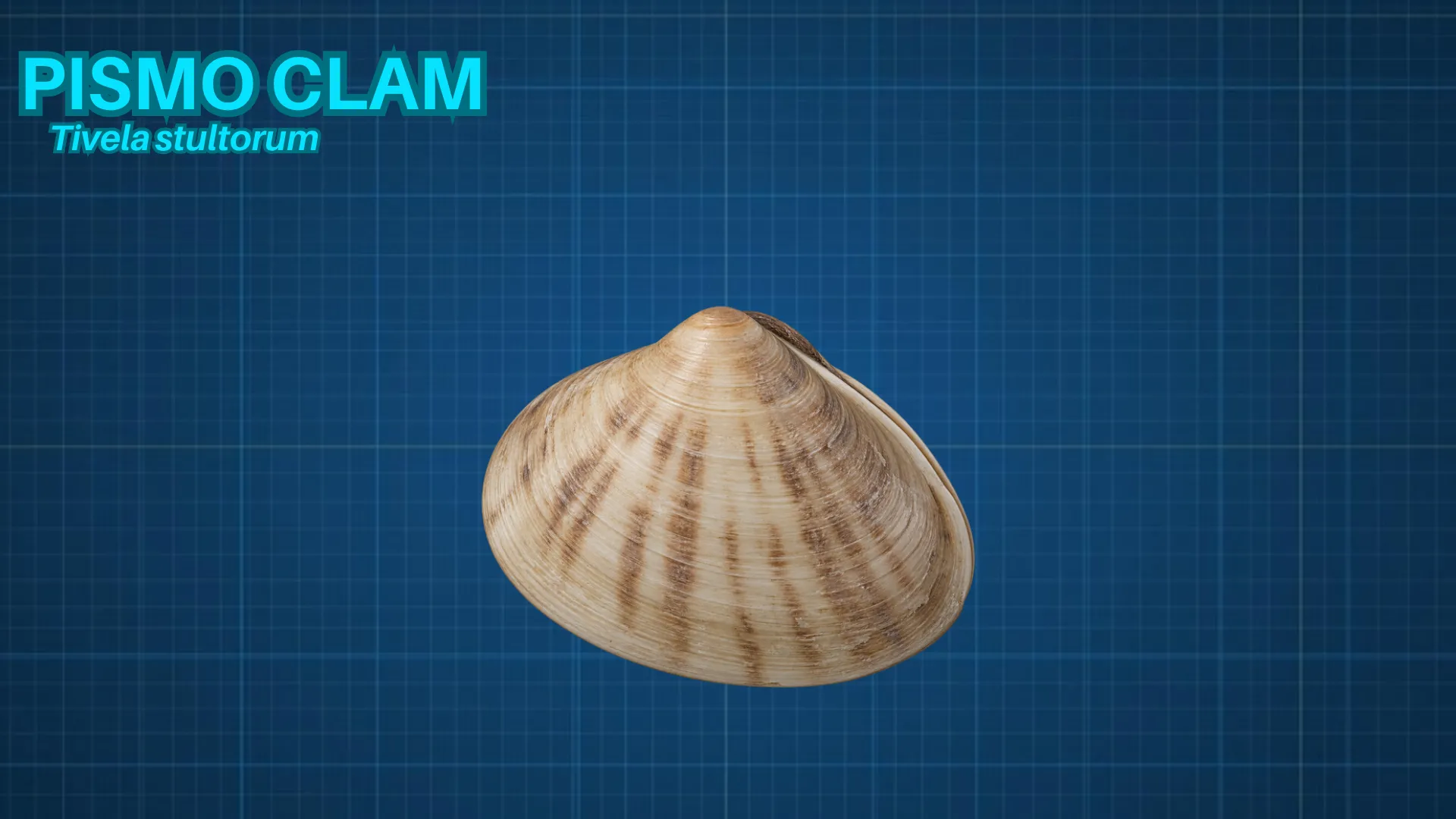
The shell is thick, heavy and strong, smooth on the outside with fine growth lines, and white inside. A varnish-like outer layer is usually yellowish, tan or greenish. Colors range from pale beige to brown, and some shells carry brown stripes running from the hinge to the edge.
The clam grows its whole life. The department reports that young clams add about 0.84 inches of shell a year for their first 3 years, growing fastest in spring, summer and early fall, and that by age 10 they add no more than about 0.2 inches a year. A winter growth ring forms most years in California. The largest Pismo clam reported in California measured 7.32 inches and was estimated at 23 years old, and the oldest was estimated at 53 years.
A Pismo clam digs by pushing its foot down into the sand, then jetting water to loosen the sand around the shell while the foot pulls it under. It feeds by pumping water across its gills and straining out plankton, bacteria and bits of decaying plants and animals. The department reports that a feeding 3-inch clam filters as much as 15 gallons of water a day, and that half of what fills its stomach is sand.
Most clams are either male or female, in equal numbers, and they release eggs and sperm into the water. A female carries 10 to 20 million eggs, about 15 million at 5 inches across. The larvae settle to the bottom and hold on to sand grains with fine threads for several months until they can stay in place on their own. Some years almost no young clams settle on the beaches, and the department links that to ocean conditions such as water temperature and currents.
Many animals eat them. The department lists moon snails, rock crabs, sharks, rays, gulls, sea otters, people and surf fishes such as the California corbina. Small pea crabs sometimes live inside the shell and pick food from the clam's gills.
Where to Find Them
Researched habitat and range candidates
San Diego · 16 beaches
Orange County · 11 beaches
Catalina Island · 2 beaches
Los Angeles · 16 beaches
Channel Islands · 7 beaches
Ventura · 22 beaches
Santa Barbara · 19 beaches
San Luis Obispo · 13 beaches
Monterey · 7 beaches
These locations have suitable habitat within the species range. An assignment is a possible encounter, not a confirmed sighting at every beach. Season, depth, and local conditions still matter. Historical habitat without present-day evidence is excluded.