
Also calledXantus swimcrab
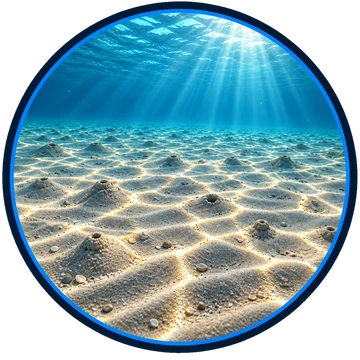

Photo: Allison Wylot, Marine Room, La Jolla
Taxonomy
Rarity
Abundance rates how many are in suitable habitat. Find difficulty rates how hard it is to locate one on a daylight snorkel or freedive through 50 ft. A higher find score means a harder search. The rarity category also reflects the kind of encounter; it is not an average of the 2 scores.
Seasonality
Location
The species ranges from Southern California south along Baja California to Cape San Lucas, and into the Gulf of California. A 1961 survey of Pacific crabs by the biologist John Garth gives Santa Barbara as the northern end of the range. The Monterey Bay National Marine Sanctuary reported in 2016 that the crab had previously been seen no farther north than Morro Bay, San Luis Obispo County. It lives from the low intertidal zone, the strip of shore uncovered only at the lowest tides, down to about 590 feet.
Its home is soft bottom. The sanctuary describes its habitat as sand and mud, such as eelgrass beds and mudflats, and SeaLifeBase adds estuaries, the places where river water mixes with the sea. On that bottom the crab digs itself in backward. It uses its last pair of legs, which are flattened into paddles, both to dig and to swim quickly away from danger.
The crab does not stay on the bottom all the time. Garth examined 10 crabs from the San Benito Islands, off the Pacific coast of Baja California, that were caught in 1937 under a light hung over the water at night. A 2025 environmental report for Alamitos Bay in Long Beach lists swimming crabs among the invertebrates of the bay's open water.
Deep Dive
Xantus' swimming crab has a broad shell with a long, sharp spine sticking out on each side at its widest point. A second prominent spine sits on the wrist of each claw arm, according to the Monterey Bay sanctuary. The claws are long. The last pair of legs ends in flat, rounded paddles. Seen from the front, the crab looks like the blue crab of the Atlantic and Gulf coasts, a likeness that both the state wildlife department and Jackie Sones, a naturalist at the Bodega Marine Laboratory, point out. SeaLifeBase gives its maximum shell width as about 3 inches.
Its color varies widely. Field notes by the naturalist Jocelyn Crane, published by Garth, describe crabs ranging from gray speckled with black and white, like salt and pepper, to pink speckled animals with a raspberry red patch in the middle of the shell. Some had a black ring along the front edge of the shell. Another carried a brown Y on its back, running from the eyes to the rear edge, with rosy pink between the forks. The dullest crab also had pinkish tips on its legs and claws, and walking legs banded white and brown. Sones described the crabs found in Tomales Bay in 2016 as purple.
The crab has changed scientific names. A 2018 genetic study of the swimming crabs of the Americas found that the genus it had long been filed under was not a single natural group of close relatives. The World Register of Marine Species now places the crab in a revived genus. Older guides and most published records still use the earlier name.
The species drew attention in 2016, when it turned up far north of its known range. In June 2016 divers found one in 15 feet of water in Monterey Harbor, and the crustacean specialist Greg Jensen identified it. The sanctuary reported that it was seen in a threatening display stance. That August, researchers trapping crabs for a study in Tomales Bay, Marin County, found 4.
A 2018 study in the journal Marine Ecology, led by Jason Sadowski, found the crab that year in every major estuary north of Monterey Bay, as far north as Tomales Bay. Water temperatures in the region had run about 3.6°F above their 2006 to 2013 average from 2014 to 2016. Crab trapping in the region since 1994 had never turned one up, so the authors concluded the species had not been there before. They linked the spread to the warm water, which likely let larvae drift north on currents and survive long enough to grow into crabs. They also suggested that warmer water inside the estuaries may let adults hang on. Nothing consulted for this page shows whether the northern crabs have lasted.
Much of this crab's basic biology is unstudied. Nothing consulted for this page describes what it eats, which animals eat it, when it breeds or how long it lives.
Where to Find Them
Researched habitat and range candidates
San Diego · 6 beaches
Orange County · 2 beaches
Los Angeles · 4 beaches
Ventura · 4 beaches
These locations have suitable habitat within the species range. An assignment is a possible encounter, not a confirmed sighting at every beach. Season, depth, and local conditions still matter. Historical habitat without present-day evidence is excluded.