
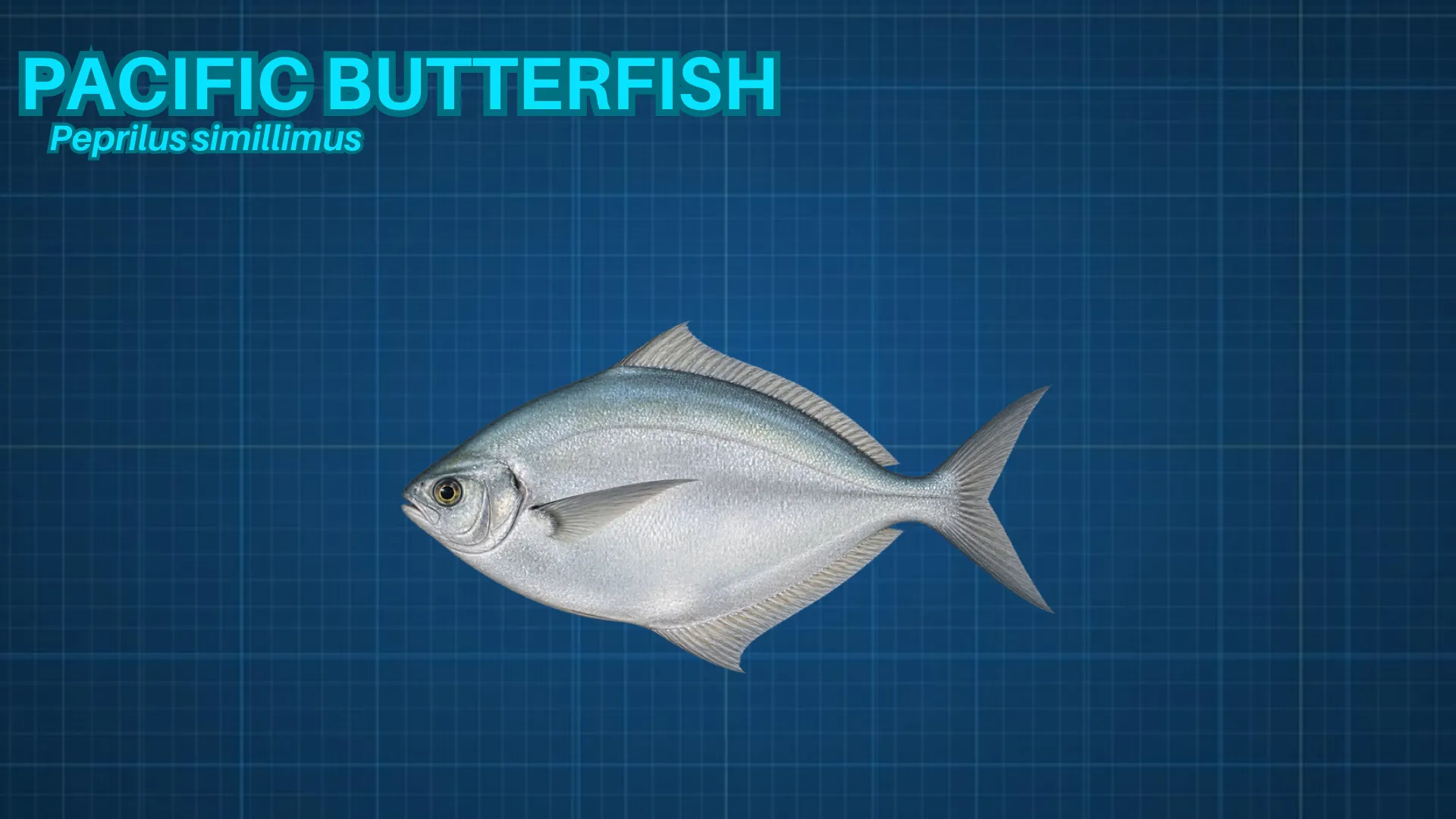
Also calledPacific pompano, California pompano, pompano, dollarfish
 Spearfishing


Spearfishing Stats
Haida Gwaii to Bahia Magdalena and the Gulf of California; common southern Baja to Vancouver Island (Ken Jones).
Taxonomy
Rarity
Abundance rates how many are in suitable habitat. Find difficulty rates how hard it is to locate one on a daylight snorkel or freedive through 50 ft. A higher find score means a harder search. The rarity category also reflects the kind of encounter; it is not an average of the 2 scores.
Regulations
CDFW rules verified 2026-10-15
Seasonality
Edibility
Most are under 8 inches, and only the largest fish carry enough meat to be worth cleaning, so it is usually cooked whole.
Location
FishBase gives the range as Queen Charlotte Sound in British Columbia to southern Baja California Sur and the Gulf of California, and Jones extends it north to Haida Gwaii. He describes it as common from southern Baja California to Vancouver Island. FishBase places it over sand on exposed coasts, usually in shallow water near shore, and gives a depth range of about 30 to 300 feet. Jones reports it from the surf zone to a recorded 991 feet.
The best piers for it, in Jones's experience, are on sandy shores from Imperial Beach to Pacifica. He has caught the most at the Ocean Beach, Seal Beach and Belmont Veterans Memorial piers. It is an infrequent catch from the beach and, as an inshore fish, is rarely taken from boats.
Spearfishing Brief
Finding a Pacific butterfish rates a 4. FishBase reports that it often travels in small but fairly dense schools, and Jones notes that it often schools together with perch. He adds that it often bites at mid-depth, as silver surfperch do. Hitting one rates a 3, because it is small. Jones reports a maximum of about 14 inches, but most fish caught from piers are under 8 inches.
California sets no bag limit, no size limit and no season for Pacific butterfish, though take is prohibited in state marine reserves. Oregon counts it under its general marine species rules, with bag limits set after the printed regulations come out.
The fish is valued for the table. Jones describes it as flavorful, with small flakes and a soft texture, and says its flesh has a moderate to high fat content, which gave it the name butterfish. He recommends pan-frying it whole, because only the largest fish have enough meat to be worth filleting, and notes that some people smoke it whole.
Deep Dive
The Pacific butterfish has a very deep, flat body shaped somewhat like a perch, with very long dorsal and anal fins and no pelvic fins at all. FishBase describes it as brilliantly iridescent, green or blue above and silvery below, with dusky fins. In Mexico, Jones notes, it is called palometa plateada.
It was once a prized market fish in California, sold under the name pompano. Jones quotes the Los Angeles Herald of January 1, 1893, which called the pompano the rarest and most expensive fish on the coast, at $1 per pound. He also quotes a 1908 Herald report of an unusually fine run of pompano at Playa del Rey, where nearly every foot of the wharf was taken by anglers. A state Fish and Game bulletin on the 1935 commercial catch called it the highest priced market fish in California and noted that it was not caught in any great abundance.
The young fish have an unusual partner. Jones describes how juvenile butterfish live with the black sea nettle, a large jellyfish whose bell can reach almost 3 feet across, during its occasional blooms in San Diego Bay. The young fish feed on plankton the jellyfish gathers, and when danger approaches, they hide inside its bell.
Where to Find Them
Researched habitat and range candidates
San Diego · 17 beaches
Orange County · 11 beaches
Catalina Island · 2 beaches
Los Angeles · 16 beaches
Channel Islands · 7 beaches
Ventura · 23 beaches
Santa Barbara · 19 beaches
San Luis Obispo · 16 beaches
Monterey · 7 beaches
Oregon South Coast · 10 beaches
Oregon Central Coast · 7 beaches
Oregon North Coast · 4 beaches
South Sound · 2 beaches
Central Sound · 1 beach
These locations have suitable habitat within the species range. An assignment is a possible encounter, not a confirmed sighting at every beach. Season, depth, and local conditions still matter. Historical habitat without present-day evidence is excluded.