
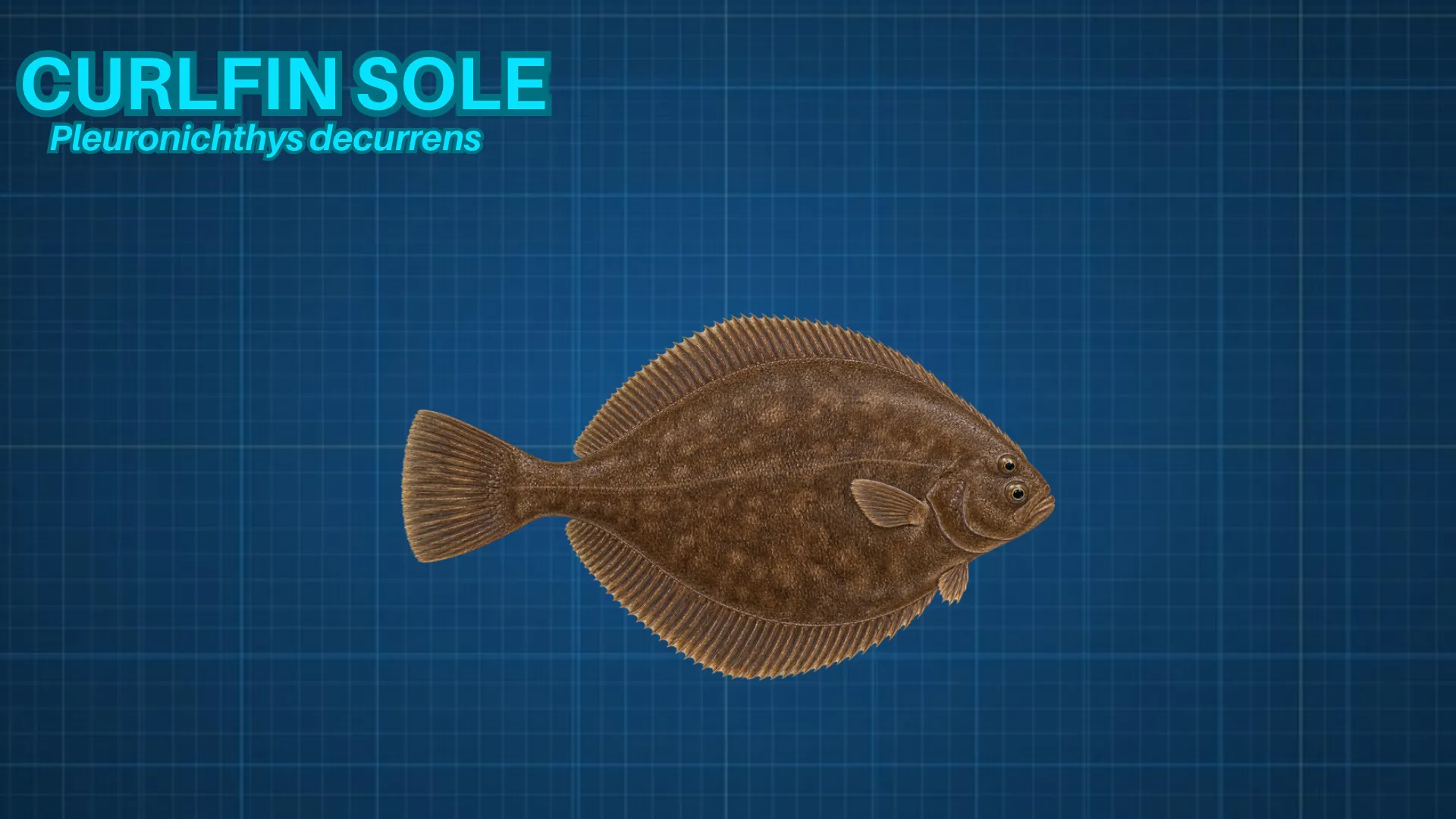
Also calledcurlfin turbot
 Spearfishing
Spearfishing Stats
Bering Sea to San Quintin Bay, Baja California.
Taxonomy
Rarity
Abundance rates how many are in suitable habitat. Find difficulty rates how hard it is to locate one on a daylight snorkel or freedive through 50 ft. A higher find score means a harder search. The rarity category also reflects the kind of encounter; it is not an average of the 2 scores.
Regulations
CDFW rules verified 2026-10-17
Seasonality
Edibility
Location
The Washington Department of Fish and Wildlife gives the range as the Bering Sea south to San Quintin Bay in Baja California, on soft bottom from about 26 to 1,740 feet, most often shallower than about 300 feet. FishBase starts its usual depth at about 66 feet, and the Oregon Department of Fish and Wildlife describes the fish as usually shallow. That puts the top of its range inside diving depth, though most of the population sits deeper.
Spearfishing Brief
California counts the curlfin sole as a federal groundfish in its "other flatfish" group. It is open all year at all depths, except in the Groundfish Exclusion Areas, and falls under the general limit of 20 finfish, with no more than 10 of any 1 species, and no size limit. The state can change the rules during the year. Take is prohibited in state marine reserves, and north of Ventura County spears may not be used within 100 yards of a stream mouth. Oregon counts it in a limit of 25 flatfish in aggregate and allows spears. Washington counts it among its bottomfish, under limits that differ by marine area.
Finding one rates a 4, because it usually sits deeper than about 66 feet and is small. Taking one that has been found rates a 2, since it lies still on the bottom. No source reviewed for this page describes its quality as food.
Deep Dive
The curlfin sole is a right-eyed flatfish with a deep oval body, reaching about 15 inches and 1.7 pounds. The Washington Department of Fish and Wildlife describes the eyed side as yellowish or reddish brown to dark brown or black, usually mottled with brown or gray. Between the eyes runs a high bony ridge with a knob or blunt spine at each end. It shares its genus with the spotted, hornyhead and C-O turbots on this coast, and the agency notes that the spotted and hornyhead turbots look similar but differ in the way the front of the top fin begins.
FishBase lists its food as brittle stars and nudibranchs, the soft-bodied sea slugs.
Where to Find Them
Researched habitat and range candidates
San Diego · 3 beaches
Orange County · 1 beach
Los Angeles · 3 beaches
Channel Islands · 4 beaches
Ventura · 1 beach
Santa Barbara · 1 beach
Central Sound · 1 beach
These locations have suitable habitat within the species range. An assignment is a possible encounter, not a confirmed sighting at every beach. Season, depth, and local conditions still matter. Historical habitat without present-day evidence is excluded.