
Also calledsoft flounder, Catalina sanddab

Taxonomy
Rarity
Abundance rates how many are in suitable habitat. Find difficulty rates how hard it is to locate one on a daylight snorkel or freedive through 50 ft. A higher find score means a harder search. The rarity category also reflects the kind of encounter; it is not an average of the 2 scores.
Seasonality
Location
The longfin sanddab ranges from Monterey Bay in Central California south to Costa Rica, including the Gulf of California. Ken Jones calls it common from southern Baja California to Southern California, and the 2001 report describes it as a warm-temperate to tropical species, unlike the Pacific and speckled sanddabs, which the report classes as temperate species. It lives on sand and sandy mud. The report records it from 7 to 660 feet, usually shallower than 450 feet, and other sources record it to 820 feet.
Most of that range is deeper than divers work. Ken Jones notes that it is usually found in deeper water and is rarely caught from shore. His best bets for catching one are Balboa Pier, Newport Pier, Redondo Beach Pier, Redondo Sportfishing Pier and Port Hueneme Pier.
Deep Dive
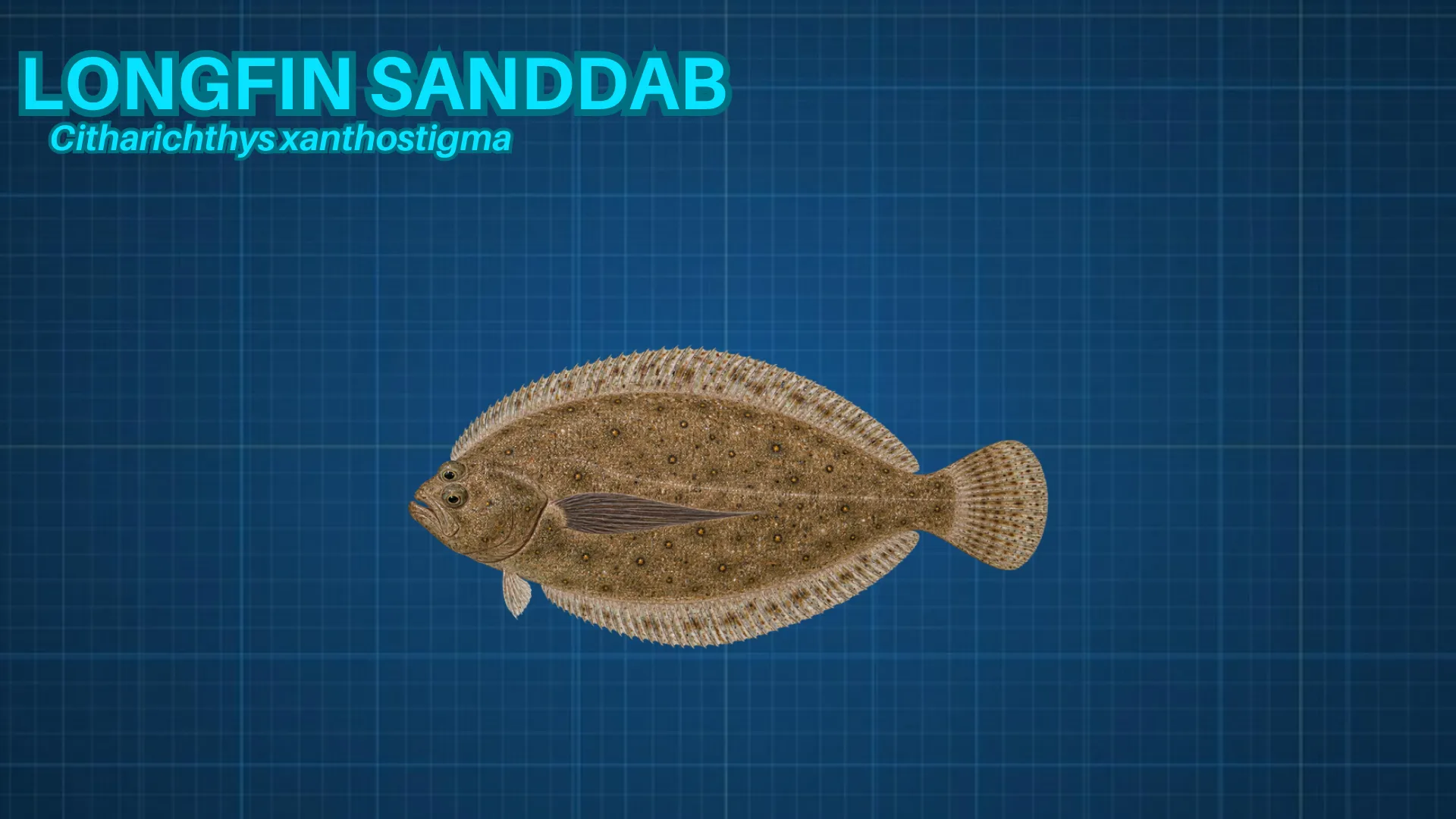
The longfin sanddab takes its name from its pectoral fin, the fin behind the gill cover, whose rays are longer than the head. Like all sanddabs it is a lefteye flounder, with both eyes on the left side of the head. Mexican Fish, a guide to the fishes of Mexico, describes the eyed side as olive brown to dark brown, speckled with orange and white, with rows of eyespots that have yellow centers and dark borders. Those eyespots set it apart from the similar sanddabs and from the fantail sole. It can change color to match the bottom, and a fish taken from the water quickly fades to plain brown.
It is the second largest of California's 4 sanddabs. The 2001 report gives its size as 10 inches, behind only the Pacific sanddab. Ken Jones records fish to 11.4 inches, though most caught from piers are under 8 inches. Females grow larger than males.
According to Mexican Fish, it eats a wide range of small bottom animals, including amphipods, copepods, shrimp, clams, worms and small fish, and is eaten in turn by marine mammals, larger fish and seabirds. Females produce eggs year round, and the fish can live up to 10 years.
Anglers catch it on light tackle and small hooks, with strips of squid, pieces of anchovy or worms. Ken Jones rates its food value as limited because of its small size, while the 2001 report counts sanddabs among the best-eating flatfish.
California sets no limit on sanddabs of any kind, with no size limit and no closed season. Take is prohibited inside state marine reserves.
Where to Find Them
Researched habitat and range candidates
San Diego · 3 beaches
Orange County · 1 beach
Los Angeles · 3 beaches
Channel Islands · 4 beaches
Ventura · 1 beach
Santa Barbara · 1 beach
These locations have suitable habitat within the species range. An assignment is a possible encounter, not a confirmed sighting at every beach. Season, depth, and local conditions still matter. Historical habitat without present-day evidence is excluded.