
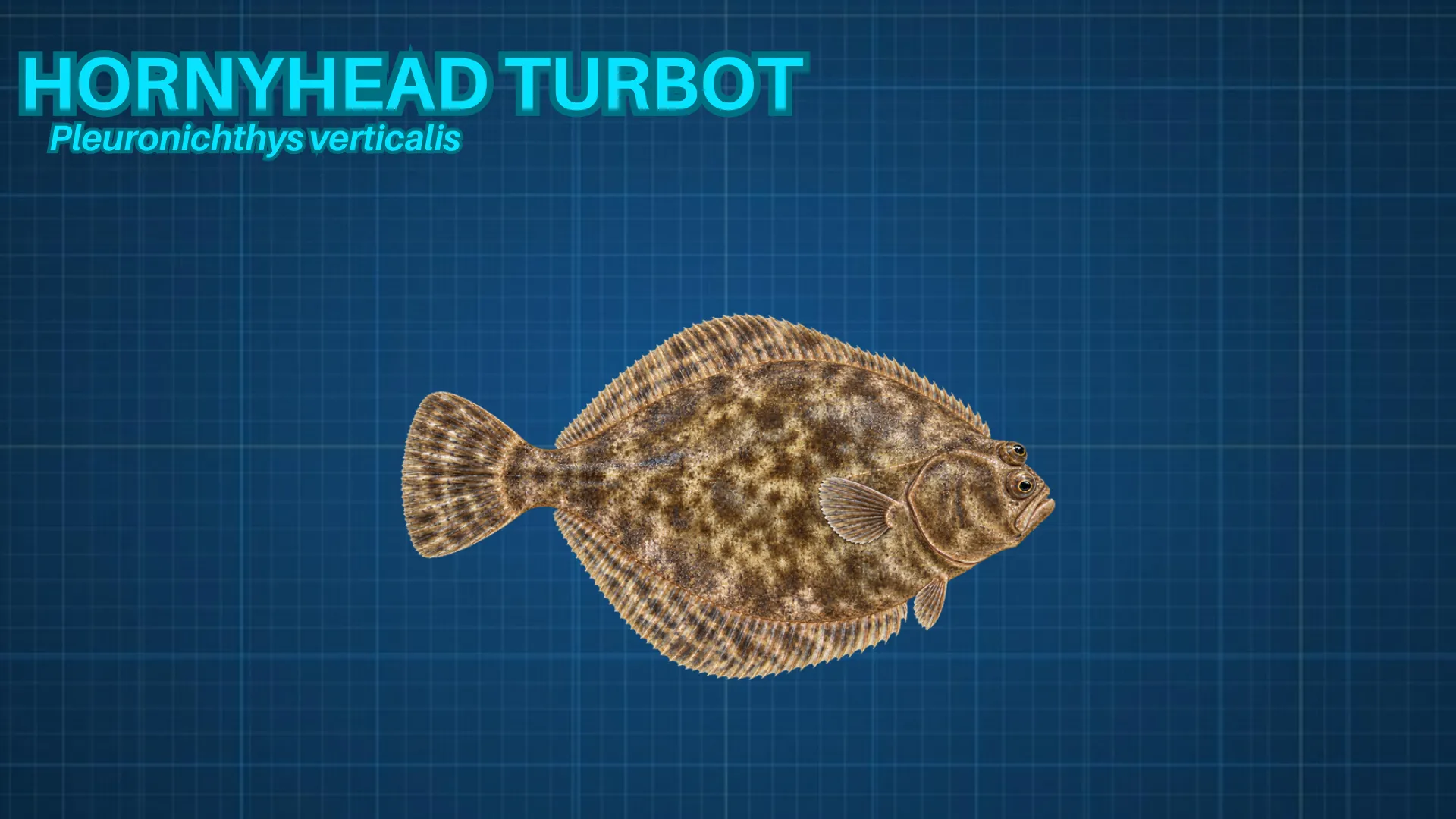
Also calledhornyhead

Taxonomy
Rarity
Abundance rates how many are in suitable habitat. Find difficulty rates how hard it is to locate one on a daylight snorkel or freedive through 50 ft. A higher find score means a harder search. The rarity category also reflects the kind of encounter; it is not an average of the 2 scores.
Seasonality
Location
The hornyhead turbot ranges from Point Reyes in Northern California south to Bahia Magdalena in Baja California Sur, Mexico, with a separate population in the northern Gulf of California. FishBase records it from about 30 to 660 feet. Mexican Fish gives a deeper limit of 1,625 feet. It lives on soft bottom of sand or mud, and much of its depth range lies below recreational diving depth. Bushing photographed one swimming and resting on the bottom at Yellowtail Point on Santa Catalina Island.
Deep Dive
The hornyhead turbot is a righteye flounder, a flatfish whose eyes both sit on the right side of the head. That side faces up as the fish lies on the bottom. The eyed side is yellowish to dark brown, marked with small cream spots and larger dark blotches, and the underside is off-white. The fish grows to about 15 inches.
The name comes from the head. A bony ridge runs between the eyes and ends in a sharp spine that points toward the tail. Mexican Fish calls that spine the key to identification, because the similar turbots of the region, including the diamond turbot and the spotted turbot, lack both the spine and the mottled coloring. Bushing adds that the fish often swims with its long pectoral fin, the fin on its side, held upright.
It hunts by waiting. Bushing describes the hornyhead turbot lying camouflaged and partly buried in the sediment, then ambushing amphipods, which are small shrimp-like crustaceans, along with marine worms and small fish. It also nips off clam siphons, the tubes a buried clam extends to the surface to breathe and feed, and it eats anemones that live in tubes. Stomach contents suggest it feeds largely at night.
Little is known about its life history, a point both Bushing and Mexican Fish make. The species is thought to spawn year round, which is unusual among local fish, and females mature at about 6 inches long. Eggs and sperm are released into the open water, and the larvae drift in the plankton before settling to the bottom. Because it feeds on the bottom, scientists sometimes sample it to measure heavy metals, DDT and other pollutants in the sediment. The species was first described in 1880 by David Starr Jordan, the first president of Stanford University, and Charles Henry Gilbert.
California counts it toward the general bag limit: no more than 10 per person per day, as part of a total of 20 finfish, with no size limit and no closed season. It is not a federally managed groundfish, so the groundfish depth and season closures do not apply. Take is prohibited inside state marine reserves.
Where to Find Them
Researched habitat and range candidates
San Diego · 3 beaches
Orange County · 1 beach
Los Angeles · 3 beaches
Channel Islands · 4 beaches
Ventura · 1 beach
Santa Barbara · 1 beach
These locations have suitable habitat within the species range. An assignment is a possible encounter, not a confirmed sighting at every beach. Season, depth, and local conditions still matter. Historical habitat without present-day evidence is excluded.