

Also calledHaller's round ray, little round stingray, stingaree



Taxonomy
Rarity
Abundance rates how many are in suitable habitat. Find difficulty rates how hard it is to locate one on a daylight snorkel or freedive through 50 ft. A higher find score means a harder search. The rarity category also reflects the kind of encounter; it is not an average of the 2 scores.
Seasonality
Location
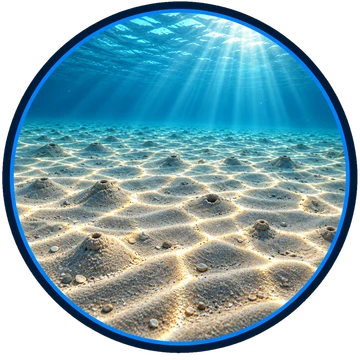
The round stingray lives in the eastern Pacific from Humboldt Bay, California south to Panama Bay, Panama, and it is most abundant south of Point Conception, Santa Barbara. It is a bottom-dwelling fish. Most of them are in water shallower than 50 feet, including bays, channels, inlets and sloughs, and the species has been recorded to at least 298 feet. The bottom it wants is soft mud or sand, and it is often found in beds of eelgrass, where its mottled back is hard to pick out.
Where an individual ray sits depends on its age and sex. Males and juveniles stay in the shallows. Adult females hold in deeper water, past about 46 feet, for most of the year. In spring and summer the adult females move inshore to mate and give birth, and that is what fills the shallow water off Southern California beaches through the warm months.
Swell and temperature concentrate them further. Abundance is greatest within the first 100 feet of shore and falls as swell height rises, so calm, shallow water holds the most rays. Warm water pulls them in the same way. At Seal Beach, Orange County, electricity generating stations on the lower San Gabriel River discharge warm seawater into the surf zone, and a survey of that area found stingray densities significantly higher at the outfall than at a comparison site up the coast at Surfside, Orange County. Acoustic tags, which are small transmitters fixed to an animal and tracked by underwater receivers, showed the rays holding to the same short stretch of that beach rather than moving along the coast.
Deep Dive
The round stingray is small and, as the name says, nearly round. The disc is about as long as it is wide, and the tail is shorter than the disc, unlike the long whip-like tails most other rays carry. The tail ends in a well developed rounded fin and holds a stout serrated spine about halfway along its length. The ray has no fins on its back. The top side is grayish brown, either plain, mottled, or spotted with dark blotches, and the underside is pale yellow, orange, or white.
It does not get big. The maximum recorded total length is 22.8 inches and the maximum recorded weight is about 3 pounds. Males reach a disc width of about 10 inches and females about 12, and most of the rays anyone sees are between 3 and 10 inches across. The California Department of Fish and Wildlife puts maturity for both sexes at a disc width of 6 inches and an age of 6 years, though other published estimates run younger, down to under 3 years. Lifespan figures disagree too. The Florida Museum of Natural History gives about 8 years, and the Shark Lab that studies the Seal Beach population reports individuals living more than 14.
The diet changes as the ray grows. Young rays eat polychaete worms, the segmented worms that burrow through mud and sand. Adults shift to crabs and clams, and the recorded prey also includes mantis shrimp, amphipods (small shrimp-like crustaceans), shrimp, and swimming crabs. The ray finds buried food by waving its pectoral fins to scoop a hole in the bottom, which uncovers whatever is under the sand. It feeds through the daylight hours rather than at night.
Round stingrays are aplacental viviparous, which means the pups develop inside the mother on a yolk sac rather than in eggs laid on the bottom, and are born live. Off Southern California, mating peaks from May through July and pups arrive between August and November, after a gestation of 3 to 4 months. Most females give birth once a year to a litter of 1 to 6 pups, each about 3 inches across. In litters examined at the Shark Lab, 90 percent held pups sired by more than 1 male. Males find females by electricity: a female gives off a weak electric field through her spiracles, the paired breathing openings behind the eyes, and males home in on it. Copulation lasts about 5 minutes. In the Sea of Cortez the same species mates from January through March instead, so the timing belongs to the population rather than to the species.
The spine is the reason most people know this animal. It sits about halfway down the tail, it is serrated, and it carries venom. The ray does not attack anyone. The spine is a defensive reflex, and the tail comes up when something presses down on the ray's back, which in practice means a foot. Wounds are not fatal, but they hurt badly, and the foot is where nearly all of them land.
Seal Beach, Orange County, is where this happens most. Lifeguards there record 200 to 300 round stingray injuries a year, most of them in the northernmost 1,600 feet of the beach, next to the warm-water discharge. The injuries cluster in the afternoon, when the tide is lower and the water is warmer. The standard prevention is to shuffle the feet along the bottom instead of stepping down, so a buried ray feels the pressure coming and moves off before a foot lands on it. The Shark Lab's treatment advice is to soak the wound in hot water that is not scalding, which breaks down the toxin, and to expect it to take more than an hour, then disinfect the cut.
Managers have tried the direct solution. Captured rays had their spines clipped, in an effort to bring the injury numbers at Seal Beach down. It failed for 2 reasons. The population is far too large and too constantly replaced for clipping to reach a meaningful share of it, and the rays grow the spine back regardless. Each ray sheds its primary spine around August and replaces it with a second spine that began growing in June, and full regeneration takes 3 to 4 months.
Documented predators include the northern elephant seal and the giant sea bass, along with larger sharks and other large predatory fishes.
The round stingray is legal to take in California. No size limit, bag limit, or season applies to rays specifically, so they fall under the general finfish rules, which allow no more than 20 finfish of all species combined and no more than 10 of any single species. Spears, harpoons and bow-and-arrow tackle are all legal for taking rays. Very little of that happens. The animal is small, commercial interest in it is minor, and its main value to people runs the other way: it holds up well in captivity and is a fixture in public aquariums, and in the water it is easy for a diver or snorkeler to approach, swimming off only when disturbed.
Where to Find Them
Researched habitat and range candidates
San Diego · 18 beaches
Orange County · 13 beaches
Catalina Island · 7 beaches
Los Angeles · 16 beaches
Channel Islands · 12 beaches
Ventura · 23 beaches
Santa Barbara · 20 beaches
San Luis Obispo · 16 beaches
Monterey · 12 beaches
These locations have suitable habitat within the species range. An assignment is a possible encounter, not a confirmed sighting at every beach. Season, depth, and local conditions still matter. Historical habitat without present-day evidence is excluded.