
 Spearfishing
Spearfishing Stats
Santa Barbara to Nome, Alaska; most common in the central Gulf of Alaska (NOAA).
Taxonomy
Rarity
Abundance rates how many are in suitable habitat. Find difficulty rates how hard it is to locate one on a daylight snorkel or freedive through 50 ft. A higher find score means a harder search. The rarity category also reflects the kind of encounter; it is not an average of the 2 scores.
Regulations
CDFW rules verified 2026-10-17
Seasonality
Edibility
Location
The Washington Department of Fish and Wildlife gives the full range as the Bering Sea to Point Camalu in northern Baja California, and FishBase extends it across the North Pacific to Japan. The Washington agency records halibut from about 16 to 3,600 feet. FishBase notes that young fish live near shore and move into deeper water as they grow, and NOAA Fisheries places those shallow nursery waters off Alaska and British Columbia. Adults spend summer on shallower feeding grounds and move deeper in winter to spawn.
Spearfishing Brief
Pacific halibut are managed under an international quota set by the International Pacific Halibut Commission, which the United States and Canada have used to manage the fish since 1923. Each state then sets its own season. California is open from April 1 to November 15, or until the quota is reached, with a limit of 1 fish per day and no size limit. Spearfishing is allowed, and a harpoon, gaff or net may be used to help land a fish caught by angling. Oregon allows spears and sets its limits and seasons each April, and they can change on short notice. Washington allows only hook-and-line angling and spearfishing, with a daily limit of 1 in Marine Area 10, an annual limit of 6, and only 1 daily limit aboard a boat. Check each state's current rules before fishing.
Finding one rates a 5. The fish live mostly deeper than divers go, and the shallow nursery grounds are farther north. Taking one rates a 3. It lies on the bottom like any flatfish, but it is a large and powerful animal, and no diver account was found in the sources reviewed for this page.
Deep Dive
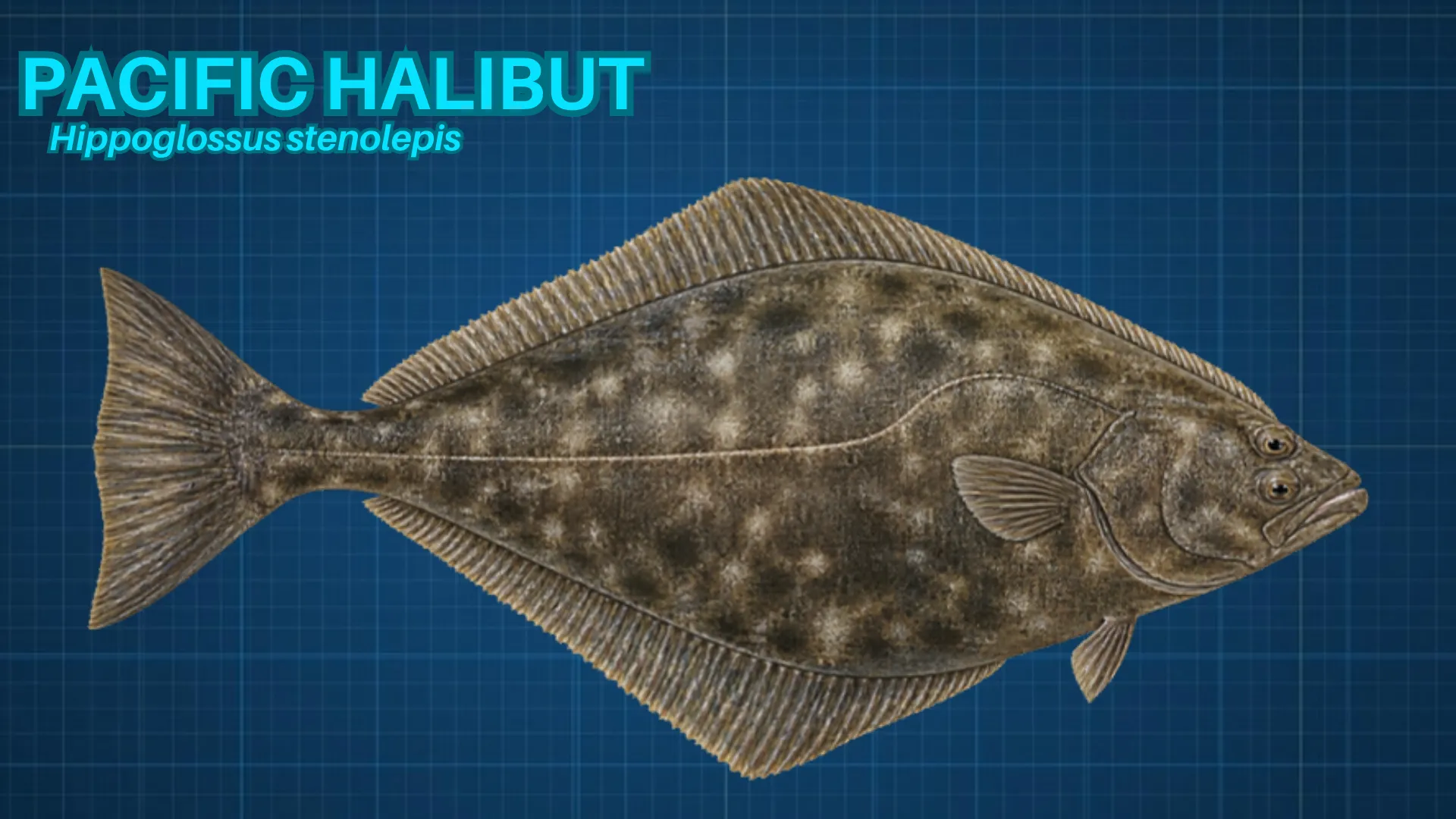
NOAA Fisheries describes a flat, diamond-shaped fish, gray to dark brown on top, with both eyes on that side. It can grow longer than 8 feet and wider than 5 feet and weigh up to 500 pounds. The Washington state record is 288 pounds, caught at Swiftsure Bank in 1989. Most fish are far smaller. Oregon's 2024 sport catch averaged 18.6 pounds. The oldest halibut on record was 55 years old, though NOAA Fisheries notes that fish over 30 are rare.
It is a hunter. NOAA Fisheries lists groundfish, sculpins, sand lance, herring, crabs and clams among its prey. Adults are rarely eaten by other fish because of their size, though marine mammals and sharks sometimes take them.
Spawning happens in winter, in deep water along the continental slope. A female releases from 500,000 to 4 million eggs.
Where to Find Them
Researched habitat and range candidates
Santa Barbara · 1 beach
Central Sound · 1 beach
These locations have suitable habitat within the species range. An assignment is a possible encounter, not a confirmed sighting at every beach. Season, depth, and local conditions still matter. Historical habitat without present-day evidence is excluded.