

Also calledflattie, chicken halibut, southern halibut, door mat, barn door
 Spearfishing

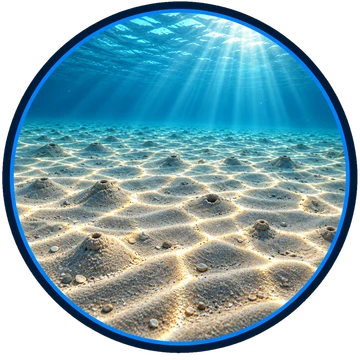
Photo: @casey_cole, La Jolla Shores
Spearfishing Stats
California sandy flats, bays and surf
Taxonomy
Rarity
Abundance rates how many are in suitable habitat. Find difficulty rates how hard it is to locate one on a daylight snorkel or freedive through 50 ft. A higher find score means a harder search. The rarity category also reflects the kind of encounter; it is not an average of the 2 scores.
Regulations
CDFW rules verified 2026-07-07
Seasonality
Edibility
Bright white, firm, and high-yield, with a very minimal bloodline.
Location
California halibut live along the eastern Pacific coast from the Quillayute River in northern Washington south to Magdalena Bay in southern Baja California, with occasional strays in the upper Gulf of California during warm-water years. They are rare north of Coos Bay, Oregon, and the population is centered from Bodega Bay, Sonoma County, south through northern Baja California. They are bottom-dwelling fish. Adults hold on sand and mud bottom from the surf zone out to about 600 feet, most abundant around 100 feet, and belong to the surf zone biome and the bay biome. Juveniles spend their first 1 to 3 years growing up in shallow bay and estuary nurseries with sandy bottoms, including San Francisco Bay and the smaller bays and estuaries along the southern coast, before moving out to the open coast at around 8 to 10 inches in length. Adults migrate into shallow water, usually 15 to 60 feet deep, from February through August to spawn. When grunion run onto Southern California beaches in spring and early summer, halibut follow them into water as shallow as 3 to 5 feet to ambush the spawning schools.
Spearfishing Brief
The California halibut is the clearest example of a hunt where the shot is easy and finding the fish is the hard part. A halibut lies flat on the sand with its color-shifting cells matching the substrate almost exactly, and it will bury itself up to its eyes for further cover. An unalarmed halibut holds while a diver eases in, and it does not flush at range the way a white seabass does. A rushed or erratic approach still spooks one, and a spooked fish lifts off the sand in a burst of silt and resettles 30 to 50 yards off, warier on the second approach. The whole difficulty of the hunt is finding one at all. That is why the find rates a 5 while the shot rates a 1, and it is why the overall difficulty for this species is a 5.
The search is slow and low. A diver searches the sand from 8 to 15 feet off the bottom, moving carefully enough to actually see what is under them. The single most useful tell is the eyes: 2 small dark dots, sometimes raised a fraction above the bottom, that do not belong on a flat patch of sand. The next tell is the outline, a faint oval or diamond where the color-match is a little too uniform or a little off in shade against the surrounding sand. A patch of sand that looks slightly darker, a small depression from where the fish settled in, a fin mark, a tail print where the fish wriggled itself down, or the faint flutter of a gill plate all give a halibut away when the eyes do not. Finding the right kind of bottom is half the game. The best areas are sand channels between rocky reefs, the edges of eelgrass beds, sand around piers and jetties, and sand-dollar beds. When the water clears above 10 feet of visibility, an incoming tide pushes bait toward shore and the fish come with it. When a small halibut turns up, a diver stays in the same area, because larger fish tend to hold in the same neighborhoods.
The shot itself is the easy half, though the last few feet still ask for discipline. Halibut are sensitive to vibration and sudden movement, so divers ease down at an angle rather than dropping straight onto a fish, and come in from the side or slightly behind where the bottom allows it. Handled that way, most shots happen at 6 to 10 feet. When a fish does bolt, divers swim a widening circle from where it flushed, since it usually settles and buries again within 30 to 50 yards, warier the second time. Guides call for a mid-length speargun with a standard flopper shaft, short enough to angle down at a fish lying flat and long enough for a 10-foot shot. Their length calls differ. Some put the gun at 90 to 100 centimeters with a single band, while others set a floor of 100 centimeters and leave band count unstated. Band setup is a matter of diver preference rather than settled practice. No slip tip is needed, because the shot is short and the sand behind the fish serves as a backstop. A 6 to 7 foot polespear with a paralyzer or 3-prong tip is a popular alternative for divers who want the faster reload and the wider impact area that pins a flatfish against the bottom. The shot is placed on the spine directly behind the head, at the base of the gill plate, which kills the fish and pins it to the sand at the same time. A shot placed too far back risks the spear pulling through thin tail meat and letting the fish go.
Because halibut are one of the top rod-and-reel gamefish in California, they are also targeted heavily by boat and shore anglers using live bait and lures. A spearo on a sand flat is one of several people after the same fish; the difference is that a diver sees exactly what is on the bottom and can size a fish before pulling the trigger. Regardless of the take method, a single live-handling detail matters: California halibut have a large mouth full of sharp, canine-like teeth that most flatfish do not have, and they will bite a diver who reaches carelessly toward a live fish. Divers grip a speared halibut through the gills, not the mouth.
Deep Dive
The California halibut is not a true halibut in the Pacific halibut sense. It belongs to the sand-flounder family, along with the summer flounder of the Atlantic coast, and it is the largest member of the family in California. The Pacific halibut, its more famous northern cousin, is a much larger true halibut in a different family and grows past 500 pounds. The California species tops out at 60 inches and about 72 pounds. A run-of-the-mill fish a diver meets is 12 to 24 inches and 6 to 30 pounds, and 5-foot fish are rare enough to make the news when someone lands one. Females grow faster and larger than males. Halibut older than 15 years are rare, and the ones that reach that age are more often female than male. The species can live 30 years, though most do not reach that.
Like all flatfish, a California halibut starts life as a symmetrical, upright larva with an eye on each side of its head. Around 42 days after hatching, and while the fish is still less than an inch long, one of the eyes migrates over the top of the skull and joins the other on the same side. From that point on, the fish spends the rest of its life lying on the blind side with both eyes facing up. What is different about California halibut, and unusual among flatfish, is that the direction of the migration is not fixed. Most flatfish species are overwhelmingly right-eyed or left-eyed. In California halibut, both patterns occur in roughly even numbers. A given fish is about as likely to end up left-eyed as right-eyed, an oddity in the group.
The other thing that sets the species apart is its jaw. Most flatfish have small mouths that suit a diet of worms and small crustaceans nudged off the bottom. A California halibut has a wide, symmetrical mouth full of sharp, canine-like teeth, and it uses it to hunt actively. Adults are ambush predators first. They bury in the sand and wait for prey to swim within about 3 head lengths, then strike. But they also chase schooling fish off the bottom, and California halibut have been observed swimming in anchovy schools and even leaping out of the water while feeding. The diet is dominated by northern anchovies, market squid, gobies, other flatfish, and any small schooling fish that comes within range. Juveniles in the bay nurseries eat small crustaceans first, then gobies, then progressively larger fish as they grow.
Spawning runs from February through August, with the peak in May, and takes place in shallow inshore waters 15 to 60 feet deep. Peak spawning shifts earlier moving south into Baja California and later moving north up the California coast. A female may release 420,000 eggs across 12 or 13 spawning events per season, with 7 to 14 days between events. Fertilization happens in the open water column, with no pairing or parental care. Larvae drift as plankton for several months before settling in bays and estuaries as juveniles. San Francisco Bay is the single largest nursery for the species in California, along with the network of smaller bays and estuaries running south through the state. Loss of that nursery habitat to dredging and filling is one of the pressures on the population, alongside the fishery itself.
Documented predators of adult California halibut include Pacific angel sharks, Pacific electric rays, California sea lions, bottlenose dolphins, and larger sharks, but the primary pressure is people. Halibut supports one of the state's largest and most valuable nearshore fisheries. Historically about half of the commercial catch came from bottom trawl, a quarter from hook-and-line, and a quarter from gillnet. The 2010 landings were about 528,000 pounds valued at $2.3 million. The species is also a leading target for recreational anglers on private boats, party boats, and the pier and surf line. The rules are the 22 inch total-length minimum, the 5-fish bag limit south of Point Sur, Monterey County, the 2-fish bag limit north of it, and the March 15 through June 15 trawl closure in the Southern California Trawl Grounds. Aquaculture research at the Hubbs-SeaWorld Research Institute in San Diego, UC Davis, and partner institutions in Baja California has produced captive-reared juveniles as a route to easing pressure on the wild population.
On the plate, the California halibut sits at the top of California's list of white fish. The meat is lean, mild, slightly sweet, tender, and breaks into large white flakes. A fish yields 4 fillets: 2 on the eyed side and 2 on the blind side, split along the lateral backbone. A 10-pound fish gives up about 4 to 5 pounds of clean boneless meat. Because the flesh is lean, it dries out fast when overcooked and loses noticeable texture when frozen, which is why fresh halibut commands the price it does. Standard preparations run from grilled and pan-seared through baked, broiled, and poached, plus tacos, ceviche, and sushi.
Where to Find Them
Researched habitat and range candidates
San Diego · 18 beaches
Orange County · 13 beaches
Catalina Island · 7 beaches
Los Angeles · 16 beaches
Channel Islands · 12 beaches
Ventura · 23 beaches
Santa Barbara · 20 beaches
San Luis Obispo · 16 beaches
Monterey · 12 beaches
Oregon South Coast · 10 beaches
Oregon Central Coast · 8 beaches
Oregon North Coast · 6 beaches
These locations have suitable habitat within the species range. An assignment is a possible encounter, not a confirmed sighting at every beach. Season, depth, and local conditions still matter. Historical habitat without present-day evidence is excluded.