
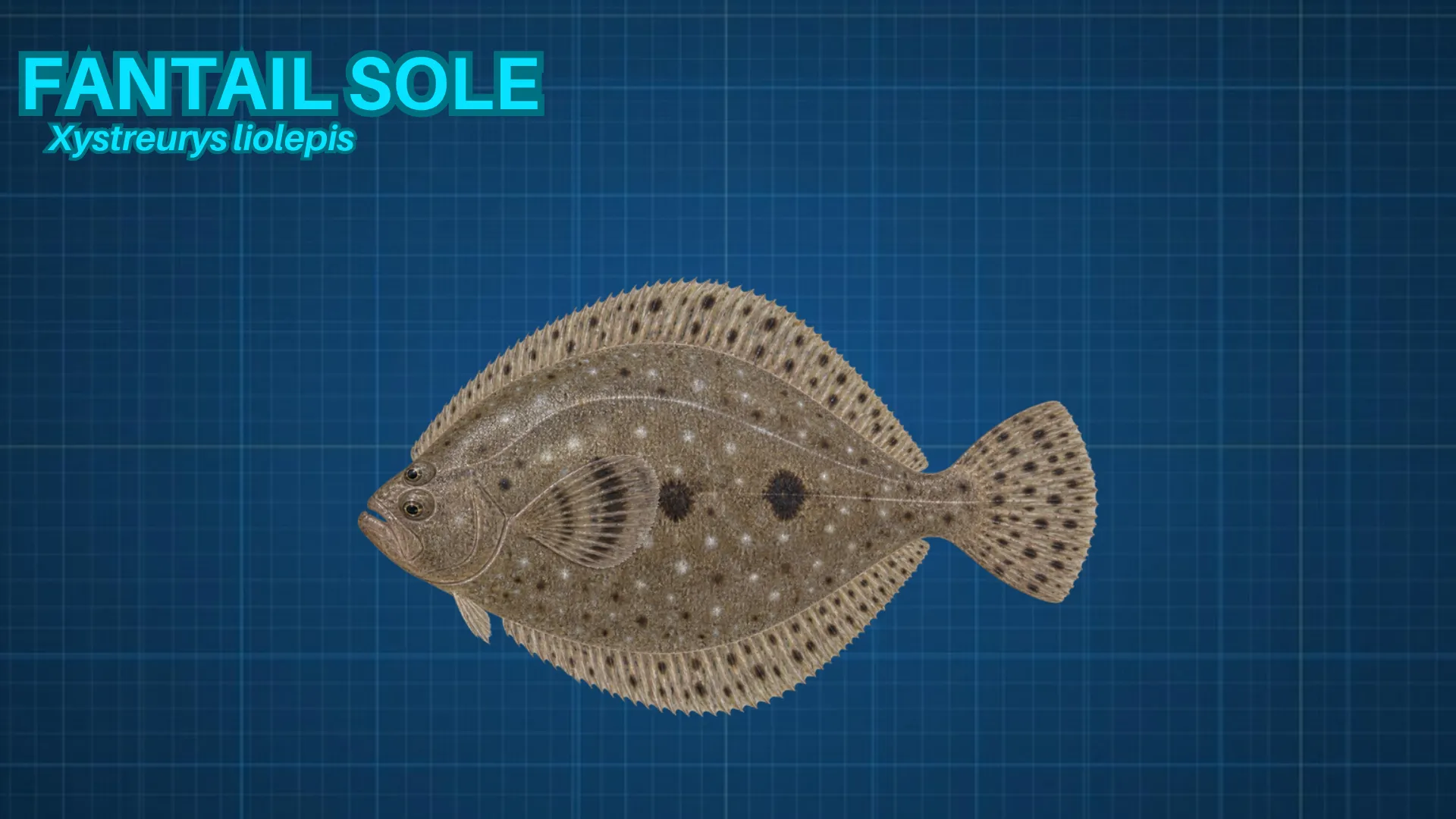
Also calledfantail flounder, fantail halibut, long fin sole, long finned flounder, true petrale
 Spearfishing

Spearfishing Stats
Monterey Bay to the Gulf of California; most catches Santa Barbara south.
Taxonomy
Rarity
Abundance rates how many are in suitable habitat. Find difficulty rates how hard it is to locate one on a daylight snorkel or freedive through 50 ft. A higher find score means a harder search. The rarity category also reflects the kind of encounter; it is not an average of the 2 scores.
Regulations
CDFW rules verified 2026-10-12
Seasonality
Edibility
Clean white meat, but soft in texture and low in fat.
Location
The fantail sole ranges from Monterey Bay in Central California south to the Gulf of California. Ken Jones records it from the surf zone down to 446 feet, though it usually lives between 20 and 164 feet. FishBase describes it on muddy and sandy bottom, usually buried in the sediment. Jones adds the detail most useful to a diver: it is generally found on sandy spots among eelgrass beds, kelp or rocks. Most pier catches come from Santa Barbara south.
Spearfishing Brief
The fantail sole rates a 4 overall, and nearly all of that is the search.
Finding one rates a 4. FishBase describes the fish as usually buried in the bottom, and its tan, spotted back is built to vanish against sand. It is also not plentiful, which is why abundance rates a 2. The best odds are on the sandy patches inside or beside eelgrass, kelp and rock, where Ken Jones says the species is generally found. The search is the same one that works on any buried flatfish: look for an outline in the sand or a pair of raised eyes, not a fish.
The shot rates a 1, the bottom of the scale. A buried flatfish holds still until a diver is nearly on top of it. A pole spear or a short speargun covers the distance. No spearfishing account for this species turned up in the research for this page, so the weapon note is reasoned from how and where the fish lives rather than taken from a published one.
California treats it like most local finfish. It counts toward the general limit of 10 per species inside a 20-fish daily total, with no size limit and no closed season, and spearfishing it is legal. Take is prohibited inside state marine reserves, and north of Ventura County spears may not be used within 100 yards of a stream mouth.
On the table, Ken Jones rates it good. The flesh is white, mild, soft and low in fat, and he calls it suitable for any method of cooking. Mexican Fish, a guide to the fishes of Mexico, calls it an excellent food fish.
Deep Dive
The fantail sole is named for its tail fin, which is broad and slightly rounded. It is a large-tooth flounder, the family that includes the California halibut, and one of its oddities is that its eyes can end up on either side of the head. Mexican Fish records fish with both eyes on the left and fish with both eyes on the right.
The body is oval. Ken Jones describes the eyed side as brown or tan with blue spots, plus 2 larger dark spots called ocelli, 1 near the pectoral fin and 1 farther back. The lateral line, the row of sensory pores along the side, arches high over the pectoral fin, and the pectoral fin is longer than the head. The mouth is small. Mexican Fish notes that the fish can be confused with the California halibut and the longfin sanddab. Other names for it include fantail flounder, fantail halibut and true petrale.
It grows to about 25 inches. FishBase gives a maximum published weight of about 4 kilograms, close to 9 pounds.
FishBase reports that it feeds almost entirely on crustaceans, and Ken Jones lists small shrimp, crabs and squid. Anglers catch it on small hooks with strips of squid or fish, or with marine worms. FishBase notes that females spawn many times over a long spawning season, but the timing in California waters is not described in the sources reviewed. Mexican Fish calls the species poorly studied, with little known about its age, growth, movements or reproduction.
Where to Find Them
Researched habitat and range candidates
San Diego · 6 beaches
Orange County · 2 beaches
Los Angeles · 3 beaches
Channel Islands · 5 beaches
Ventura · 3 beaches
Santa Barbara · 1 beach
Monterey · 1 beach
These locations have suitable habitat within the species range. An assignment is a possible encounter, not a confirmed sighting at every beach. Season, depth, and local conditions still matter. Historical habitat without present-day evidence is excluded.