



Taxonomy
Rarity
Abundance rates how many are in suitable habitat. Find difficulty rates how hard it is to locate one on a daylight snorkel or freedive through 50 ft. A higher find score means a harder search. The rarity category also reflects the kind of encounter; it is not an average of the 2 scores.
Seasonality
Location
The speckled sanddab ranges from Montague Island in the northern Gulf of Alaska south to Bahia Magdalena in Baja California Sur, Mexico, and it lives along the whole California coast. That 2001 report records it from the surface to 1,200 feet, but notes that it seldom lives deeper than 300 feet. Most sanddabs prefer mud or sandy mud, and this one is the exception: it is common on clean sand. It also comes into very shallow water, down to the intertidal zone.
Pier catches show where it is most common. It turns up at many California piers, mainly north of Los Angeles and above all in Central California. Ken Jones has taken it from Balboa Pier in Newport Beach north to Trinidad Pier in Humboldt County, from every oceanfront pier between Malibu and Pacifica, and from a pier at Mukilteo, Washington.
Deep Dive
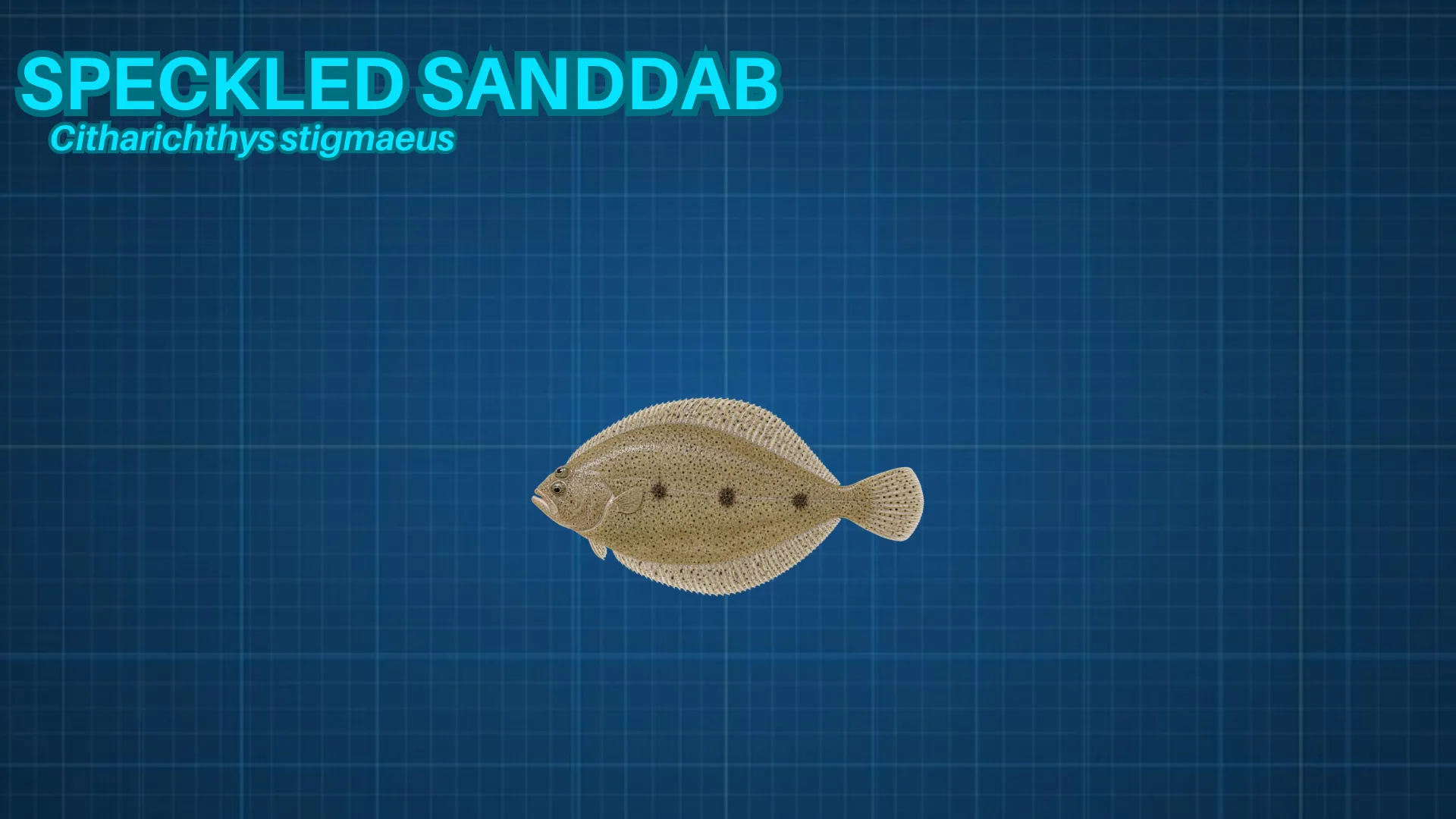
The speckled sanddab is the smallest of California's 4 sanddabs, which also include the Pacific, longfin and gulf sanddabs. It reaches about 7 inches, and most fish caught from piers are 4 to 5 inches long. It is a lefteye flounder, meaning both eyes sit on the left side of the head, and that side faces up as the fish lies on the bottom. The upper side is brown or tan and scattered with black spots, which is where the name comes from.
It lives fast. A speckled sanddab matures at 1 year old and lives only about 3.5 years. The larger Pacific sanddab, by comparison, matures at about 3 and can live to 10. The speckled sanddab spawns over a long season, from spring to fall, and a female may spawn twice in one season. The larvae drift near the surface, sometimes many miles offshore, and settle to the bottom once they reach 0.6 to 1.6 inches long.
It feeds on the bottom. Its diet is mostly mysids and amphipods, 2 groups of small shrimp-like crustaceans. Sanddabs in turn are eaten by larger fish, diving birds and marine mammals.
Anglers rarely set out to catch one. Ken Jones calls it generally too small to eat and advises releasing it gently. It bites readily on very small hooks baited with squid, fish or worm, and on one visit to the Santa Cruz Wharf he found the bottom so thick with speckled sanddabs and small octopuses that every cast brought up one or the other, or both.
California sets no limit on sanddabs of any kind. In Oregon it counts toward the flatfish limit of 25 fish in combination, and anglers fishing for it in the ocean need an Ocean Endorsement. Washington classifies all dabs as bottomfish, so the speckled sanddab falls under each marine area's bottomfish rules.
Where to Find Them
Researched habitat and range candidates
San Diego · 17 beaches
Orange County · 11 beaches
Catalina Island · 2 beaches
Los Angeles · 16 beaches
Channel Islands · 7 beaches
Ventura · 23 beaches
Santa Barbara · 19 beaches
San Luis Obispo · 16 beaches
Monterey · 7 beaches
Oregon South Coast · 10 beaches
Oregon Central Coast · 7 beaches
Oregon North Coast · 4 beaches
South Sound · 2 beaches
Central Sound · 1 beach
These locations have suitable habitat within the species range. An assignment is a possible encounter, not a confirmed sighting at every beach. Season, depth, and local conditions still matter. Historical habitat without present-day evidence is excluded.