


Taxonomy
Rarity
Abundance rates how many are in suitable habitat. Find difficulty rates how hard it is to locate one on a daylight snorkel or freedive through 50 ft. A higher find score means a harder search. The rarity category also reflects the kind of encounter; it is not an average of the 2 scores.
Seasonality
Location
The spotted turbot ranges from Morro Bay in Central California south to southern Baja California, Mexico. FishBase records it from about 3 to 165 feet. Reeflex, a marine species reference, describes a wider range, from the lower edge of the intertidal zone out to the edge of the continental shelf at about 650 feet. It lives on soft bottom, especially in bays, over sand, mud and gravel.
Deep Dive
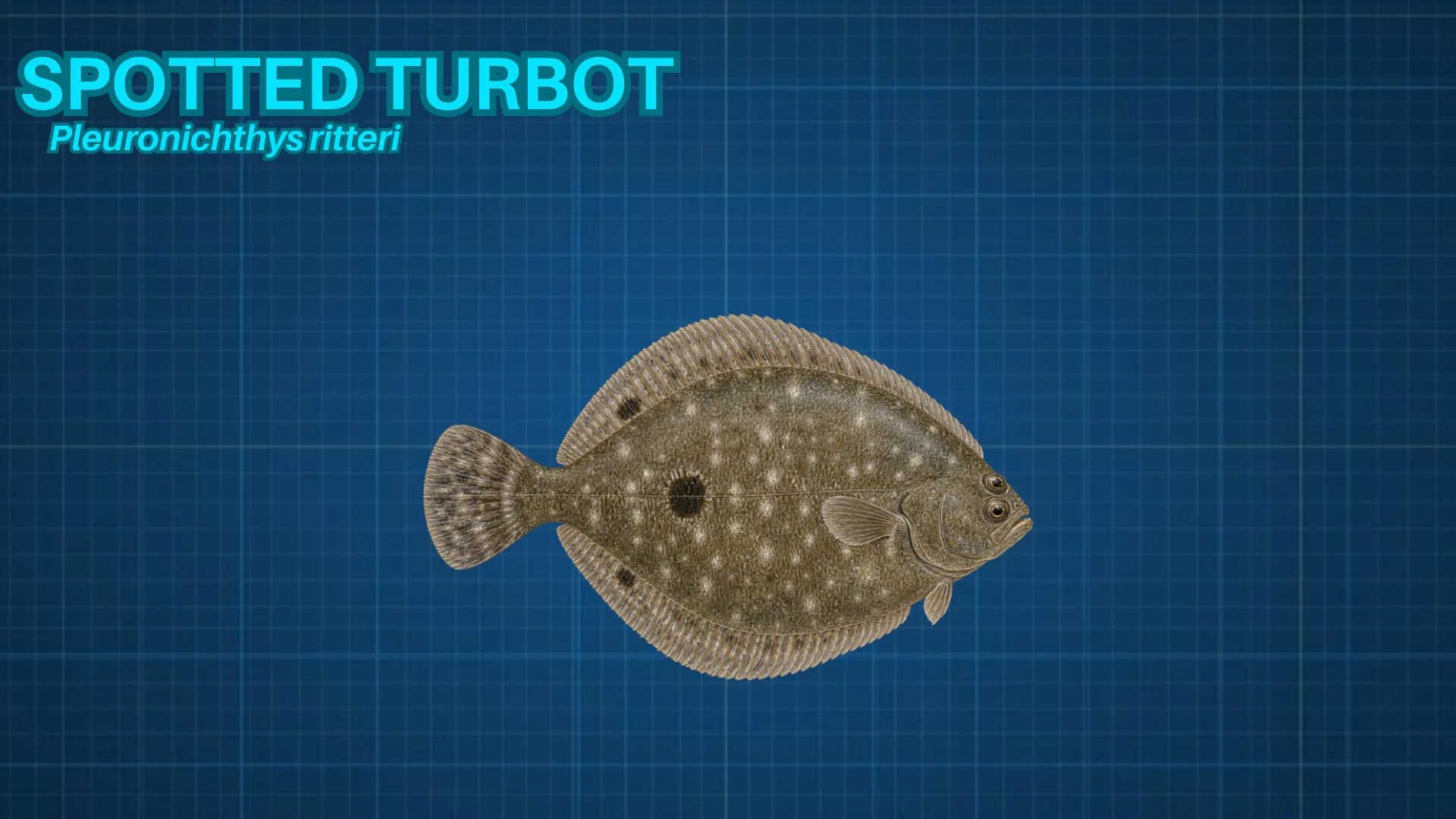
The spotted turbot is a righteye flounder, a flatfish whose eyes both sit on the right side of the head. Reeflex describes the eyed side as brown to gray-brown with light speckles, and the underside as white. Its most visible mark is a dark spot that usually sits in the middle of the body, centered on the lateral line, the row of sensory pores that runs along a fish's side. Smaller dark spots, 1 on each fin, sit at the base of the last rays of the dorsal and anal fins, the long fins along the top and bottom edges of the body.
The body is widest in the middle. The mouth is small and lopsided, with folds across the lips, and the space between the eyes is low and has no spines. That last detail separates it from the hornyhead turbot, which carries a sharp spine between its eyes. The spotted turbot grows to about 12 inches.
The species was described in 1907 by the ichthyologists Starks and Morris, and its name honors William Emerson Ritter, an American marine biologist.
Its diet, spawning season and lifespan are not covered in the sources reviewed for this page.
California counts it toward the general bag limit: no more than 10 per person per day, as part of a total of 20 finfish, with no size limit and no closed season. It is not a federally managed groundfish, so the groundfish depth and season closures do not apply. Take is prohibited inside state marine reserves.
Where to Find Them
Researched habitat and range candidates
San Diego · 4 beaches
Orange County · 1 beach
Los Angeles · 4 beaches
Channel Islands · 4 beaches
Ventura · 2 beaches
Santa Barbara · 3 beaches
San Luis Obispo · 4 beaches
These locations have suitable habitat within the species range. An assignment is a possible encounter, not a confirmed sighting at every beach. Season, depth, and local conditions still matter. Historical habitat without present-day evidence is excluded.