

Taxonomy
Rarity
Abundance rates how many are in suitable habitat. Find difficulty rates how hard it is to locate one on a daylight snorkel or freedive through 50 ft. A higher find score means a harder search. The rarity category also reflects the kind of encounter; it is not an average of the 2 scores.
Regulations
CDFW rules verified 2026-08-20
Seasonality
Edibility
Cleans easily and is eaten whole, so there is no bloodline or trimming work.
Location
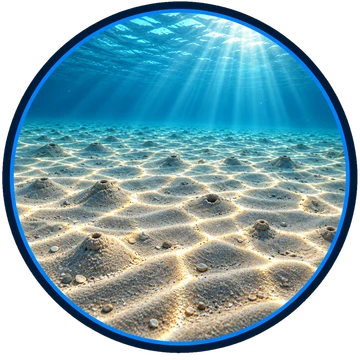
California grunion live in the eastern Pacific from Monterey Bay, California, south to Baja California Sur, Mexico. Adults stay inshore along the open coast and in bays, usually at or near the surface, and have been recorded from the surface down to about 60 feet. They have no teeth. They feed on zooplankton, the tiny drifting animals that graze on algae.
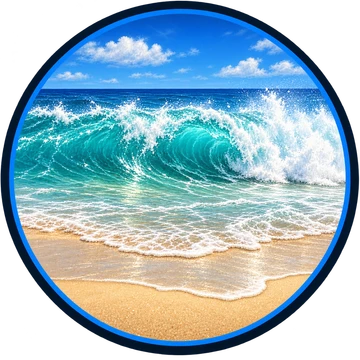
The part of their habitat that decides their future is the part they occupy for only a few minutes at a time. Grunion spawn on sandy beaches and nowhere else, which ties the whole species to a thin strip of shoreline. Researchers put the total California spawning habitat at about 0.56 square miles. That strip is narrowing under what scientists call coastal squeeze, the loss of sandy beach caught between a rising sea on one side and seawalls and development on the other. Beach grooming, the machine raking that many cities run to clear kelp and litter, disturbs eggs buried in the sand. Light pollution, water pollution, and harmful algal blooms add to the pressure, and warming water may push the sex ratio of hatchlings toward males.
Harvest Brief
Southern California sandy nearshore water
Taking grunion is legal, and the rules about method are unusually strict. They may be taken by hand and by nothing else. California regulation 29.00 states that no appliances of any kind may be used to take grunion, and no holes may be dug in the beach to entrap them. That rules out nets, traps, and containers used to scoop, though a bucket to hold fish already caught is fine. Anyone 16 or older needs a California sport fishing license, and the daily limit is 30 fish.
The season catches people out more than the method does. Grunion may be taken in March, July, and August only. April, May, and June are closed, and that closure is a no-contact rule rather than a no-keep rule: during those 3 months the runs may be watched, but the fish may not be handled at all. June was added to the closure in 2022, so older guides listing only April and May are out of date.
Finding them is a matter of timing rather than searching. Runs come on the 4 nights following a full or new moon, after the high tide, from March through August, with the strongest activity from late March to early June. Because that schedule tracks the tides and the moon, run nights are forecast in advance. What no forecast can supply is whether the fish will actually arrive, and a predicted night often produces nothing. The calendar compounds the problem. The peak of the spawning season sits inside the closed months, and the open months fall at either edge of it. March is the only open month inside the peak.
The take itself is simple once a run is underway. A spawning fish strands itself on open wet sand, and catching one means picking it up. It does not stay long. A grunion is out of the water for somewhere between 30 seconds and a few minutes before it returns to the waves.
Deep Dive
The California grunion comes out of the ocean to breed. The timing that allows it is precise, and it is what the species is known for. Spawning runs happen from March through August, occasionally as early as February and as late as September, and peak from late March to early June. They come on the 4 consecutive nights that follow a full or new moon, which are the nights of the highest tides, and they begin after the tide has turned and started to fall. That last detail is the whole trick. A female that spawns on a falling tide leaves her eggs above the water line, where the sea will not immediately dig them back up.
The run itself is quick. A female strands herself on the wet sand as the water pulls back, wriggles down into it to make a nest, and lays her eggs below the surface. Males curl their bodies around her and fertilize them. The whole visit ashore, from the moment a fish clears the water to the moment it returns, takes anywhere from 30 seconds to several minutes. A female may spawn up to 6 times in a season, laying between 1,600 and 3,600 eggs each time.
What follows is a stretch of development that happens on land. The eggs sit buried in damp sand for roughly 10 days to 2 weeks, out of reach of everything in the water that eats fish eggs. Warm sand speeds them along, faster than the same eggs would develop in the sea. They do not hatch on a schedule of their own. They wait for the next series of high tides to reach far enough up the beach to wash them free, and being washed out is what sets them hatching.
Grunion grow fast and do not live long. Most reach 5 to 6 inches, the largest fish on record measured 7.5 inches, and a typical life is 3 to 4 years, with 8 years the maximum recorded. They spawn for the first time within their first year, though the exact size and age at first spawning does not appear in a source solid enough to state here.
Grunion are prey for a wide range of animals. In the water, adults are taken by California corbina, halibut, guitarfish, sharks, sea lions, dolphins, squid, and a long list of seabirds and shorebirds. On the beach during a run, herons, egrets, and other land predators hunt the tide line. The eggs feed shorebirds, sand worms, and beetles.
People have been on that list a long time, and the state has only recently begun managing it. Until 2022, California set no bag limit on grunion at all, and closed only April and May. The rules changed that June: the closure grew to include June, and a limit of 30 fish per person appeared for the first time. The Grunion Greeters record that prompted the change also documented how thin enforcement is. Poaching was reported during roughly 20 percent of closed-season observations, and across 5,133 reports, volunteers saw a game warden on fewer than 5 occasions. The program is coordinated by Dr. Karen Martin, a biology professor at Pepperdine University, and its run-strength record remains the best measure of grunion abundance available, because the species has never had a formal stock assessment.
On the plate, grunion are treated like sardines, which is roughly what they are in size and oil content. They are small enough that nobody fillets them. The usual preparation is to flour or bread them and fry them whole for 2 to 3 minutes a side, at which point they are crisp enough to eat head, tail, and all. Some cooks gut them first and grill them hot and fast with lemon. The flavor is rich and buttery, closer to herring than to any of the white-fleshed fish a California diver usually brings home.
Where to Find Them
Researched habitat and range candidates
San Diego · 17 beaches
Orange County · 12 beaches
Catalina Island · 6 beaches
Los Angeles · 16 beaches
Channel Islands · 12 beaches
Ventura · 23 beaches
Santa Barbara · 20 beaches
San Luis Obispo · 13 beaches
Monterey · 12 beaches
These locations have suitable habitat within the species range. An assignment is a possible encounter, not a confirmed sighting at every beach. Season, depth, and local conditions still matter. Historical habitat without present-day evidence is excluded.