

Also calledbarred surfperch, barreds, sand perch, California perch
 Spearfishing
Spearfishing Stats
Southern California sandy surf, specifically barred surfperch
Taxonomy
Rarity
Abundance rates how many are in suitable habitat. Find difficulty rates how hard it is to locate one on a daylight snorkel or freedive through 50 ft. A higher find score means a harder search. The rarity category also reflects the kind of encounter; it is not an average of the 2 scores.
Regulations
CDFW rules verified 2026-07-16
Seasonality
Edibility
Small, soft fillets carrying a lot of fine bones.
Location
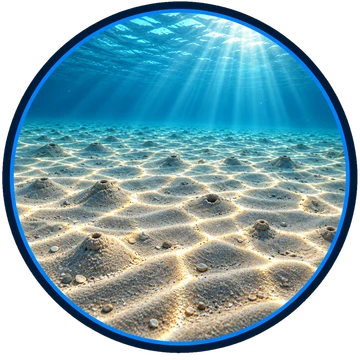
Barred surfperch live along the eastern Pacific from Bodega Bay in northern California south to Guerrero Negro in central Baja California, Mexico. They are rarely seen north of Bodega Bay. The center of the population sits on the sandy beaches of Southern California, where the species is the most common surfperch a diver or angler encounters. The fish belong to the surf zone biome. Adults hold in the wash, in the trough just outside the first sandbar, and in the deeper depressions along the beach face, usually in less than 20 feet of water, though the species has been recorded from bottom trawls to about 240 feet offshore. Structural features that concentrate the fish include troughs between sandbars, pier pilings, jetty rocks, and sand adjacent to rocky outcrops on pocket beaches. Barred surfperch also turn up in the depressions surf anglers call croaker holes, at the outer edge of the sand shelf where the bottom starts to slope down, though those holes hold California corbina and yellowfin croaker more reliably. In winter and early spring, large pregnant females move into shallow water in preparation to give birth, which is when the surf fishery sees the biggest fish of the year. Small schools cruise the bottom on the same beaches through the rest of the year, though the fish that remain in summer are mostly smaller adults and fish born that spring.
Spearfishing Brief
The barred surfperch is not a documented California spearfishing target. It is primarily a rod-and-reel surf-fishing species, and the published sourcing reflects that. Of the main California spearfishing guides reviewed for this entry, the 3 from Cast and Spear, Spearfactor, and Guardian Charters list every serious shore-spear target from calico bass to California corbina. None of them lists surfperch. When surfperch appear in spearfishing community forums, they are almost always incidental catches by shore divers on nearby rocky reef, not the reason someone got in the water.
Water clarity is what keeps most divers out of it. The zone where barred surfperch live is the same zone that produces the sand-plume brown water and thick foam a diver looks at from the beach and does not put on a mask for. Southern California surf-zone visibility rarely opens up to the range at which a shot is possible, which is why the shore-spear community hunts kelp beds and rocky reef instead. On a clean day the fish are there to be hunted. Barred surfperch travel in schools through the shallows, and both halves of the hunt rate a 2.5. The species is abundant, so the rating is not about scarcity. Barred surfperch are cautious and flighty and are very good at keeping away from a diver, which makes getting on a school and staying on it the work of the dive. A school worked once moves off the stretch of beach a diver is holding, and finding the next one means covering the wash and the trough behind the first sandbar again. The weapon that fits is a long pole spear, for the reach it gives on a fish that keeps its distance.
Deep Dive
The barred surfperch belongs to the surfperch family, a group of about 23 species that live along the temperate coasts of the North Pacific. What sets the family apart is the way its members reproduce. Most bony fish scatter their eggs into open water. Surfperch instead fertilize their eggs inside the female's body, where she carries the young for the next 5 to 6 months. The embryos have specialized dorsal and anal fins covered in blood vessels that press against the equally blood-rich wall of the mother's ovary, and they absorb oxygen and nutrients directly from her bloodstream. It is an arrangement more often associated with mammals than with fish. Instead of releasing hundreds of thousands of tiny eggs, a female surfperch produces a small number of large, fully formed young that swim off the moment they are born.
For the barred surfperch, mating happens in the surf zone in winter, most often from September into November. The female stores fertilized eggs, and the embryos develop through the winter. Live young are released between March and July, with the peak in April and May in Southern California. A brood ranges from about 4 to more than 100 young, depending on the size of the female. Fry are already 2 to 3 inches long at birth, ready to swim and feed on their own. This is the reason the surf fishery peaks in December through April: heavy, pregnant females move into shallow water in preparation to give birth, and they are the largest fish of the year. By late summer, the same beaches hold mostly smaller fish grown from the previous spring's births.
The barred surfperch is the largest species in its family by length. The maximum recorded length is about 19.5 inches, and the maximum recorded weight is about 4.7 pounds. Most fish encountered are far smaller. A barred surfperch under 14 inches is typical, and a fish over 15 inches is a good one. Females grow faster and larger than males and live longer, up to about 9 years, while males rarely exceed 6. The California state record stands at 4 pounds 2 ounces, matched twice in 1995 and 1996. The all-tackle world record listed by the International Game Fish Association is 4 pounds 12 ounces, set in 2016.
The diet of the barred surfperch is one of the narrowest on the California coast. Studies of stomach contents put sand crabs at up to 90 percent of the diet by volume. Sand crabs are the small, oval-bodied crustaceans that dig into the wet sand of a wave-swept beach and filter plankton from each retreating wave with their feathery antennae. Every time a wave breaks and pulls back, sand crabs are lifted briefly out of the sand, and the surfperch cruise the wash to intercept them. Beach-by-beach research has found sand-crab share ranging from 2 to 87 percent of stomach contents depending on the site, so the diet is dominated by sand crabs overall but shifts with local prey abundance. Beyond sand crabs, the fish eat marine bristle worms, small shrimp-like crustaceans, bean clams, mussel meat, and juvenile northern anchovy and Pacific sardine. Juveniles eat the eggs of northern anchovy, Pacific sardine, and smelt during their first months.
Barred surfperch are hunted by a wide range of predators. Documented fish predators include leopard shark, barred sand bass, kelp bass, California halibut, lingcod, Pacific bonito, and larger inshore rockfish. Marine mammal predators include harbor seals and river otters. Birds take a heavy share of the population, including great blue heron, common loon, osprey, cormorants, gulls, and several tern species. The largest source of mortality, however, is people. The California recreational surf fishery has been the dominant human take of the species since at least 1960, when the California Department of Fish and Game published its foundational biological study of the species in Southern California and identified barred surfperch as the single most important species in the Southern California surf fishery. That has not changed in the decades since.
On the plate, barred surfperch are a modest but usable table fish. The meat is white, low in fat, and mild in flavor. It flakes small and cooks fast. Community opinion on the fish is not unanimous. Some Southern California surf anglers rate it excellent when handled well: iced on the beach, filleted the same day, and pan-fried in flour or panko. Others consider the flesh soft and prone to going mushy if the fish sits before it is cleaned. A separate argument for releasing surfperch rests on 2 other grounds. The fillets are small for the effort, and from November through early May most of the larger fish are pregnant females that expel their fry when they are handled. The middle ground the community mostly settles on is that a barred surfperch over 12 inches, kept cold and cooked the day it is caught, gives up small, delicate white fillets that fry cleanly. Grilling, baking, air-frying with a panko coating, and tacos all work, but the fish is at its best when it is fried, because the crust holds the soft flesh together.
Where to Find Them
Researched habitat and range candidates
San Diego · 17 beaches
Orange County · 12 beaches
Catalina Island · 6 beaches
Los Angeles · 16 beaches
Channel Islands · 12 beaches
Ventura · 23 beaches
Santa Barbara · 20 beaches
San Luis Obispo · 13 beaches
Monterey · 12 beaches
These locations have suitable habitat within the species range. An assignment is a possible encounter, not a confirmed sighting at every beach. Season, depth, and local conditions still matter. Historical habitat without present-day evidence is excluded.