

Also calledtwospot fringehead
Taxonomy
Rarity
Abundance rates how many are in suitable habitat. Find difficulty rates how hard it is to locate one on a daylight snorkel or freedive through 50 ft. A higher find score means a harder search. The rarity category also reflects the kind of encounter; it is not an average of the 2 scores.
Seasonality
Location
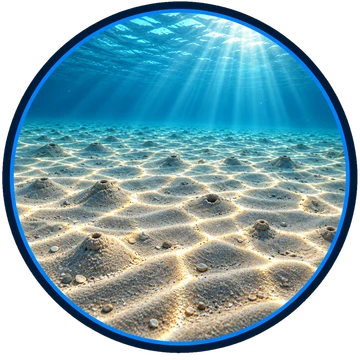
Sarcastic fringeheads live in the eastern Pacific from San Francisco south to central Baja California. The habitat is soft bottom on exposed coast, sand or hard mud below the low-tide line, and they are less common inside bays. The depth band runs from about 10 feet down to about 240 feet, which puts the shallow end within easy reach of a snorkeler over the right ground.
What matters is not the bottom but what is lying on it. A fringehead needs a container. Empty mollusk shells, the burrows left behind by boring clams, cracks in rock, and human litter all work, and the last of those is why the species turns up in photographs peering out of a beer bottle. They are solitary. One fish, one hole.
They eat small prey: fish, crustaceans, and squid eggs. That last item is worth pausing on, because California market squid lay their eggs in dense fields on sandy bottom in exactly the depths a fringehead occupies, so an entire seasonal food supply arrives at the fish's front door.
They are also, for their size, remarkably willing to take on anything that comes near. The Aquarium of the Pacific describes fringeheads attacking almost anything that strays too close, divers included. FishBase's own threat-to-humans field lists the species as harmless, and both things are true at once: this is a fish under a foot long that does not back down.
Deep Dive
Everything memorable about the sarcastic fringehead comes down to the mouth.
At rest the fish looks ordinary enough, a small mottled blenny with its head sticking out of a hole. When another fringehead approaches, the mouth opens, and the jaws unfold into something that can reach as much as 4 times the closed size of the head, lined with color on the inside. The conservation organization Oceana describes the combination of that coloration and that size as the mechanism by which a larger male establishes dominance over a smaller one. The first stage of a fight is a threat: the fish snaps its mouth open and shut to look bigger than it is.
If the threat does not work, the 2 fish fight by pressing their fully opened mouths together, which looks like kissing and is not. It is a physical contest, and pressing 2 open mouths together measures which mouth is larger. The fish with the smaller mouth usually loses.
The stakes are the hole. Males compete for shelter, and shelter is what makes reproduction possible. When a female chooses a male, she lays her eggs inside his den and he fertilizes them there, and he then guards them until they hatch. FishBase records the same arrangement in slightly different words, noting that females lay in abandoned boring-clam holes, under rocks, and in beer containers, and that males guard the eggs. A male without a container has nothing to offer and no way to breed, which is why the fighting is as serious as it is.
The display has been studied properly. A team from the Scripps Institution of Oceanography at UC San Diego published a paper in the journal Ecology in 2023 on the function of the display and its evolution, working on questions of aggressive behavior, gaping displays, competition between males, and sexual selection. That paper was not read for this entry, so nothing here is attributed to its findings. It is named because anyone who wants the rigorous version should go to it.
The rest of the file is thin. Fringeheads reach a maximum of 11.8 inches, though most are between 3 and 8 inches, and the maximum reported age is 6 years. No California spawning season has been published. There is no egg count, no larval account, and no named predator. The name is at least accounted for in part. The gaping display is what earned the fish the sarcastic half of it.
Where to Find Them
Researched habitat and range candidates
San Diego · 16 beaches
Orange County · 11 beaches
Catalina Island · 7 beaches
Los Angeles · 12 beaches
Channel Islands · 15 beaches
Ventura · 12 beaches
Santa Barbara · 10 beaches
San Luis Obispo · 6 beaches
Monterey · 12 beaches
These locations have suitable habitat within the species range. An assignment is a possible encounter, not a confirmed sighting at every beach. Season, depth, and local conditions still matter. Historical habitat without present-day evidence is excluded.