
 Tidepools
 Tidepools
Tidepools
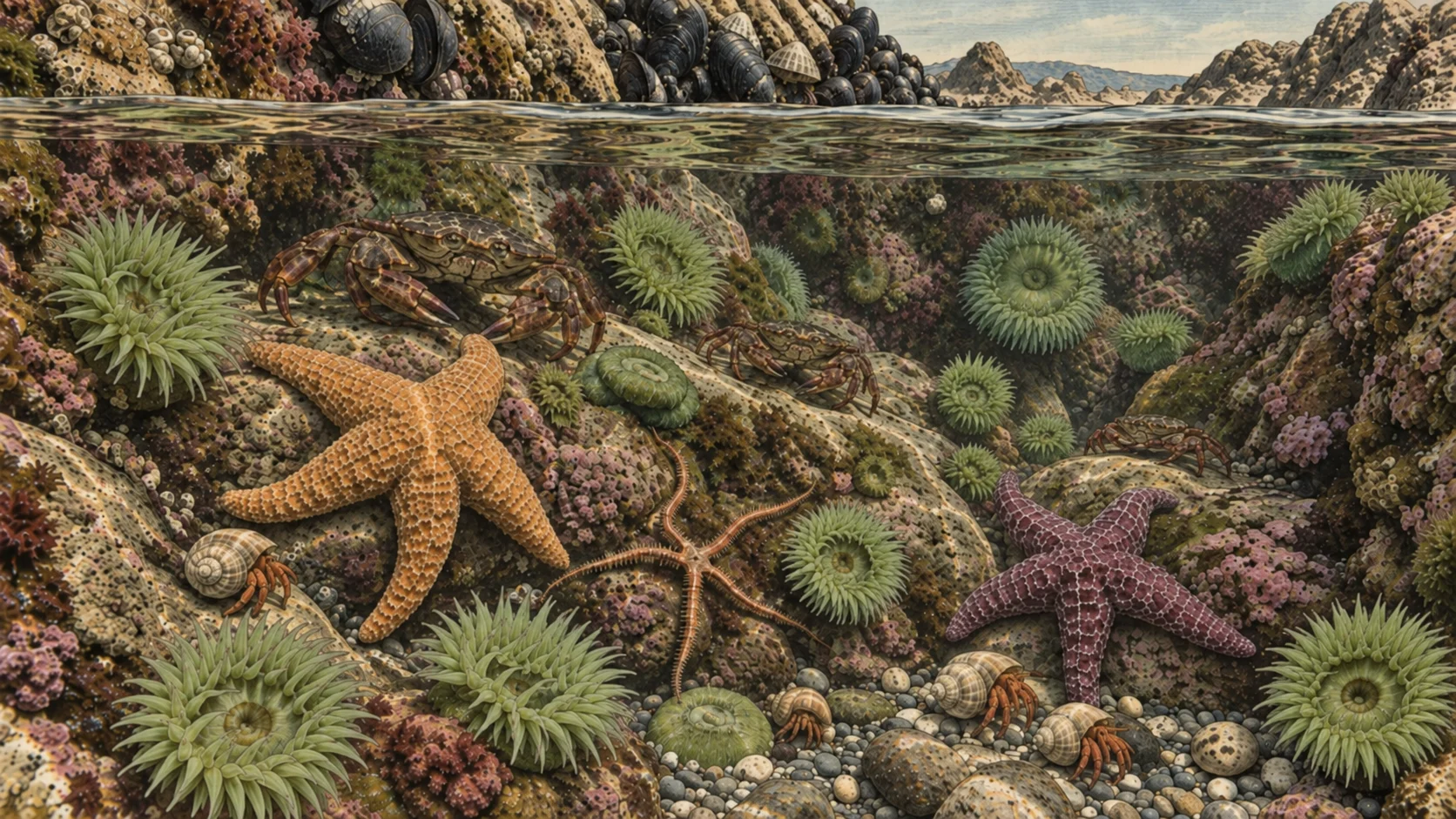
Rocky shore that floods at high tide and drains at low tide, leaving pools of anemones, sea stars, urchins, and small fish.
About
The Tidepools biome is the rocky intertidal zone, the strip of rocky shore that the ocean covers at high tide and uncovers at low tide. Tidepools are the hollows in that rock that stay full of seawater after the tide drops. Everything that lives here spends part of each day underwater and part of it in the open air, and how long an animal can last out of the water decides how high on the rock it can live. It is the only biome on this site that is explored on foot.
Two tides a day
The West Coast of the United States has mixed semidiurnal tides, which NOAA defines as 2 high tides and 2 low tides of different sizes every lunar day, the 24 hours and 50 minutes it takes the moon to return to the same place in the sky. That means the shore floods and drains twice in that time, and 1 of the 2 low tides drops farther than the other. Rock near the top of the shore can sit dry for most of the day. Near the bottom, rock is uncovered only briefly, and only on the lowest tides.
NOAA's Monterey Bay sanctuary monitoring network names the 3 stresses that come with that cycle: large swings in temperature, desiccation (drying out), and the force of breaking waves. A pool holds water through low tide, but it is a small body of water sitting in the sun. The National Park Service notes that tidepool animals have to cope with changes in temperature, salinity (how salty the water is), and oxygen until the ocean returns.
Bands up the rock
Because the stress rises with height, the shore sorts itself into horizontal bands. NOAA's National Ocean Service divides it into 4. The spray zone at the top is wetted by spray and high waves and goes underwater only during very high tides or storms. Just below it, the high intertidal zone floods at the peak of each high tide and stays dry for long stretches in between. Barnacles, limpets, snails, mussels, shore crabs, and hermit crabs live there.
The middle intertidal zone is covered and uncovered twice a day and holds more kinds of life, including sea stars and anemones. Below it, the low intertidal zone is almost always underwater and is exposed only on the lowest tides, and NOAA describes life as most abundant there because the water protects it. Animals high on the shore close up inside their shells to stay moist, or they are mobile enough to follow the water down. Those low on the shore fasten themselves in place and are built sturdy or flexible enough to take the waves.
The sanctuary network describes the same gradient from the other direction. Physical stress is highest at the top of the shore. At the bottom, what limits an animal is mostly other animals, through interactions such as predation and crowding.
Mussels and the sea star
The California mussel builds the most obvious band on a wave-beaten shore. It grows to about 13 centimeters (5 inches) and ties itself to the rock, and to other mussels, with byssal threads, fibers that harden when they touch seawater. A mussel is a filter feeder, an animal that strains food particles out of the water, and the Monterey Bay Aquarium reports that each one filters 2 to 3 liters (2 to 3 quarts) of water an hour. Beds can hold 1 million mussels or more. They also shelter other life in the gaps between the shells: researchers cited by the University of California, Santa Cruz monitoring program identified 610 species of animals and 141 species of algae in mussel beds at the Channel Islands.
A mussel bed has 2 edges, and a different force sets each. According to the same program, drying out likely sets the upper edge, and sea stars eating the lowest mussels set the lower edge. The main predator is the ochre sea star, which lives in the middle and low zones from Alaska to Baja California. It is most often purple, and about 20 percent of the stars in long-term surveys are orange. On the open coast it eats mostly mussels, along with barnacles, snails, and limpets.
This is the animal behind the term keystone species, a species that has a major influence on how its ecosystem works. The ecologist Robert Paine coined the term in the 1960s after an experiment on the rocky coast of Washington. When the sea stars were removed from a stretch of shore, the mussels spread and crowded out other species, and the variety of life on the rock dropped sharply.
Life in the pools
A pool stays full through low tide, so animals that cannot survive in the air can live in it. The giant green anemone is one of the largest pool animals, with a crown up to 18 centimeters (7 inches) across. Much of its green color comes from microscopic algae that live inside its tissues and pass it nutrients. It stuns prey with stinging cells on its tentacles and eats mussels that have been knocked loose, crabs, and small fish.
Small fish called sculpins spend low tide in the pools, in mottled, muted colors that match the rock. Oxygen can run low in a pool at night, when the seaweeds stop photosynthesizing, and the National Park Service reports that the tidepool sculpin can breathe air when that happens. At Cabrillo National Monument in San Diego, the park lists octopus, sea stars, sea hares, sea urchins, spiny lobsters, and nudibranchs, which are sea slugs, in the low zone that only the lowest tides uncover.
Where the biome occurs
Rocky intertidal habitat runs the length of the West Coast wherever bedrock or boulders meet the surf. The California mussel ranges from the Aleutian Islands in Alaska to southern Baja California, and the ochre sea star from Prince William Sound to Baja California. Rocky shore makes up about 39 percent of the shoreline in the Monterey Bay National Marine Sanctuary. Sandy beaches have an intertidal zone too, but this biome covers only the rocky kind.
Visiting at low tide
The timing of the low tides changes with the season. Cabrillo National Monument reports that the lowest tides fall during daylight in fall and winter, and that summer low tides usually come at night. The park recommends the 2 hours before and after low tide.
Visitor pressure is heavy. Cabrillo receives more than 350,000 visitors a year, and its rules ban collecting animals or shells, prying attached animals off the rock, and moving rocks. A study in the Monterey Bay sanctuary found the effect of foot traffic only in the high zone, where seaweed cover was reduced. California law also protects the biome. State regulations allow only a short list of invertebrates (animals without a backbone) to be taken between the high tide mark and 1,000 feet seaward of the low tide mark, including mussels, limpets, turban snails, crabs, octopus, and sea urchins. Sea stars, anemones, and barnacles are not on that list, and nothing may be taken in a state marine reserve.
Threats
Disease has changed these shores within the last 15 years. Sea star wasting disease was first noted in ochre sea stars in Washington in June 2013 and spread from Alaska through California, with the worst die-offs in 2013 and 2014. It has been seen in more than 20 species of sea star. A sick star goes limp, develops lesions (open sores), and can fall apart within days. Researchers have since identified a strain of the bacterium Vibrio pectenicida as a cause of the disease in sunflower stars, and regional flare-ups continue.
The black abalone, a large sea snail of the intertidal and shallow reefs down to about 5.5 meters (18 feet), once numbered in the millions on the California coast. Its commercial fishery peaked in the mid-1970s and was closed in 1993. A fatal disease called withering syndrome attacks the digestive organs and is now the main threat to the species. The black abalone was listed as endangered in 2009. NOAA's sanctuary network also lists oil spills, ship groundings, collecting, and trampling among the pressures on rocky shores.
Marine Life
Listed here are many of the aquatic species that you can find in this biome.
 Spearfishing