
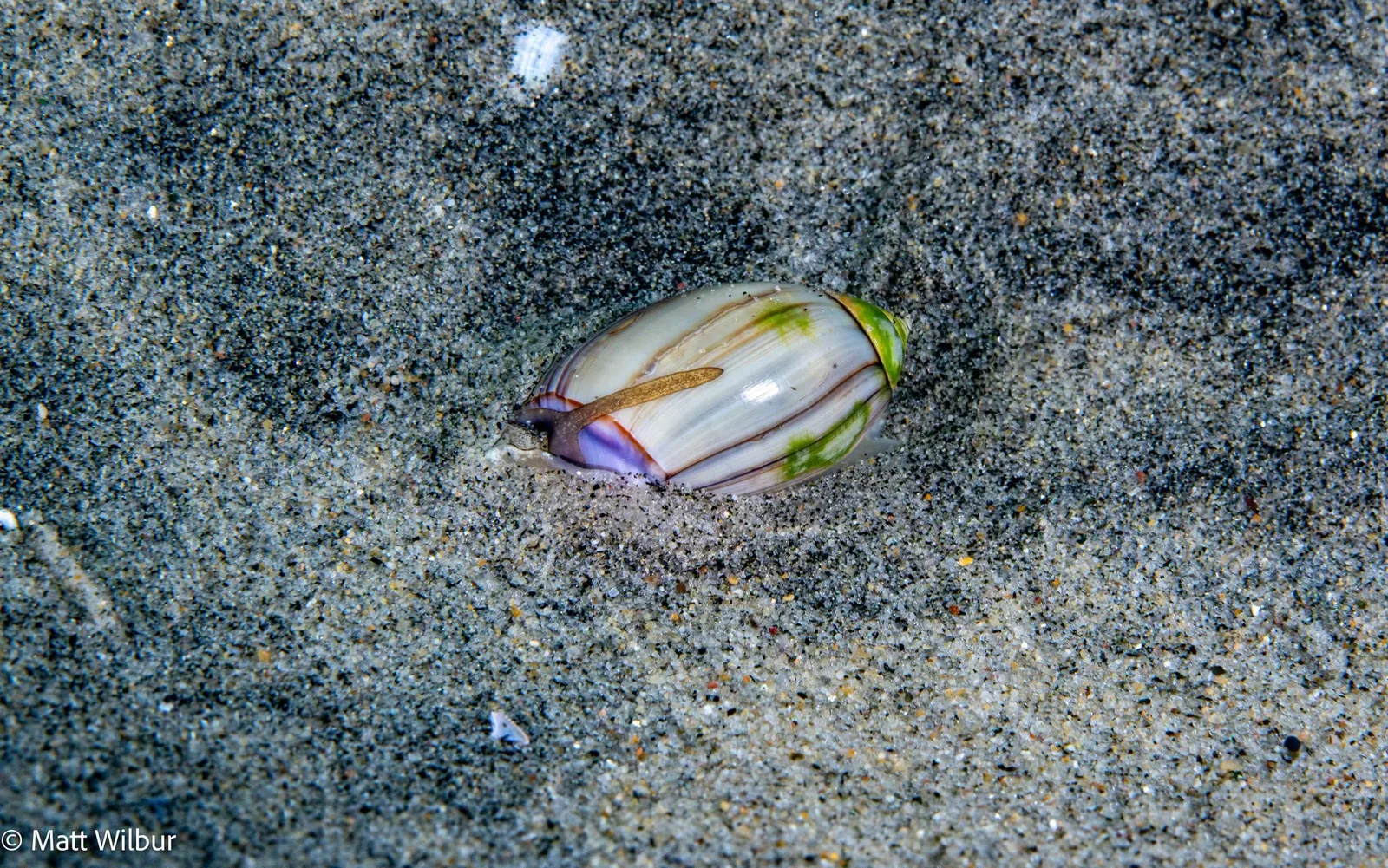
Also calledPurple Dwarf Olive, Purple Olive Shell, Purple Olivella
Taxonomy
Rarity
Abundance rates how many are in suitable habitat. Find difficulty rates how hard it is to locate one on a daylight snorkel or freedive through 50 ft. A higher find score means a harder search. The rarity category also reflects the kind of encounter; it is not an average of the 2 scores.
Seasonality
Location
The purple olive snail ranges from British Columbia to Baja California. It is common on sand, in the intertidal zone, the band of shore between high and low tide, and below it, both in bays and on the outer coast.
Deep Dive
The shell is smooth, shiny and oval, about 1 inch long. It is usually some shade of grayish purple, though it can be whitish, tan or dark brown. Darker shells often have rich yellow above the seam between the turns of the shell. A notch at the front of the opening lets the live animal's breathing tube reach out.
This is a burrowing snail that may eat only animals or a mixed diet. It is also the main prey of the spiny sand star, which can eat about 1 a day.
These shells have a long human history. Native people of central and southern California made decorative beads from them for at least 9,000 years, and the beads traveled as far inland as Idaho and Arizona. In the last 1,000 years, people on the Santa Barbara Channel Islands began making them in large quantities, which suggests they served as shell money in trade. The Chumash called them anchum.
Where to Find Them
Researched habitat and range candidates
San Diego · 17 beaches
Orange County · 11 beaches
Catalina Island · 2 beaches
Los Angeles · 16 beaches
Channel Islands · 7 beaches
Ventura · 23 beaches
Santa Barbara · 19 beaches
San Luis Obispo · 16 beaches
Monterey · 7 beaches
Oregon South Coast · 10 beaches
Oregon Central Coast · 7 beaches
Oregon North Coast · 4 beaches
South Sound · 2 beaches
Central Sound · 1 beach
These locations have suitable habitat within the species range. An assignment is a possible encounter, not a confirmed sighting at every beach. Season, depth, and local conditions still matter. Historical habitat without present-day evidence is excluded.