
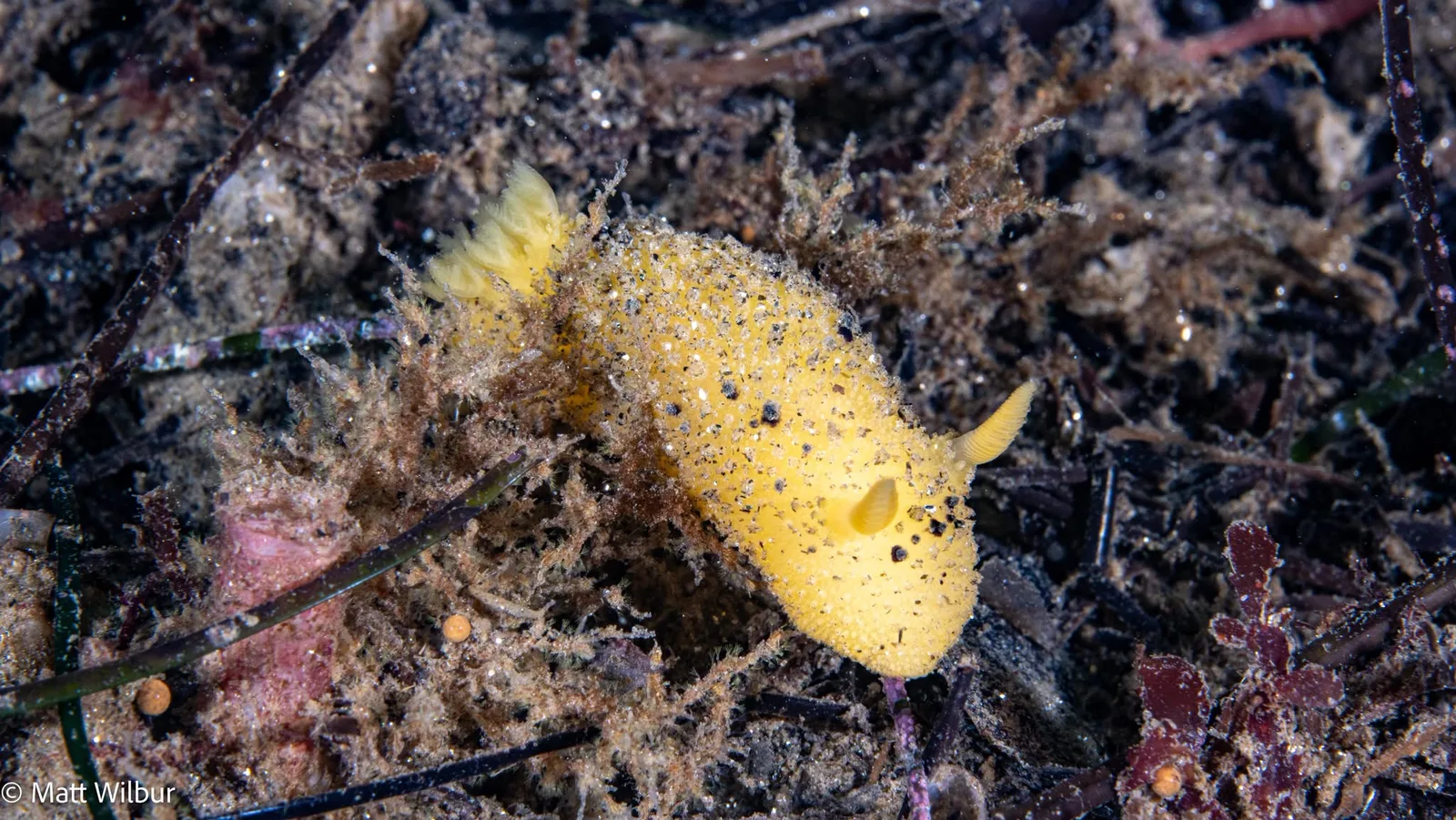
Also calledMonterey Sea Lemon
Taxonomy
Rarity
Abundance rates how many are in suitable habitat. Find difficulty rates how hard it is to locate one on a daylight snorkel or freedive through 50 ft. A higher find score means a harder search. The rarity category also reflects the kind of encounter; it is not an average of the 2 scores.
Seasonality
Location
The Monterey dorid ranges from Alaska to San Diego. It lives on hard bottom from the low intertidal zone, the part of the shore uncovered only at the lowest tides, to about 90 feet.
Deep Dive
A dorid is a nudibranch, a sea slug with no shell. This one is large, usually about 2 inches and recorded up to 6 inches. It is yellow to orange-yellow, with bumps called tubercles across the back, many tipped with dark brown or black. Dark markings also sit between the bumps.
The gills are yellow like the body, a useful field mark, because a similar sea lemon has white gills. It feeds on sponges, including encrusting species.
Where to Find Them
Researched habitat and range candidates
San Diego · 14 beaches
Orange County · 10 beaches
Catalina Island · 13 beaches
Los Angeles · 10 beaches
Channel Islands · 24 beaches
Ventura · 15 beaches
Santa Barbara · 10 beaches
San Luis Obispo · 22 beaches
Monterey · 17 beaches
Oregon South Coast · 15 beaches
Oregon Central Coast · 8 beaches
Oregon North Coast · 8 beaches
South Sound · 12 beaches
Hood Canal · 9 beaches
Central Sound · 13 beaches
North Sound · 8 beaches
San Juan Islands · 8 beaches
Strait of Juan de Fuca · 5 beaches
Cape Flattery · 4 beaches
These locations have suitable habitat within the species range. An assignment is a possible encounter, not a confirmed sighting at every beach. Season, depth, and local conditions still matter. Historical habitat without present-day evidence is excluded.