
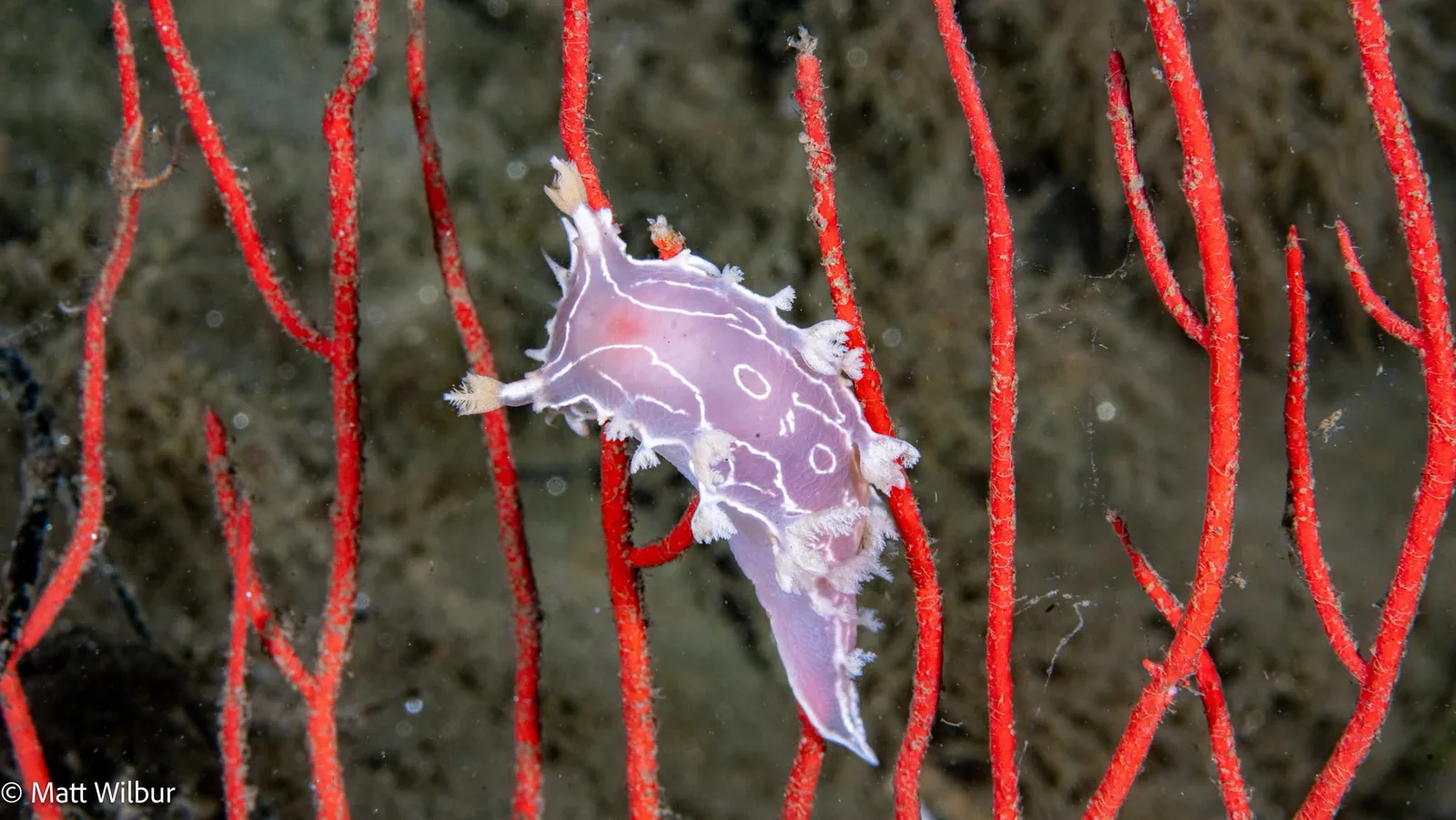
Also calledDiamondback Tritonia, Festive Tritonid

Taxonomy
Rarity
Abundance rates how many are in suitable habitat. Find difficulty rates how hard it is to locate one on a daylight snorkel or freedive through 50 ft. A higher find score means a harder search. The rarity category also reflects the kind of encounter; it is not an average of the 2 scores.
Seasonality
Location
The festive tritonia ranges from south-central Alaska to northern Baja California, and it is also recorded from Japan and Korea. Its flat body fits into the small spaces of rocky shores between the tides. Sources read do not give a depth range.
Deep Dive
A nudibranch is a sea slug with no shell. This one varies from translucent white through pink, orange and yellow to brown. Most carry a white net or diamond pattern on the back, the source of its other name, the diamondback tritonia. Branching gill plumes line both sides of the body, and a veil at the front carries a row of finger-like projections. Animals from between the tides run about 1.4 inches. Subtidal ones can pass 2 inches, and Puget Sound animals reportedly reach about 4 inches.
It preys on soft corals, sea pens, sea pansies and sea whips, and it takes the young of these animals. It uses the frontal veil to find prey before the polyps, the individual animals of a colony, can pull back. It has small leftover ridges of chitin, a hard natural material. The species was first described from San Francisco Bay in 1873.
Where to Find Them
Researched habitat and range candidates
San Diego · 14 beaches
Orange County · 10 beaches
Catalina Island · 13 beaches
Los Angeles · 10 beaches
Channel Islands · 24 beaches
Ventura · 15 beaches
Santa Barbara · 10 beaches
San Luis Obispo · 22 beaches
Monterey · 17 beaches
Oregon South Coast · 15 beaches
Oregon Central Coast · 8 beaches
Oregon North Coast · 8 beaches
South Sound · 12 beaches
Hood Canal · 9 beaches
Central Sound · 13 beaches
North Sound · 8 beaches
San Juan Islands · 8 beaches
Strait of Juan de Fuca · 5 beaches
Cape Flattery · 4 beaches
These locations have suitable habitat within the species range. An assignment is a possible encounter, not a confirmed sighting at every beach. Season, depth, and local conditions still matter. Historical habitat without present-day evidence is excluded.