
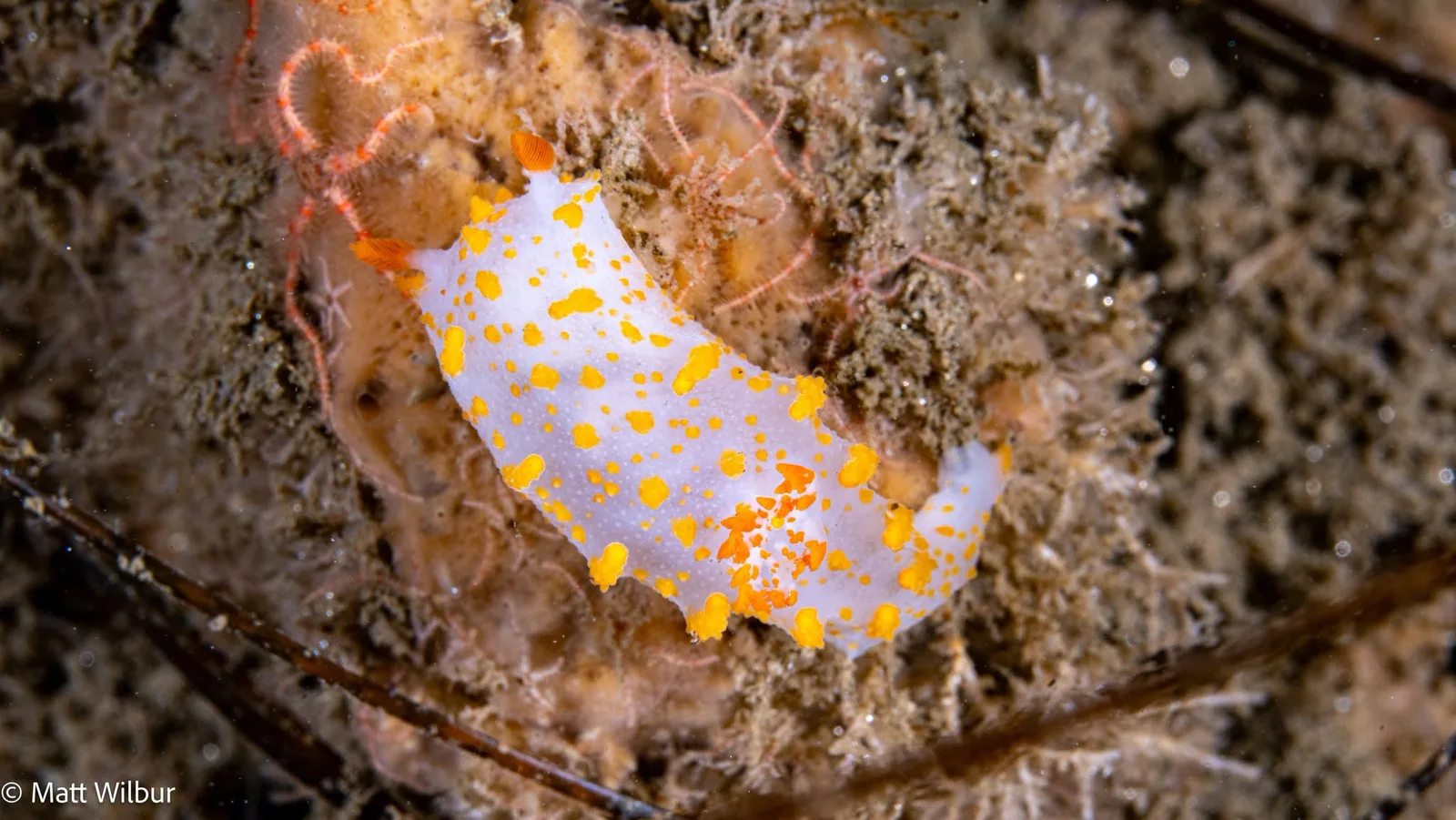
Also calledClown Dorid, Sea Clown, Sea Clown Triopha
Taxonomy
Rarity
Abundance rates how many are in suitable habitat. Find difficulty rates how hard it is to locate one on a daylight snorkel or freedive through 50 ft. A higher find score means a harder search. The rarity category also reflects the kind of encounter; it is not an average of the 2 scores.
Seasonality
Location
The clown nudibranch ranges from southeastern Alaska to Baja California. It lives on rocky bottoms from the low intertidal zone, the part of the shore uncovered only at the lowest tides, to about 55 feet in SeaLifeBase and about 260 feet in Sea Slug World.
Deep Dive
A nudibranch is a sea slug with no shell. This one is translucent white with orange to orange-red bumps across the back, and branched white projections around the edge of the mantle, the fleshy top of the body, and the front of the head, each tipped with bright orange. The sensory tentacles and gills are orange-tipped as well. It reaches about 2.75 inches.
It grazes on bryozoans, small colonial animals, including several branching species.
Asian animals once went under this name too. A 2020 study showed that the Japanese population is a separate species that looks very similar and can only be reliably told apart with genetics. The true clown nudibranch lives only along the Pacific coast of North America.
Where to Find Them
Researched habitat and range candidates
San Diego · 14 beaches
Orange County · 10 beaches
Catalina Island · 13 beaches
Los Angeles · 10 beaches
Channel Islands · 24 beaches
Ventura · 15 beaches
Santa Barbara · 10 beaches
San Luis Obispo · 22 beaches
Monterey · 17 beaches
Oregon South Coast · 15 beaches
Oregon Central Coast · 8 beaches
Oregon North Coast · 8 beaches
South Sound · 12 beaches
Hood Canal · 9 beaches
Central Sound · 13 beaches
North Sound · 8 beaches
San Juan Islands · 8 beaches
Strait of Juan de Fuca · 5 beaches
Cape Flattery · 4 beaches
These locations have suitable habitat within the species range. An assignment is a possible encounter, not a confirmed sighting at every beach. Season, depth, and local conditions still matter. Historical habitat without present-day evidence is excluded.