
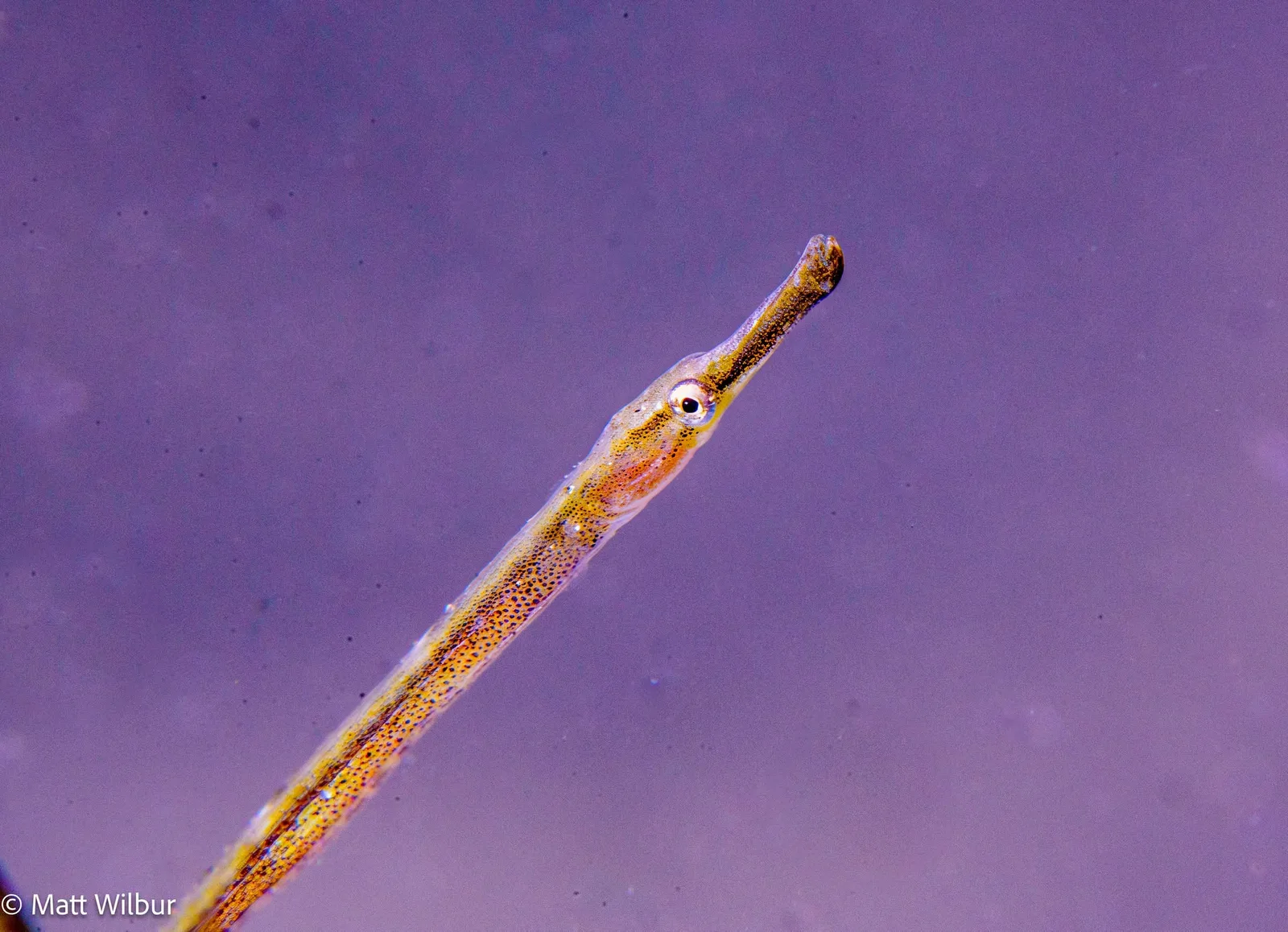
Also calledbay pipefish

Photos: Matt Wilbur, La Jolla Shores, San Diego
Taxonomy
Rarity
Abundance rates how many are in suitable habitat. Find difficulty rates how hard it is to locate one on a daylight snorkel or freedive through 50 ft. A higher find score means a harder search. The rarity category also reflects the kind of encounter; it is not an average of the 2 scores.
Seasonality
Location
Under its older name of kelp pipefish, this fish lives among attached and drifting kelp, rarely in bays, down to about 50 feet. Under the name bay pipefish, it is common in the eelgrass of bays and estuaries and sometimes turns up in shallow water offshore. FishBase runs the 2 names together from Sitka, Alaska to southern Baja California.
Deep Dive
Guides long listed the kelp pipefish and the bay pipefish as 2 species, and FishBase still does. The World Register of Marine Species and the California Academy of Sciences now treat the bay pipefish as the same species, so this page covers both names.
It is a long, slender fish with a tube-shaped snout. Its color varies from beige-gray to green, and females grow larger than males. FishBase gives a maximum of about 20 inches under the kelp pipefish name and about 15 inches under the bay pipefish name. It feeds on small crustaceans and zooplankton.
The male carries the eggs in a brood pouch under his tail. During mating, the female wraps around him in a rigid, upright S shape while the eggs are fertilized in the pouch.
Where to Find Them
Researched habitat and range candidates
San Diego · 15 beaches
Orange County · 10 beaches
Catalina Island · 14 beaches
Los Angeles · 10 beaches
Channel Islands · 24 beaches
Ventura · 17 beaches
Santa Barbara · 10 beaches
San Luis Obispo · 25 beaches
Monterey · 18 beaches
These locations have suitable habitat within the species range. An assignment is a possible encounter, not a confirmed sighting at every beach. Season, depth, and local conditions still matter. Historical habitat without present-day evidence is excluded.