
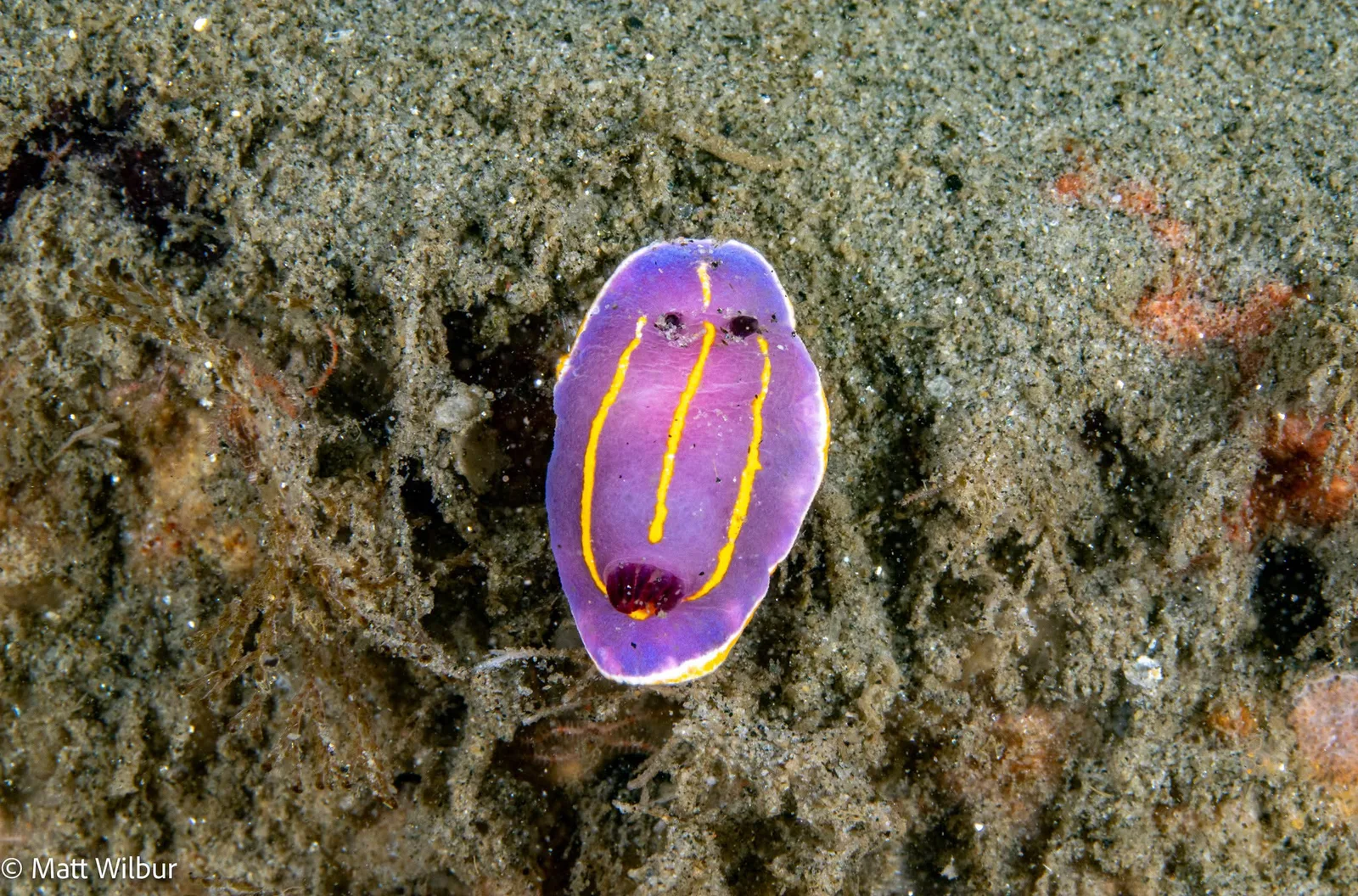
Also calledThree-stripe Doris, Macfarland's Nudibranch
Taxonomy
Rarity
Abundance rates how many are in suitable habitat. Find difficulty rates how hard it is to locate one on a daylight snorkel or freedive through 50 ft. A higher find score means a harder search. The rarity category also reflects the kind of encounter; it is not an average of the 2 scores.
Seasonality
Location
MacFarland's chromodorid ranges from Central California to Baja California and lives on rocky reefs below the low tide line. The sources read do not give a depth range.
Deep Dive
A nudibranch is a sea slug with no shell, and this one is hard to miss. The mantle, the fleshy top of the body, is deep purple with usually 3 bright orange stripes running down the back, and it has a white edge. The sensory tentacles and gills are tinged with purple. It usually measures about 1 inch and can reach about 2.5 inches.
It feeds on sponges, including species in the sponge groups Aplysilla, Gellius and Haliclona. An observer at Bird Rock in La Jolla found one on a sponge in 2000, and a laboratory test suggested it prefers that sponge. Researchers have suggested it may get its color from those sponges.
T. D. A. Cockerell described the species in 1901 and named it for Frank Mace MacFarland of Stanford University.
Where to Find Them
Researched habitat and range candidates
San Diego · 14 beaches
Orange County · 10 beaches
Catalina Island · 13 beaches
Los Angeles · 10 beaches
Channel Islands · 24 beaches
Ventura · 15 beaches
Santa Barbara · 10 beaches
San Luis Obispo · 22 beaches
Monterey · 17 beaches
These locations have suitable habitat within the species range. An assignment is a possible encounter, not a confirmed sighting at every beach. Season, depth, and local conditions still matter. Historical habitat without present-day evidence is excluded.