


Taxonomy
Rarity
Abundance rates how many are in suitable habitat. Find difficulty rates how hard it is to locate one on a daylight snorkel or freedive through 50 ft. A higher find score means a harder search. The rarity category also reflects the kind of encounter; it is not an average of the 2 scores.
Seasonality
Location
FishBase gives the range as Prince William Sound in Alaska to Long Beach in Southern California. The fish lives near shore and in bays, and the 2001 report notes that it is a common bycatch in the shrimp fishery, which suggests it spends its life close to the coast. Little is known of its larvae or of where adults go between spawning runs.
Spawning happens on particular beaches. The report describes the favored ones as coarse sand mixed with pea-sized gravel, often with fresh water seeping through, and counts 19 or 20 principal spawning beaches in the state for the surf smelt and night smelt together. Most commercial landings come from Eureka and Arcata, with most of the rest from Crescent City.
Deep Dive
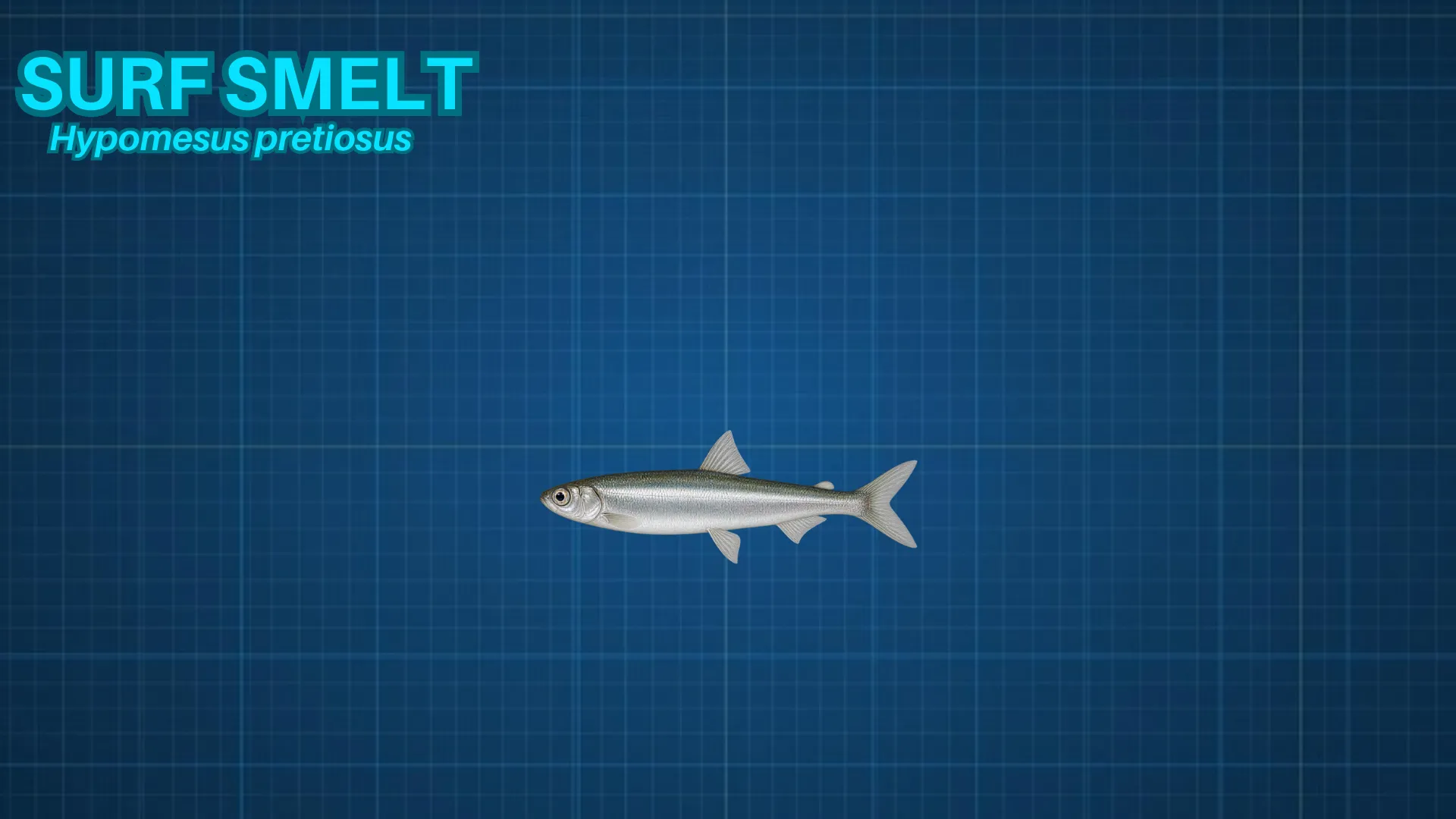
The surf smelt is a true smelt, a member of a family of small, cold-water fish. The 2001 report explains that true smelts are a different family from the silversides, such as jacksmelt and topsmelt, even though those fish carry the word "smelt" in their names. Like salmon, true smelts have a small fleshy fin, the adipose fin, on the back near the tail, and some carry a curious smell of cucumber. The report notes that the family is prized for its delicate flavor.
Its name fits the way it spawns. The report describes schools crowding into the surf by day, usually on a falling tide, with the biggest gatherings when high tide falls in the late afternoon. FishBase describes the act itself. Females arrive a few days before males. Males crowd the edge of the surf, and when a ripe female appears, 1 to 5 males press alongside her. As they reach water only 1 to 2 inches deep, the fish bend and vibrate to release eggs and sperm, then slip back to deeper water, and repeat the act on wave after wave. The waves bury the sticky eggs in the sand and gravel, and the report notes that during heavy spawning some beaches are literally coated with eggs. The eggs hatch in 2 to 3 weeks.
That beach habit created a fishery. The 2001 report describes the A-frame dip net used on spawning beaches, a triangle of netting 3 to 4 feet long on 2 poles, based on a net used by Native Americans, and reports that about 95 percent of commercial landings are caught with it. Sport fishermen use the same nets. California's sport limit for true smelts is 25 pounds a day, and the report estimated the 1958 sport catch at 400,000 pounds, or about 4 million fish.
The report describes it as a schooling fish that eats plankton, reaching about 10 inches. FishBase gives a larger maximum of about 12 inches and adds that at sea it eats small crustaceans, worms, jellyfish and larval fish. Females grow larger and live longer, up to 5 years, while males rarely live past 3. A female can carry from 1,300 to 37,000 eggs. The report warns that heavy recreational use of spawning beaches may compact the gravel and crush the eggs.
Where to Find Them
Researched habitat and range candidates
Orange County · 1 beach
Los Angeles · 15 beaches
Channel Islands · 5 beaches
Ventura · 23 beaches
Santa Barbara · 19 beaches
San Luis Obispo · 16 beaches
Monterey · 7 beaches
Oregon South Coast · 10 beaches
Oregon Central Coast · 7 beaches
Oregon North Coast · 4 beaches
South Sound · 2 beaches
These locations have suitable habitat within the species range. An assignment is a possible encounter, not a confirmed sighting at every beach. Season, depth, and local conditions still matter. Historical habitat without present-day evidence is excluded.